Follow Us on Google Discover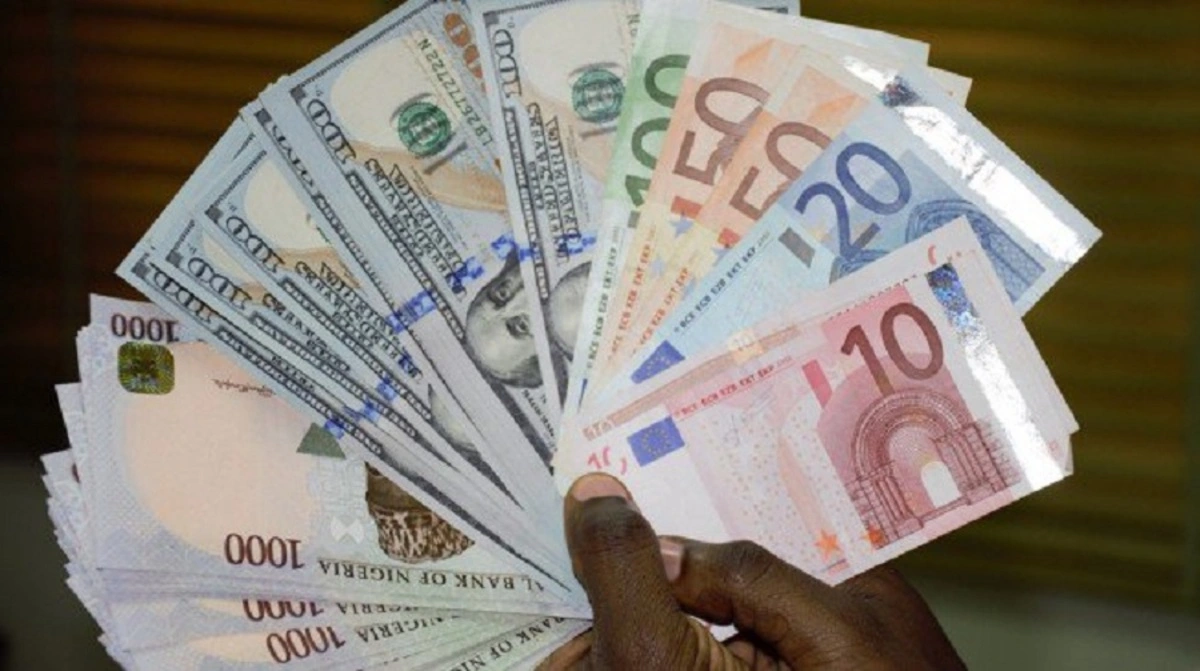
The naira strengthened by 0.84% against the US dollar at the Nigerian Foreign Exchange Market (NAFEM) this week, closing at N1,346.90/$ on Friday from N1,358.25/$ recorded on August 14.
This is according to the data from the Central Bank of Nigeria’s (CBN) website on Friday.
The currency gained N11.35 during the week as foreign exchange activity increased significantly, with NAFEM transactions reaching about $4.52 billion between Monday and Friday.
Weekly FX turnover more than doubled from approximately $2.18 billion recorded during the previous trading week of August 10–14, representing a 107.6% increase.
Also Read
What the data is saying
CBN data showed that the naira traded between N1,342/$ and N1,348/$ on Friday, with a weighted average rate of N1,346.49/$ and a simple average of N1,346.07/$.
- The currency opened the week at N1,350/$ on August 17 and strengthened to N1,346.90/$ by Friday.
- It traded as high as N1,361/$ and as low as N1,347/$ on Monday before closing at N1,350/$. The naira closed at N1,350.70/$ on August 18, N1,351/$ on August 19 and N1,347.50/$ on August 20.
- Friday’s N1,346.90/$ close was the strongest level recorded during the week.
- The sharp increase in turnover was driven by elevated activity throughout the week. NAFEM turnover stood at $1.41 billion on August 17, $1.08 billion on August 18, $1.11 billion on August 19 and $920.46 million on August 20.
As of the time of filing this report at 6:15 pm on Friday, August 21 CBN has not provided the NFEM total turnover for the day.
- By comparison, daily turnover in the previous week ranged from $185 million to $607.47 million. August 11 recorded the lowest turnover at $185 million, while August 12 posted the highest at $607.47 million.
- Interbank transactions also recorded substantial activity, with turnover of $437.53 million on August 17, $364.71 million on August 18, $370.98 million on August 19, $371.79 million on August 20 and $159.73 million on Friday.
More insights
Analysts said the sharp rebound in NAFEM turnover points to improved liquidity and stronger participation in the official foreign exchange market, although they cautioned that the surge may have been driven by large transactions and should not yet be interpreted as a sustained shift in market conditions.
Dr Muda Yusuf, Chief Executive Officer of the Centre for the Promotion of Private Enterprise (CPPE), speaking to Nairametrics said the increase could have been driven by large transactions involving major corporate users of foreign exchange.
- “I think it may be due to some big companies who have made huge transactions which can make a whole lot of difference,” he said.
Yusuf identified large importers of raw materials, machinery and other inputs as possible contributors to the spike in turnover.
- “Imagine, for instance, maybe Dangote goes into the market to import crude. You can imagine the amount that he will make,” he said.
- He added: “My own guess is that this may be coming from some of the big consumers of forex, either in terms of their raw materials or major import of machinery. It could also be government projects which may require some foreign inputs.”
The explanation is important because a sharp increase in turnover does not necessarily mean that foreign exchange demand and supply have increased uniformly across the market. A small number of large transactions can significantly influence daily and weekly turnover figures.
What you should know
The latest activity also follows a broader improvement in Nigeria’s external position. Nairametrics earlier reported that the country’s external reserves rose to $52.02 billion on July 20, 2026, their highest level since January 2009.
The figure was also above the CBN’s December 2025 projection of $51.04 billion for the full year 2026.
The apex bank had attributed its outlook to stronger oil earnings, FX market reforms and improved external inflows.