Follow Us on Google Discover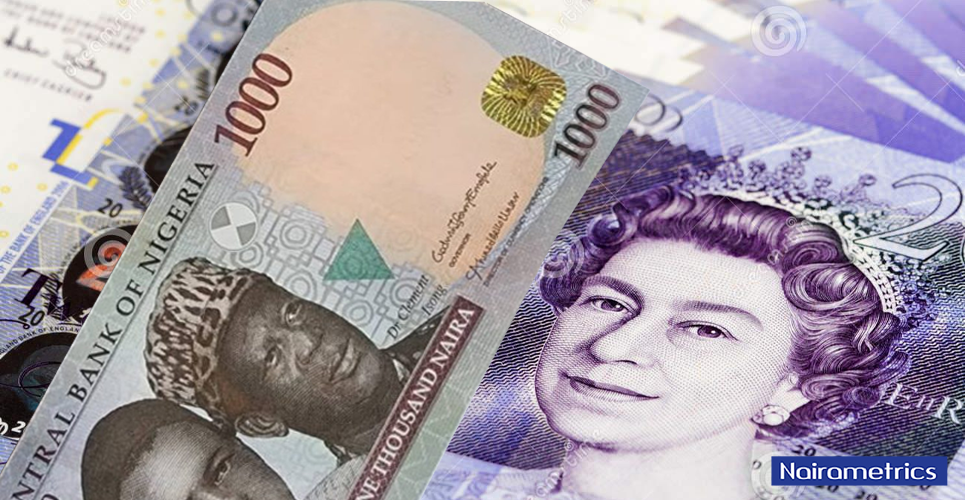
The British Pound’s last bargain was at N1,819/£1 against the naira on Tuesday’s trade session, up from N1,830/£1 at the start of the week.
Its all-time low and high stand at approximately N1805/£1 -N1875/£1 respectively in the last 30 trading days.
The Nigerian currency had days of relative strength locally against other major global currencies in the official segment (where it is now trading in the N1,340/$1-N1,350/$1 territory) driven by the improved dollar supply.
Even though the Nigerian Foreign Exchange Market is generally reflecting lower margins, the parallel market still has broader gaps between the ask/bid prices and parallel rates are typically higher, still making retail/cross-border pound rates high for transactions.
The CBN has recorded a significant inflow of dollars into the official segment of the foreign exchange market-the Nigerian Foreign Exchange Market (NFEM)-a development that has led to a more stable, and at times, firmer Naira against key major currency pairs.
Nigeria’s external reserves have expanded, now standing at multi-year highs of roughly $52.2 billion; an expansion in the reserve buffer gives the CBN added firepower to either defend the local currency or manage instances where demand can spiral into an event that might spark investor fear.
British pound posts gains against US dollar
Sterling jumped against the US Dollar after UK inflation was out, but the Cable seems to have settled in the mid-1.355 level again on Wednesday, gaining slightly on this day after the day activity, trading a few pips over 1.355 at the moment of writing.
- Nevertheless, it seems it’s stuck again in the former session range, unable to breach above the 1.3570 resistance zone. It came out from National Statistics that the UK CPI accelerated as forecast in July.
- July UK CPI monthly readings were 0.3%, and Y-o-Y was at 2.9% from June readings of 0.1% and 2.6%, respectively. UK CPI Core rate was unchanged month-on-month; Y-o-Y 2.6%, while the market expected a downtick to 2.5%.
- UK jobs data last year did little to encourage anything beyond cautious sentiment – released Monday, this consisted of a flat and expected ILO unemployment rate, a moderating gain in employment figures, but a better-than-expected and welcomed fall in jobless claimants.
Growth in wages in the United Kingdom surged following three months stagnancy although a modest retreat by the Pound against its major counterparts was seen.
The latest market fundamentals will be dominated by the minutes of last month’s Federal Open Market Committee (FOMC) decision not to raise rates amid a split decision by members, leaving markets searching for the path of US monetary policy.
The US dollar has been weakening as it seems that the recent data is suggesting the US economy will weaken, as job numbers from last month were unexpectedly lower than estimates and inflation is being modest.
Investors have therefore scaled back expectations about further interest rate increases. This has now changed the expectations of traders of a September quarter-point increase to approximately a 70 percent possibility of no increase in rate of interest; the change in expectations from earlier is in view of recent disappointing numbers showing the loss of jobs last month and other economic indicators, according to traders.
Current levels, particularly dollar-denominated pairs, are just reflecting the surprised dovishness we saw in the last Fed meeting or at least the interpretation of dovishness.
Federal Reserve policy currently seems otherwise, even though former governor Kevin Warsh has seemed like a hawk, or it is not being perceived as such by the markets.
- The decline in the US job market and intervention efforts made in July to boost the yen have contributed to the broad slide of the dollar and while the Straits of Hormuz is effectively closed and the conflict between US and Iran seems to remain, it is quite unpredictable when it could lead to inflation at higher levels even though a high annual increase would make little or no breathing room for it and hence would remain a matter of concern to the Fed and to the traders around the world.
The war, which has been ongoing for five months now, has been raising rate concerns and completely altering the outlook for interest rates worldwide.
The fall in interest rates on global bonds again reflects investors’ concern over the prolonged closure of the Strait of Hormuz that might raise the price of energy resources, and therefore the US 30-year Treasury yielded its highest price in seven years.