Follow Us on Google Discover
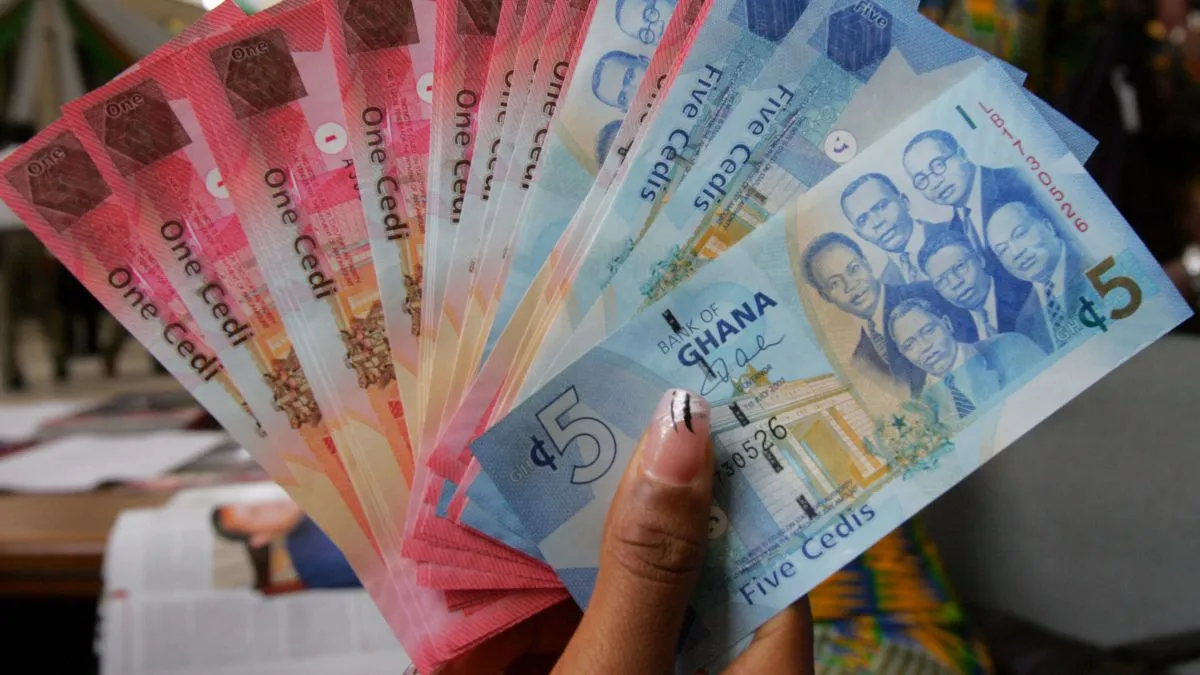
The Ghanaian cedi appreciated against the US dollar on Tuesday, November 10, 2026, with its average buying rate strengthening to GH¢11.84 per dollar, from GH¢11.89 recorded on Monday, while its selling rate stood at GH¢12.16 per dollar.
The latest exchange rates were published by Cedirates.com, a Ghanaian platform that tracks daily currency and fuel prices, while the Bank of Ghana provided the corresponding interbank market rates.
The latest movements reflect mixed changes across Ghana’s foreign exchange market, with varying rates among forex bureaus, the official interbank market, international remittance platforms and digital payment channels.
The developments come amid rising inflationary pressure and recent fluctuations in the cedi’s performance against the dollar.
Also Read
Ghana cedi appreciates against dollar
The latest figures show an improvement in the cedi’s average buying rate, although its selling rate recorded a different movement, highlighting continued fluctuations in Ghana’s foreign exchange market.
- The average buying rate appreciated by five pesewas from Monday’s rate, while the selling rate stood at GH¢12.16 per dollar, compared with GH¢12.14 previously.
- The report provides an overview of exchange rates across Ghana’s foreign exchange market, covering forex bureaus, the Bank of Ghana’s interbank market, international remittance platforms and digital payment channels.
- At forex bureaus, the dollar traded at GH¢12.00 for buying and GH¢12.25 for selling, while the Bank of Ghana’s interbank market quoted GH¢11.68 and GH¢11.70, respectively.
The British pound traded at GH¢15.51 for buying and GH¢16.37 for selling at forex bureaus, equivalent to approximately $1.31 and $1.38, respectively, using the average cedi buying rate. The Bank of Ghana’s interbank rate stood at GH¢15.69, equivalent to approximately $1.33.
The euro traded at GH¢13.02 for buying and GH¢13.81 for selling at forex bureaus, equivalent to approximately $1.10 and $1.17, respectively. Its interbank rate stood at GH¢13.10, or approximately $1.11.
For international remittances, LemFi and Taptap Send offered GH¢11.68 and GH¢11.70 per dollar, respectively. Both platforms quoted GH¢15.75 per pound, equivalent to approximately $1.33, while their euro rates stood at GH¢13.12 and GH¢13.13, equivalent to approximately $1.11 each.
For digital subscriptions such as Netflix, Spotify and Apple Music, Visa and Mastercard applied exchange rates of GH¢12.58 per dollar each.
The differences highlight the varying conversion rates consumers encounter depending on the channel used to access foreign currencies or pay for international services.
Ghana inflation rises as cedi fluctuates
The cedi’s latest exchange-rate movements come amid renewed inflationary pressure in Ghana, with annual inflation rising to 5.5% in October 2026, its highest level in 11 months.
Nairametrics reported on November 4 that inflation had increased from 5.2% in September, ahead of the Bank of Ghana’s November monetary policy decision.
The increase reflected higher price pressures in non-food items and services, although food inflation moderated during the period.
- Non-food inflation increased to 7.9% in October from 6.2% in September.
- Services inflation rose to 11.5% from 8.3% over the same period.
- Food inflation moderated to 2.8% from 4% in September.
- The Ghanaian cedi had weakened by 10% against the US dollar in 2026, adding to domestic price pressures.
The Bank of Ghana maintained its policy rate at 14% from March while monitoring inflationary developments. Its next monetary policy decision was scheduled for November 18, 2026.
Meanwhile, the cedi recorded a 0.60% gain against the US dollar in October, offering some relief after significant depreciation in September.
Data compiled by Nairametrics Research from official exchange rate figures showed that the cedi improved from GH¢11.71 per dollar at the end of September to GH¢11.64 per dollar at the end of October.
The appreciation marked a recovery after the currency recorded the largest depreciation among the African currencies examined in September. Its 0.60% gain placed it marginally ahead of the Liberian dollar in October’s ranking.
Only nine of the 54 country-level entries examined recorded gains against the dollar during October, while 39 recorded depreciation and six remained unchanged.
Naira weakens to N1,350 despite rising reserves
Nigeria’s naira also weakened against the US dollar in the first week of November, falling to N1,350.45 per dollar at the Nigerian Foreign Exchange Market (NFEM) on November 5, 2026, from N1,346.01 recorded on November 2.
- According to a Nairametrics report published on November 6, 2026, citing data from the Central Bank of Nigeria (CBN), the naira lost N4.44 against the dollar within the first four days of November, following successive declines from N1,347.75 on November 3 and N1,348 on November 4.
- The depreciation came despite an increase in Nigeria’s gross external reserves, which rose by $295.35 million in October, while net foreign exchange reserves reached a record $46 billion.
- The latest exchange-rate figures show that the naira continued to face pressure during the opening days of November, even as the country’s external reserve position improved.
The movement from N1,346.01 on November 2 to N1,350.45 on November 5 represented a weakening of the local currency against the dollar over the period. The successive increases in the exchange rate also reflected the naira’s gradual depreciation during the first four days of the month.
The increase in gross external reserves and the record $46 billion in net foreign exchange reserves provide additional context to the currency’s performance, highlighting the contrast between improving reserve figures and the naira’s movement against the US dollar.