Follow Us on Google Discover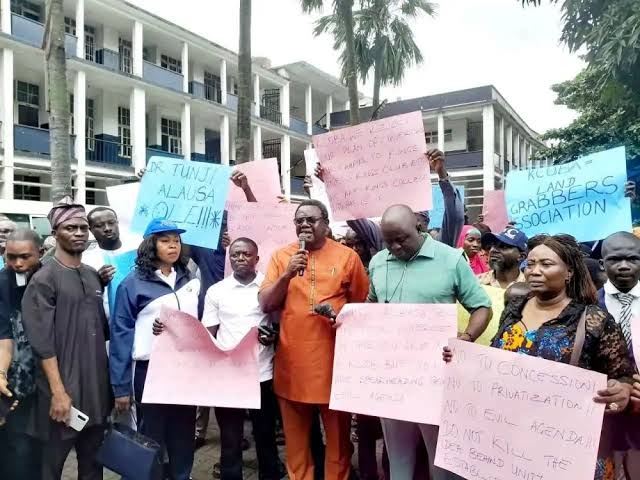
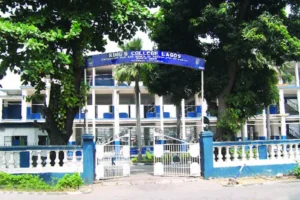
Some unions under the Joint Workers Council of the Federal Ministry of Education have rejected the suspension of industrial action announced by the Trade Union Congress (TUC), insisting that the concession of King’s College, Lagos, must be reversed.
The Chairman of the Joint Council, Mr Abraham Onuche, disclosed this on Tuesday while addressing journalists during a protest at the ministry’s headquarters in Abuja.
The unions said TUC was not directly involved in their protest or negotiations with the Federal Ministry of Education and questioned its decision to suspend an action it did not participate in.
What they are saying
Onuche said the unions had been protesting for three days against the proposed concession of King’s College, describing the arrangement as detrimental to public education.
Also Read
He said the unions had barricaded the entrance to the ministry’s headquarters to prevent officials and other workers from accessing the premises, adding that the action was intended to draw attention to what they considered a critical threat to the future of Federal Unity Colleges.
Onuche said the unions were surprised that TUC met with the Minister of Education, Dr Tunji Alausa, and subsequently announced the suspension of industrial action despite not participating in the protest.
- “TUC never came here for one day to listen to us, our demands,” he said.
He questioned how the congress could suspend an action it had neither joined nor discussed with the unions directly involved.
According to him, the unions formally wrote to the Minister of Education on July 6 seeking an opportunity to discuss their concerns, but had yet to be granted an audience.
Onuche said the unions were demanding dialogue and consultation before any final decision was taken on the concession, particularly because of its potential implications for teachers and other workers at King’s College.
Concerns over affected teachers
Onuche also questioned the planned deployment of teachers who could be affected by the concession to other schools in Lagos.
- He recalled that the Federal Government had approved a waiver for the employment of more than 3,000 Parent-Teacher Association staff.
- Onuche, however, questioned what would happen to teachers displaced by the King’s College concession if new PTA workers were being employed at the same time.
- He warned that allowing the concession to proceed could encourage similar demands from old students’ associations of other Federal Unity Colleges.
Also speaking, Mr Chigozie Ngadi, Chairman of the Association of Senior Civil Servants of Nigeria (ASCSN), Federal Ministry of Education chapter, said the protest was aimed at protecting access to quality education.
Ngadi said the unions were particularly concerned about children from less privileged families who might be unable to afford education if access to King’s College became restricted.
- “We are speaking for Nigerians. We are speaking for down-trodden Nigerians to have access to good education,” he said.
Get up to speed
The dispute began with the Federal Government’s decision to concession King’s College and later escalated into planned industrial action by education unions.
- On September 11, Nairametrics reported that the Federal Government had retained ownership of King’s College while the King’s College Old Boys’ Association was to finance, rehabilitate, operate and maintain the school under a concession arrangement.
- The concession subsequently drew opposition from education unions, leading to planned industrial action over the arrangement.
- Days later, on September 15, Nairametrics reported that the Trade Union Congress (TUC) suspended its planned shutdown of Federal Unity Colleges over the King’s College concession following a meeting with Education Minister Tunji Alausa.
A seven-member committee was constituted to review the unions’ concerns, while TUC said the suspension was not permanent.
In the latest development, the unions under the Joint Workers Council have now rejected the suspension.
What you should know
The Federal Government is pursuing broader reforms in Nigeria’s education sector, including efforts to improve how tertiary institutions are assessed and ranked.
On September 2, Nairametrics reported that the Federal Government planned to develop a credible national ranking system for tertiary institutions that could serve as a benchmark across Africa.
The framework is expected to be integrated into the Nigeria Education Data Initiative (NEDI), with the government saying better data collection and performance measurement could improve the global recognition of Nigerian universities.