Follow Us on Google Discover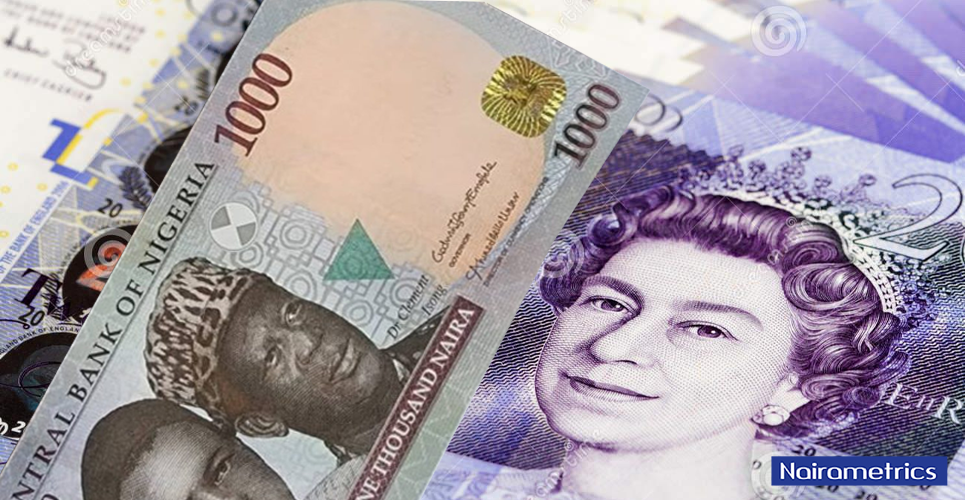
The Nigerian currency overcame a resistance level against the British pound amid robust fundamentals within the Nigerian economy.
The naira broke below the N1,800/£ resistance, trading around N1,788/£ against the British Pound.
Appreciation beyond this psychological barrier necessitates significant macroeconomic drivers that alter demand and supply dynamics in the foreign exchange (FOREX) market.
The Central Bank of Nigeria (CBN) has notably implemented an aggressive interest rate hike, complemented by the promotion of high-yield instruments such as prominent T-Bills and PMAs.
Also Read
These measures increase institutional investment and bank holdings of Naira-denominated assets, thereby reducing the surplus demand for limited foreign currencies circulating within Nigeria.
Inflow of foreign capital, whether driven by attractive domestic yields or bolstered market confidence, enhances the supply of foreign currencies such as the US dollar and the British pound.
This influx effectively reduces the cost of cross-border transactions in pounds expressed in Nigerian Naira. Additionally, the growth in Nigeria’s gross external reserves—stemming from stable oil production or rising global oil prices—provides the CBN with greater scope for market intervention, which can mitigate panic demand and discourage the hoarding of speculative foreign currencies.
Consequently, a contraction in the UK economy, alterations in government fiscal policies, or reductions in Bank of England (BoE) interest rates are influential factors that can weaken the pound globally and accelerate its decline, thereby fostering a recovery of emerging market currencies such as the Naira.
Currency traders and technical analysts often observe structural configurations when a critical psychological level like N1,800 is breached. Such levels often serve as support or floor levels, with the price typically consolidating within a narrow range between N1750/£ and N1850/£ over several weeks.
The breach below N1,800/£ will likely trigger stop-loss orders for long positions, particularly in British pound sterling, and is confirmed by sharply bearish candles on weekly and daily charts accompanied by volume indicative of institutional selling activity, rather than low-liquidity events driven solely by short selling.
Price declines in a linear fashion are rare; following a breach of N1,800/£, the market may retest previous support levels now acting as resistance or form bearish rejection patterns, signifying continued downward momentum toward lower supports at N1750/£ or N1700/£. Such movements are often associated with convergence between official and parallel market rates, reducing opportunities for speculative arbitrage during substantial structural upward moves.
British pound holds the $1.35 mark against dollar
The British pound sterling shows prospects of reaching the 1.3550 level against the dollar in European trading session on Wednesday.
UK Chancellor John Healey has announced several measures aimed at stimulating growth and attracting private investment, thereby providing support to the British Pound. These include granting more powers to city regions and reaffirming commitment to fiscal discipline, notably aiming to reduce regulatory costs by 25% by the next general election.
Reuters polls suggest that the Bank of England (BoE) intends to maintain interest rates at current levels through the end of 2024 and into mid-2027. BoE Governor Sir Andrew Bailey’s comments on Tuesday appeared to dismiss immediate prospects of rate hikes, emphasizing policy stability amid uncertain economic and geopolitical conditions.
Analysts forecast that the Pound will trade within a range of approximately 1.3490 to 1.3540. In practice, the currency exceeded this range, rising from 1.3508 to 1.3547.
Meanwhile, geopolitical tensions persist, with recent Middle Eastern developments and US strikes against Iranian oil tankers at the Gulf of Oman and offshore Kharg Island, followed by Iran’s retaliatory missile attacks targeting US personnel, maintaining elevated risk premiums for geopolitical instability. This situation sustains support for the safe-haven US dollar, prompting cautious positioning among bearish traders.