Follow Us on Google Discover
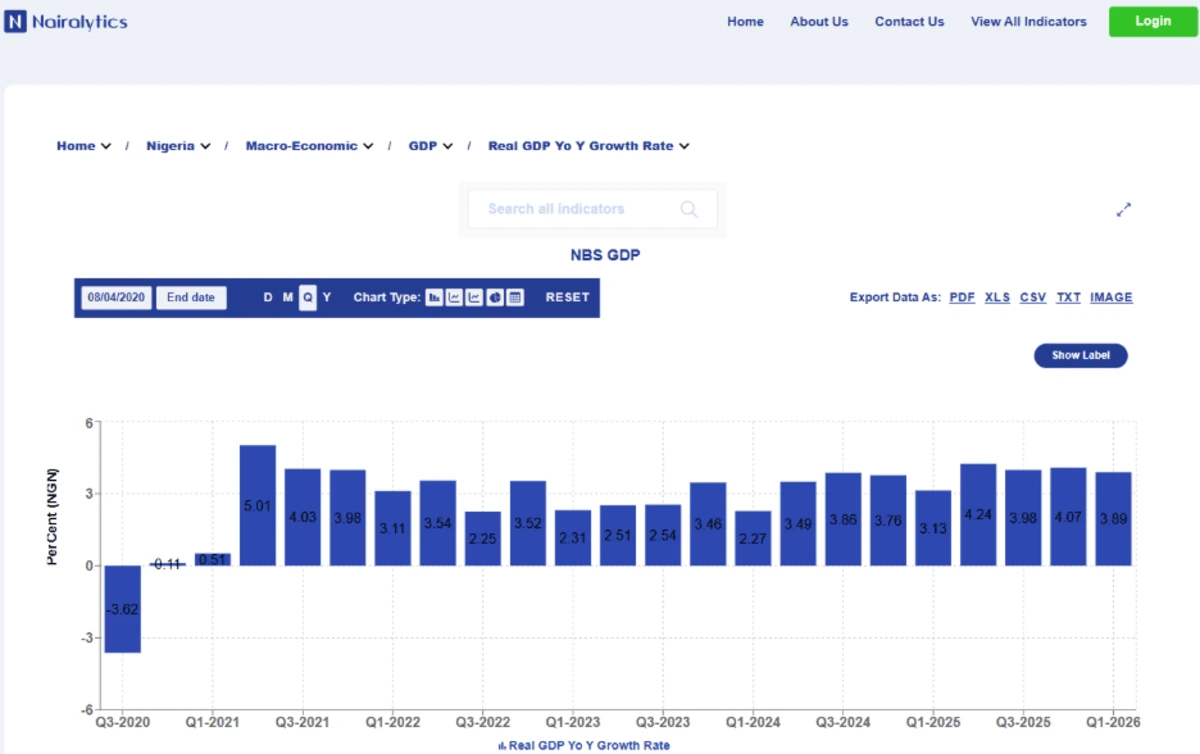
Nigeria’s economy grew 4.43% year-on-year in Q2 2026, its highest quarterly performance in five years, since Q3 2021, according to the Q2 GDP data from the Nigerian Burxseau of statistics (NBS).
The strongest growth rates were recorded in coal mining, oil refining and metal ores, although the broader expansion was supported mainly by larger activities across agriculture, services and the non-oil economy.
Coal mining led the pack, soaring 74.89% after swinging from a -9.80% contraction just one quarter earlier. The sharp rebound reflects revived power-sector demand, continued mine rehabilitation, and ongoing energy diversification investment.
Financial Institutions, for instance, slowed to 8.35% in Q2 2026 from 16.18% in Q2 2025, as the elevated interest rates that contributed to higher interest income in the sector through 2025 began to normalize.
The 10 fastest growing sectors in Q2 2026
10. Financial Institutions – 8.35%
Financial Institutions growth was essentially flat on a quarter-on-quarter basis, edging down from 8.40% in Q1 2026 to 8.35% in Q2 2026. However, the sector has decelerated sharply, falling from 16.18% in Q2 2025 to 8.35% in Q2 2026. A drop of nearly half.
Elevated interest income that supported the sector last year is beginning to normalize, while the banking-sector recapitalization has strengthened capital buffers and positioned banks for further expansion.
9. Motion Pictures, Sound Recording and Music Production – 9.15%
The sector improved marginally, from 8.86% in Q1 2026 to 9.15% in Q2 2026. Year-on-year, growth more than doubled, up from 4.07% in Q2 2025.
The creative sector is continuing its recovery after slowing to 3.60% growth in Q4 2025. Growth accelerated to 8.86% in Q1 2026 and edged higher to 9.15% in Q2 2026.
8. Telecommunications & Information Services – 10.38
Telecoms growth pulled back from 12.24% in Q1 2026 to 10.38% in Q2 2026. The sector still grew faster than the 7.39% posted in Q2 2025, an increase of roughly 3 percentage points.
Continued data demand and digital-services adoption are keeping the sector in double digits even as the pace of expansion moderated quarter-on-quarter.
7. Water Supply, Sewerage, Waste Management and Remediation – 11.24%
The sector rose from 10.32% in Q1 2026 to 11.24% in Q2 2026. Year-on-year, growth was roughly flat, up only slightly from 10.60% in Q2 2025.
This sector has maintained consistently strong growth since early 2024, remaining above 6% in every quarter and reaching 11.24% in Q2 2026.
6. Arts, Entertainment and Recreation – 11.93%
Arts, Entertainment and Recreation improved from 11.25% in Q1 2026 to 11.93% in Q2 2026. Year-on-year, growth jumped from 7.64% in Q2 2025, a gain of more than 4 percentage points.
The sector has maintained positive growth throughout the period, rising from 7.17% in Q4 2024 to 11.93% in Q2 2026, despite some quarter-to-quarter fluctuations.
5. Cement – 12.75%
Cement growth continued to climb, up from 11.53% in Q1 2026 to 12.75% in Q2 2026. Year-on-year, growth has nearly tripled from 4.86% in Q2 2025.
Sustained construction and infrastructure activity, alongside capacity expansions among major producers, continue to drive output higher.
4. Insurance – 16.13
Insurance growth accelerated sharply, from 9.94% in Q1 2026 to 16.13% in Q2 2026. Year-on-year, growth was roughly flat versus the 15.70% recorded in Q2 2025, after peaking at 21.37% in Q4 2025.
Deeper enforcement of compulsory insurance classes, expanding corporate coverage, and continued digital policy distribution are keeping the sector among the economy’s fastest growers.
3. Metal Ores – 20.18%
Metal Ores staged a sharp reversal, from a -8.75% contraction in Q1 2026 to 20.18% growth in Q2 2026. Year-on-year, the swing is even more dramatic, from a -6.96% contraction in Q2 2025 to positive 20.18% growth.
This volatility echoes the sector’s pattern through 2024 and 2025, when growth swung from as high as 113.72% in Q1 2024 to as low as -8.75% in Q1 2026. The 20.18% rebound points to renewed mining activity and stronger demand for industrial and construction inputs.
2. Oil Refining – 43.94%
Oil Refining growth continued to climb, up from 37.46% in Q1 2026 to 43.94% in Q2 2026. Growth nearly tripled year-on-year, from 15.78% in Q2 2025.
The sector has staged a strong turnaround from double-digit contractions in 2024, with growth reaching 37.46% in Q1 2026 and 43.94% in Q2 2026. The recovery reflects increased domestic refining capacity, supported by the expansion of the Dangote Refinery, and a gradual shift away from imported refined products.
1. Coal Mining – 74.89%
Coal Mining staged the sharpest reversal in the economy on a quarterly basis, swinging from a -9.80% contraction in Q1 2026 to 74.89% growth in Q2 2026. Year-on-year, growth also accelerated significantly, up from 57.53% in Q2 2025 to 74.89% in Q2 2026.
The sector has recorded significant swings in growth over the past two years, from 8.69% expansion in Q1 2024, through contractions as steep as -23.37% in Q3 2024, to 74.89% growth in Q2 2026. This reflects how sensitive coal output remains to power-sector demand, and shifts in industrial energy sourcing.
What this means
The Q2 2026 sector data shows that Nigeria’s stronger GDP performance was accompanied by significant differences in growth across sectors. Extractive and energy-related sectors recorded the strongest expansions, while services and other productive sectors recorded positive growth at more moderate rates.
Coal Mining and Oil Refining were clear outliers, growing at 74.89% and 43.94%, respectively. Metal Ores also staged a sharp recovery, growing 20.18% after contracting by 8.75% in Q1 2026.
What you should know
Nigeria’s 4.43% GDP growth in Q2 2026 masks significant differences across sectors. The strongest growth was concentrated in extractive and energy-linked activities, while services continued to provide a broader base of economic expansion.
The sector data also shows that some of the fastest-growing industries have experienced significant volatility in recent quarters, particularly Coal Mining and Metal Ores. Meanwhile, sectors such as Water Supply, Sewerage, Waste Management and Remediation and Telecommunications & Information Services have maintained positive growth across the period, pointing to more consistent expansion.
Overall, the Q2 results point to an economy gaining momentum, but with growth remaining uneven across sectors.