Follow Us on Google Discover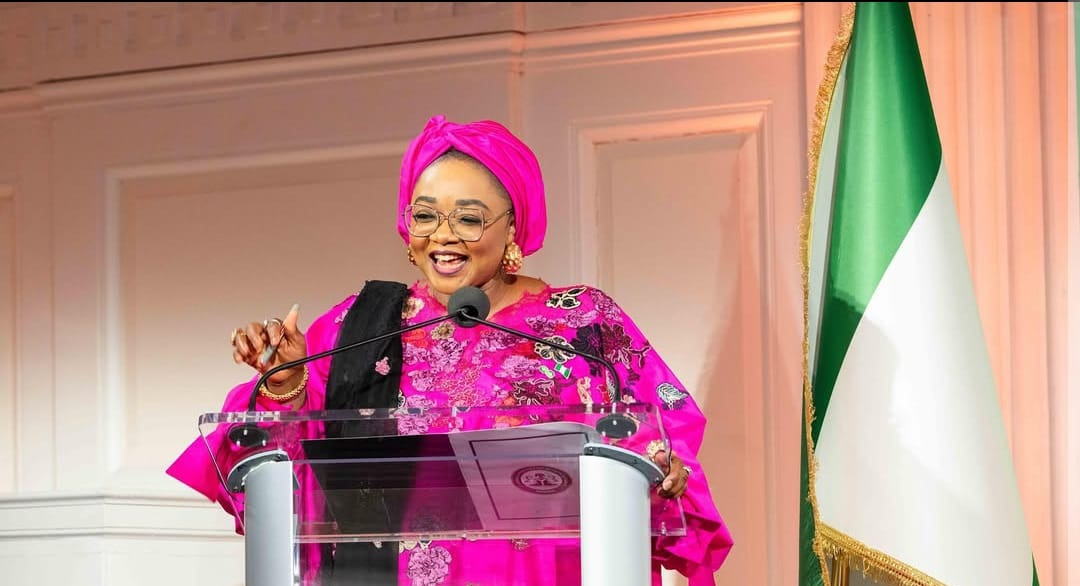
The Federal Government of Nigeria has urged banks and payment operators to unlock Nigeria’s $14.8 billion annual gender financing opportunity.
The Minister of Women Affairs and Social Development, Hajiya Imaan Sulaiman-Ibrahim, made the call on Wednesday at the Second National Gender Inclusion Conference (SheIsIncluded) 2026 in Abuja, themed “Designing for Delivery: Financing, Systems and Scale for Women’s Economic Transformation.”
The SheIsIncluded Initiative’s Aso Accord on Financial and Economic Inclusion was signed on April 25, 2024, as a strategic initiative designed to address gaps in economic and financial inclusion.
What they are saying
The minister said the difficulty in attaining economic transformation for Nigerian women has never been about ambition, adding that Nigeria has ambition in abundance, but “the difficulty has been the design.”
Sharing observations drawn from what her ministry has learned in the field, she said, for instance, that financial systems were built to recognise collateral, while women hold less of it.
- She said this difficulty is why the World Bank-supported Nigeria for Women Project (NFWP) Scale-Up is organising women into Women Affinity Groups that save together, lend to one another and grow their enterprises.
- She disclosed that the Scale-Up now extends its architecture to 4.5 million women through 300,000 groups nationwide, after mobilising over 560,000 women into more than 26,000 groups in the first phase of the programme.
- The women saved in excess of N4.9 billion of their own resources and accessed about N15.6 billion in livelihood grants, according to her.
She urged banks and other financial institutions to close the multi-billion-dollar financing gap in the country by redesigning some of their models, adding that the ministry is prepared to open its programme pipelines to any institution wishing to test a product at scale.
- “To our banks, guarantors and payment operators, I would respectfully invite you to design for the woman who exists rather than the borrower our models were built for.
- “The International Finance Corporation estimates that closing Nigeria’s gender financing gap could unlock some $14.8 billion annually. That is not a social return. It is a commercial one, and it remains unclaimed,” she said.
- She proposed “alternative-data credit scoring; guarantee-backed lending that recognises group liability, for which the Affinity Groups are ready-made; and low-cost interoperable payments that work on the handset she already owns.”
She also called on state governments to co-finance and localise national programmes into a lived reality.
She urged development partners to help the nation maintain a shared map of who is doing what and where, so that resources reach the underserved.
- “In a period of contracting global development financing, coordination is how we protect coverage,” she added.
Vice President Kashim Shettima, represented by the Special Adviser to the President on General Duties, Dr. Aliyu Modibbo Umar, maintained that every serious commitment towards women’s economic empowerment should carry three things: an owner, a metric and a deadline.
According to him, these commitments must be visible, tracked and reviewed and, where they succeed, recognised through the nation’s first National Gender and Financial Inclusion Awards.
He said delivery, however, requires financing, necessitating the intervention of financial institutions, fintechs, investors and development partners.
He added that while the government can set the rules, scale will come from the capital, technology and discipline of the private sector.
For Dr. Nurudeen Abubakar Zauro, Technical Adviser to the President on Economic and Financial Inclusion, when productive capital cannot reach productive citizens, talent is not matched to opportunity, and the whole economy operates below its potential.
He stressed that credible estimates suggest national output could be materially higher by as much as 23 per cent, with greater equality in women’s participation.
Women’s participation in capital market is low — SEC
At a panel session on how regulators are redesigning the rules to drive women’s inclusion, the Director-General (DG) of the Securities and Exchange Commission (SEC) of Nigeria, Dr. Emomotimi Agama, represented by Ojone Kabir, said women’s participation in the capital market is low.
Giving the metrics, she highlighted that women’s participation in corporate institutions is between 12 and 15 per cent, while those in executive offices are below 7 per cent.
- “Women accessing capital to raise funds is below 5 per cent,” she added.
She disclosed that entry criteria into the capital market are being reviewed to “favour women most and SMEs generally.”
She advised women to take advantage of crowdfunding platforms within the capital market, adding that the networking and visibility opportunities are huge.
The official admitted that although the capital market has several compliance requirements, women should not see them as a challenge but should venture into the market.
What you should know
The NFWP, originally approved on June 27, 2018, through an International Development Association (IDA) credit of $100 million, was primarily designed to foster improved livelihoods for women across various states in Nigeria by engaging them in meaningful economic activities and business ventures.
The project aims to equip women with the necessary skills and resources to engage in sustainable economic activities, enhancing their contributions to household incomes and community development.
In 2024, the Federal Government appealed to the World Bank to extend the deadline for the $100 million Nigeria for Women Project (NFWP).