Follow Us on Google Discover
Nigeria’s food inflation rate rose to 20.31% year-on-year in July 2026, marking its highest level since September 2025 despite a further decline in the country’s headline inflation rate.
The latest figure was contained in the Consumer Price Index (CPI) report released by the National Bureau of Statistics (NBS), which showed that headline inflation declined to 15.43% in July from 15.91% in June.
The rise in food inflation comes as the Federal Government continues to introduce measures aimed at easing food prices and addressing the country’s cost-of-living pressures.
What the data is saying
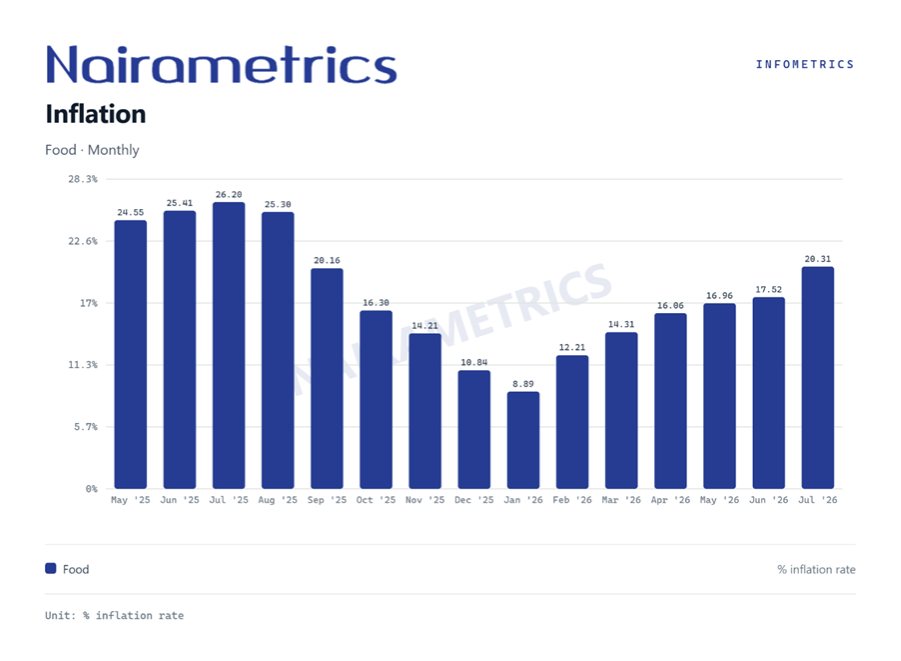
Food inflation stood at 20.31% in July 2026, significantly higher than the 17.52% recorded in June and the highest rate recorded since September 2025.
- Food inflation was 20.16% in September 2025 before declining to 16.30% in October and 14.21% in November.
- The rate fell further to 10.84% in December 2025 and reached 8.89% in January 2026 before beginning to rise again.
- Food inflation increased to 12.21% in February, 14.31% in March, 16.06% in April and 16.96% in May 2026.
- The rate climbed to 17.52% in June before accelerating to 20.31% in July.
The July increase highlights renewed pressure on food prices even as the broader inflation rate continued to moderate during the month.
Get up to speed
Earlier in July, the Federal Government commenced reductions in import duties on essential goods, including food staples and passenger vehicles, as part of measures to address the country’s cost-of-living crisis.
The 2026 Fiscal Policy Measures, approved by Finance Minister and Coordinating Minister of the Economy Taiwo Oyedele, represented a significant overhaul of the country’s tariff regime.
- Nigeria’s food and beverage imports stood at N1.393 trillion between January and March 2026, according to the latest trade data from the NBS, down from N1.671 trillion recorded in the corresponding period of 2025. This represents a year-on-year decline of about 16.7%.
- Nigeria’s headline inflation rate declined by 0.48 percentage points to 15.43% in July 2026 from 15.91% in June.
Urban inflation stood at 16.12% year-on-year in July, while the month-on-month rate declined to 1.90% from 2.13% in June.
- The urban month-on-month inflation rate declined by 0.23 percentage points during the month.
- The corresponding 12-month average urban inflation rate stood at 16.81%.
- The 12-month average was 13.93 percentage points lower than the 30.74% recorded in July 2025.
- Rural inflation stood at 13.77% year-on-year in July, below the urban rate during the period.
- Rural month-on-month inflation increased to 0.78% in July from 0.52% in June.
- The July rate represented a 0.25 percentage-point increase from the previous month.
- The corresponding 12-month average rural inflation rate stood at 16.72%.
This was 10.33 percentage points lower than the 27.05% recorded in July 2025.
The divergence between headline and food inflation indicates that the moderation in the overall inflation rate has not translated into similar relief for food prices.
What you should know
In June 2024, President Bola Tinubu ordered a six-month suspension of import duties on staple food items, drugs and other essential goods as part of measures to ease inflation.
The Central Bank of Nigeria also reported that Nigeria spent $2.34 billion on food imports in 2025.
More recently, the Minister of Agriculture and Food Security, Senator Abubakar Kyari, unveiled a National Agricultural Mechanisation Policy and National Agricultural Mechanisation Investment Strategy aimed at establishing a commercially viable mechanisation ecosystem.
The strategy includes plans for a mega tractor assembly plant capable of producing between 2,000 and 4,000 tractors annually, as the government seeks to boost agricultural productivity and strengthen food sovereignty.