
 Follow Us on Google Discover
Nigeria can reach a trillion dollars without its people getting much richer.
And it can make its people much richer without ever reaching a trillion dollars.
That is not a riddle. It is the most important thing to understand about the government’s headline goal.
The reason is that the target is counted in dollars, and the dollar size of an economy moves for two very different reasons: how much a country actually produces, and what happens to its currency.
Also Read
Look at last year. In 2025, Nigeria’s economy grew about 4 percent in real terms, producing that much more than the year before. Measured in dollars, though, it grew about 15 percent, rising from about USD 252 billion to about USD 291 billion.
Both figures are from the World Bank. The difference between them was not new production. It was mostly the naira recovering the ground it lost in 2024, and rising prices. The country did not become 15 percent richer. Its money simply measured larger.
Now weigh that against the goal. To reach a trillion dollars by 2030, from about USD 291 billion today, the dollar figure would have to grow about 28 percent every year, five years running. Real growth is nowhere near that pace. So if the milestone were reached on that timetable, most of the distance would be covered not by farms, factories and firms producing more, but by prices and a stronger naira.
That is the trap. The quickest way to move the headline number is to move the currency, not the economy. A country that fixes its gaze on the dollar figure can end up chasing the exchange rate while the real economy stands still. The number would arrive. The prosperity would not.
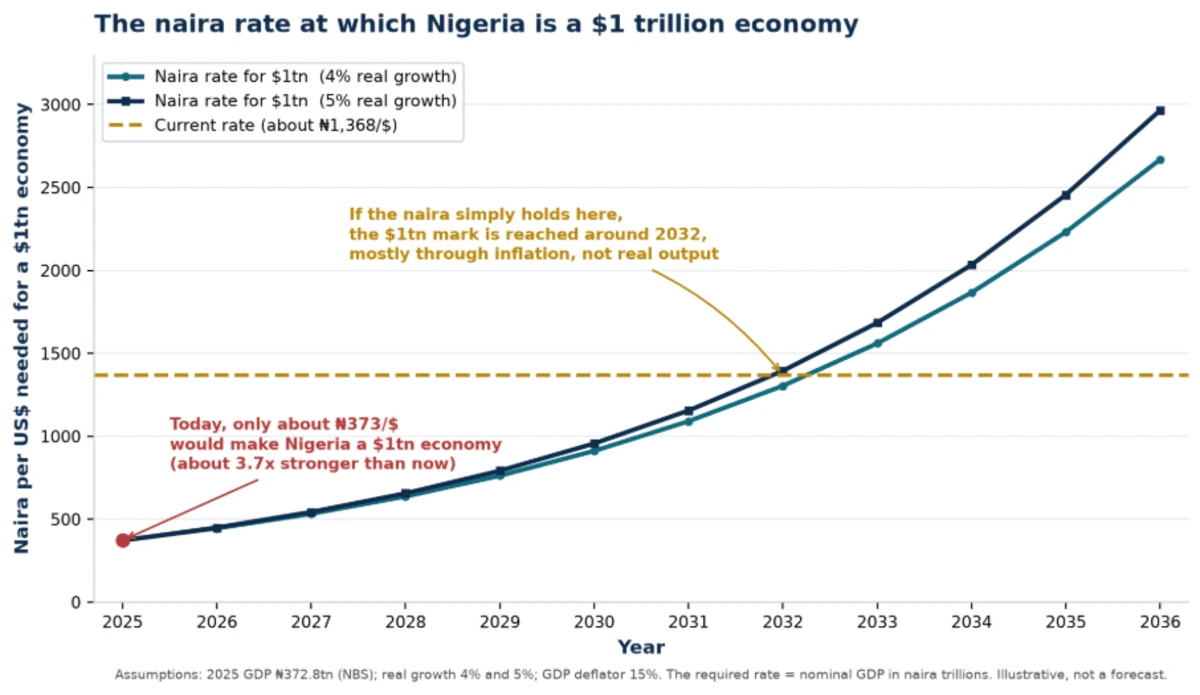
There is a better road, and it is the one every country that truly reached a trillion dollars actually took. Indonesia, India and others got there not through currency swings, but through steady real growth of around 5 to 7 percent a year, sustained for a generation.
They produced their way to the milestone, and a stronger currency followed real strength rather than being chased for its own sake. Real growth is the engine. A sound currency is the reward.
So we should keep score differently. A year in which Nigeria grows 5 or 6 percent in real terms, with more people in decent work, is a real step towards a trillion-dollar economy, even if the dollar figure barely moves. A year in which the dollar figure leaps because the naira rallied deserves far less applause, because nothing was built. The date on the target matters far less than the direction beneath it.
For anyone who invests or builds here, this is more than a point of principle. The naira is the single biggest swing factor in dollar returns. The same company can look brilliant or brutal in dollars depending only on where the currency goes, as 2024 and 2025 showed in quick succession.
Money made because the naira rallied can vanish when it slips. Money made because a business sells more, to more people, at better margins, tends to last. So the wise way to read Nigeria, whether you are pricing a single company or the whole economy, is to look past the dollar headline to the real growth underneath it.
None of this is an argument against the goal. A trillion-dollar economy is a worthy ambition, and a bold target is how serious countries rally their effort. It is an argument about what the goal truly requires.
Reach a trillion dollars on the back of real, broad and lasting growth, and it will be one of the great development stories of the century. Reach it on a currency swing, and it will be a headline that fades with the next one. The number is not the achievement. The economy underneath it is. That is the one worth building.
This is part of a series exploring whether, and how, Nigeria can become a one trillion-dollar economy. Next in the series: are the fundamentals in place to power the growth?
Frank Nnamka is a private equity and impact investor. He writes here in a personal capacity, and the views expressed are his own and do not reflect the position of his employer or any organisation he is affiliated with.
 Follow Us on Google Discover


According to local parlance “no be juju be that”
Nigerians want sudden growth. The growth he is referring to in India – still poverty capital of the world and Indonesia came from years of austerity and increase in tax revenue and the people of those countries still complain. China did it best by taking strong measures to stop brain drain, reduce population growth and reduced salaries but mass employment in agriculture and manufacturing. Nigerians will protest if the government tries any of these measures. Nigeria as a people do not have a history of building anything or paying taxes.