Follow Us on Google Discover
Nigeria’s manufacturing sector will struggle to achieve a sustained recovery unless soaring production costs are brought under control, analysts have warned, citing persistent inflation, elevated energy costs and high interest rates as major constraints to growth.
The warning comes despite signs of a modest improvement in business activity, as manufacturers continue to grapple with mounting cost pressures that are weighing on production and new orders.
According to the latest Purchasing Managers’ Index (PMI) tracked by Nairametrics, the Manufacturing PMI stood at 50.10 in June, from 49.6 in May.
The latest reading indicates that more manufacturers recorded declines in output, new orders and production activity than those reporting growth, extending the sector’s weak performance after a strong start to the year.
Also Read
What they are saying
Analysts attribute the prolonged contraction largely to rising production costs, elevated borrowing costs and weak consumer demand.
Chief Executive Officer of the Centre for the Promotion of Private Enterprise (CPPE), Dr. Muda Yusuf, said higher energy costs have significantly increased manufacturers’ operating expenses.
- “I will put it down to the fact that the cost of operations has been increasing, especially since the Iran war started. Costs of energy products—diesel, gas and others—have been going up significantly. Manufacturing is energy intensive, so rising energy costs will naturally affect performance.”
- “Many manufacturers are still grappling with high interest rates. Development finance institutions are unable to meet the growing demand for financing because they are not adequately funded.”
- “Accessing forex is no longer a major issue because we now have liquidity in the market. Except for compliance challenges arising from documentation requirements, foreign exchange availability is no longer the problem.”
- Kuteyi Duro, President of the Association of Food and Agro-allied Processors of Nigeria, added: “The cost of production is increasing daily. When diesel and petrol prices rise together, alongside raw material costs, it becomes difficult for industries to break even.”
Duro also criticised the implementation of government fiscal policies, including taxation and import waivers, warning that the operating environment is forcing some manufacturers to consider shutting down.
More Insights
The latest PMI marks a sharp reversal from the sector’s performance earlier in the year.
According to Nairametrics data, manufacturing activity expanded strongly between September 2025 and March 2026 before slipping into contraction in April, where it has remained for three consecutive months.
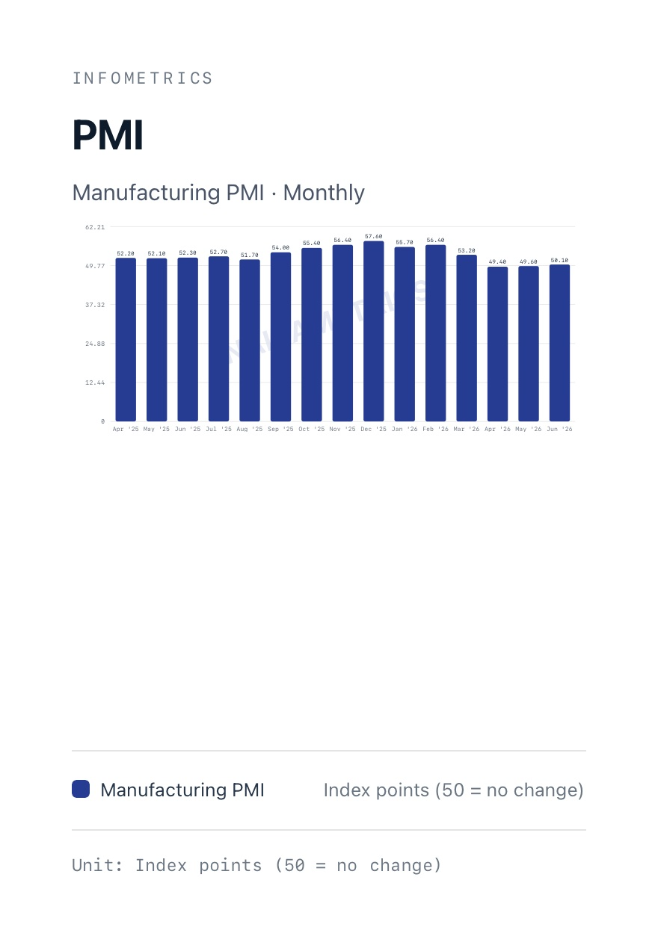
The slowdown has coincided with persistent production costs despite improving foreign exchange liquidity and stronger external reserves.
Although headline inflation eased marginally to 15.91% in June from 15.93% in May, manufacturers continue to contend with expensive energy, high borrowing costs and subdued consumer demand.
The CBN also retained the Monetary Policy Rate (MPR) at 26.5% in July, keeping financing costs elevated for manufacturers that rely on bank credit to fund production and expansion.
According to the National Bureau of Statistics, Nigeria’s manufacturing sector contributed 9.57% to the country’s real Gross Domestic Product in the first quarter of 2026.
This is an improvement from the 7.40% posted in the fourth quarter of 2025.
Economist Dr. Almarouf Yusuf of the University of Abuja said improvements in foreign exchange liquidity and investor confidence have yet to translate into lower operating costs for businesses.
According to him, high diesel prices, transport costs, lending rates and multiple regulatory charges continue to constrain industrial production.
Industry analysts say prolonged weakness in manufacturing could weigh on Nigeria’s broader economic performance, given the sector’s contribution to employment, value addition and non-oil exports.
While Nigeria’s external reserves have risen above $52 billion and exchange rate stability has improved, analysts say these gains alone are insufficient to restore manufacturing growth.
- Manufacturers continue to face high energy and financing costs.
- Household purchasing power remains weak, limiting demand for manufactured goods.
- High lending rates continue to discourage investment and expansion.
Analysts say affordable credit, improved electricity supply, infrastructure upgrades and incentives for local sourcing are needed to revive the sector.
Analysts expect manufacturing activity to remain under pressure in the coming months unless production costs ease significantly. They argue that while macroeconomic stability has improved, sustained recovery in the sector will depend on reforms that reduce the cost of doing business and stimulate consumer demand.
What you should know
Nairametrics reports that Nigeria’s private sector sustained its growth momentum in June 2026, marking the fifth consecutive month of expansion as stronger customer demand and new product offerings continued to drive business activity.
The PMI eased slightly to 53.4 in June from 54.1 in May but remained comfortably above the 50.0 threshold that separates expansion from contraction, indicating that business conditions continued to improve at the end of the second quarter.
A PMI reading above 50.0 indicates improving business conditions compared to the previous month, while a reading below 50.0 signals a contraction.