Follow Us on Google Discover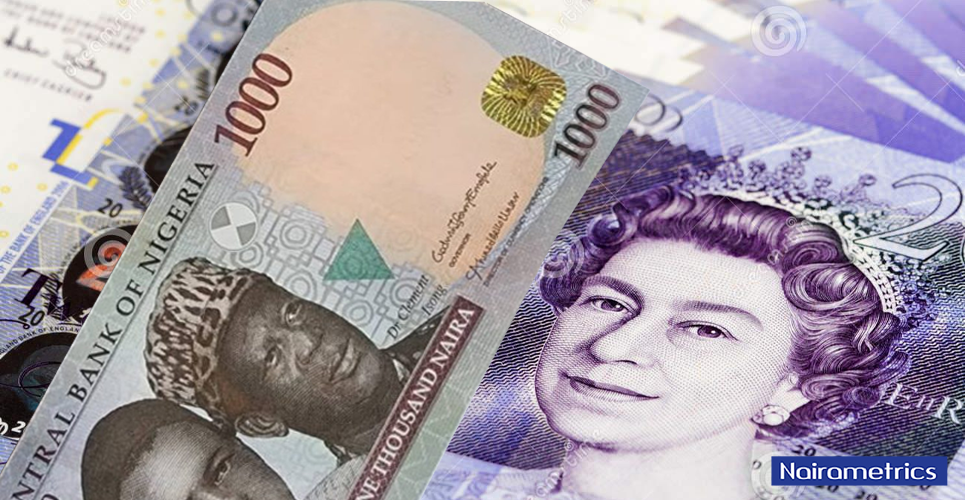
The official exchange rate for the British Pound against the Nigerian Naira strengthened to N1,841/£ at the start of the mid-week trading session in the Nigerian foreign exchange market.
The pair has seen relative stability since the naira eased off highs of N1,950/£ witnessed earlier in the year.
Developments in FX market reforms, coupled with efficient clearing of FX backlogs by the Nigerian Apex Bank, have dramatically reduced the differential between the official market window and the parallel market, thus eliminating arbitrage opportunities.
The CBN kept the MPR unchanged at 26.5% following its MPC meeting this week.
Nigerian Apex Bank indicated it remained wary of inflationary pressures amid high energy/logistics costs, though inflation moderated to about 15.9% (from highs of over 30% in previous cycles).
Maintaining a relatively positive real interest rate to inflation offers comfort to foreign portfolio flows in the local debt market, in turn supporting FX reserves.
Heightened geopolitical tensions and the oil market uncertainty were identified as reasons to maintain a wait-and-see attitude.
Sterling edged higher towards $1.338 at midweek in the London trading session. It appears to have moved past a downtrend resistance line extending from May peaks; it is struggling to breach its 200-day simple moving average at $1.34.
British Pound sellers could emerge in the initial knee-jerk to UK CPI Inflation data with hopes that it would put pressure on a potential hike in rates later this month from the Bank of England.
The US Dollar is now on pause after rising four consecutive days to a week’s high amid a potential US-Iran mediation that might help defuse energy price pressures and also mitigate some of the high hawkish rate expectations from the US Federal Reserve, which is a factor that is helping to sustain support for the GBP/USD pair, while geopolitical risk still exists.
Additional tensions between the two countries have been a further factor in geopolitical risk. Traders seem reluctant to place heavy bets on the GBP ahead of today’s UK CPI report, which should provide clues to the Bank of England (BoE)’s upcoming rate decisions, and investors await UK Prime Minister Andy Burnham’s fiscal plans.
Currency traders also appear to be pricing in at least one further increase in interest rates from the Fed as US energy prices are driving inflation expectations.
Yemen’s Iran-aligned Houthi movement has announced a naval blockade of Saudi Arabia amid an ongoing conflict because of the Strait of Hormuz closure and pushed oil prices to a new high after the 12th of June.
Some market participants point to uncertainty about Premier Burnham’s fiscal intentions as another concern.
It is still uncertain as to how Burnham plans to fund his agenda,’ they argue, now anticipating the 10-year plan that he is scheduled to release later this year. Burnham has already signaled he plans to adopt ‘flexibility’ within the fiscal rules, which will likely keep markets on alert.
‘The United Kingdom has a low savings ratio and a large current account deficit. ‘Such metrics can increase the sensitivities of its debt market to perceived bad news.’
Although the UK ‘may not have the largest debt/GDP ratio in the developed world,’ analysts suggest that ‘arguably it has one of the most sensitive debt markets’, meaning gilts are more susceptible than others to additional concerns about the fiscal trajectory.