
 Follow Us on Google Discover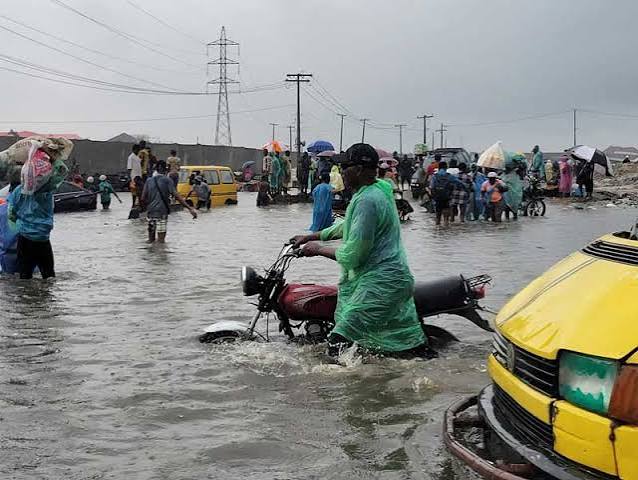
On the morning of June 29, 2026, the Lekki-Epe Expressway disappeared.
Four hours of relentless rain submerged one of Lagos’s principal arteries under a sheet of water that vehicles could not navigate and many could not avoid.
The Apapa-Oshodi Expressway flooded. Ikorodu Road flooded. Sections of Lagos-Ibadan Expressway flooded.
Motorists abandoned their cars in the middle of the road. Businesses dependent on the movement of goods and people across the city lost the working day. As floodwaters receded, the warnings did not.
Also Read
The Nigerian Meteorological Agency (NiMet) continued to caution about heavy rainfall and flash-flood risks, while the National Economic Council had, less than two weeks earlier, approved N83.2 billion for anticipatory flood mitigation across the country. None of it had yet been deployed. The relevant fact is not that it flooded. The relevant fact is that it always floods. This is an infrastructure story wearing a weather costume.
Lagos wants to be a global city. The Lagos Development Plan 2052 is explicit: the ambition is to reposition Lagos as Africa’s premier global city and a globally competitive economic and financial hub by the mid-twenty-first century. The economic foundations are compelling.
According to Lagos Economic Development Update (LEDU) 2025, Lagos is Africa’s second-largest (after Cairo) urban economy by purchasing power parity, with a GDP of $259.75 billion in 2023 and a first-quarter 2025 reported output of N14.85 trillion. The city hosts Nigeria’s stock exchange, its major banks, its most dynamic fintech ecosystem, and the operational headquarters of many multinationals operating in West Africa.
With a population of between 17 and 22 million people, Lagos is generally ranked one of the twenty largest cities on earth. The ambition is not fantasy. The question is whether the city’s physical infrastructure is remotely consistent with the scale of that ambition.
This article constructed an Infrastructure Gap Index (IGI) to answer that question with precision. The IGI measures infrastructure quality across 5 dimensions of transport, energy, water and drainage, digital connectivity, and housing on a 10-point scale.
These index, even though based on the author’s scoring are determined by available data and can vary on absolute terms depending on the scorer, will most likely lead to the same final ranking. Applied across ten cities from Singapore to Dar es Salaam, based on geographic representation as well as Afro-global benchmark, the results are unambiguous and, for Lagos, uncomfortable.
Lagos’s composite score is 3.22 out of 10, ranking it 9th above only Dar es Salaam. Singapore scores 9.50. Johannesburg, the continent’s most globally integrated city, scores 5.98. Nairobi, smaller than Lagos in every absolute measure, scores 4.76. The gap between Lagos and the global frontier is not merely large. It is, in several dimensions, generational.
Energy and housing are the weakest dimensions. Lagos scores 2.5 on energy: the average business or household receives eight to 20 hours of grid power per day on a good day and self-generates the remainder. Nigeria loses an estimated $25 billion annually to power supply inadequacy, with Lagos accounting for the largest share. Because of unreliable grid supply, many Nigerian businesses depend on diesel and petrol generators, making electricity costs several times higher than they would be under reliable public power and eroding the competitiveness of MSMEs.
On housing, Lagos scores 2.1. There is a documented deficit of three million housing units, and an estimated 60 to 70% of the city’s population lives in informal settlements. The formal market, including developments like Eko Atlantic, serves a small fraction of the population at price points disconnected from the economic reality of the other nineteen million.
Water and drainage, the third-weakest dimension at 2.8, is where the flooding of June 29 finds its structural explanation. Lagos Water Corporation, irregularly, reaches perhaps 40% of the city’s population through the reticulated network. The rest drink from boreholes or purchase from tanker trucks. But the supply gap has, over decades, been partially absorbed by private substitution. The drainage gap has not.
Between 2025 and April 2026, Lagos State enforcement teams demolished or removed 1,544 structures illegally built on or over drainage channels. A further 674 remained. In Ajiran, a land-owning family had physically blocked the Ajiran outfall channel. In Ikota, a major Estate had illegally reclaimed a portion of the Ikota River and begun construction without drainage approvals. A man who builds his house where the river once ran will one day wake to find the river has returned. The Ikota River found the Ikota Estate on June 29. It will find it again.
The economic cost is quantifiable. Nigerian states lost N13 trillion, approximately $9.5 billion, to flooding in 2024 and 2025 combined. NiMet’s 2026 Seasonal Climate Prediction forecast above-normal rainfall across Lagos, with annual accumulations projected at up to 2,010 millimetres in the Badagry Division and an average of 1,965 millimetres across the state. Lagos is among 33 states at high flood risk for 2026.
The scenario modelling in this article projects that, under the current trajectory with no structural drainage reform, annual flood-related losses for Lagos and its economic hinterland will rise from approximately N7 trillion in 2026 to N9.6 trillion by 2030. Under a credible reform path of canal clearance at scale, integrated pump and lake systems, planning enforcement on wetlands, the same losses could fall to N1.6 trillion by 2030. The elder who will not patch the roof in the dry season will learn his lesson in the wet.
The reclaimed land dimension compounds the risk. Eko Atlantic City is built on 95 million cubic metres of dredged sand reclaimed from the Atlantic Ocean, protected by an 8.5-kilometre sea wall. The wall performs its structural function, but the reclamation altered coastal currents and eroded more than 25 metres of adjacent shoreline. Parts of Lekki, Lagos’s fastest-growing residential corridor, are built on reclaimed wetland.
The IPCC projects sea-level rise of between 54 and 75 centimetres for Lagos’s coastal zone by 2100. A city building premium real estate on sand, below projected sea-level rise, without drainage infrastructure adequate for current annual rainfall, is in a planning emergency. Not merely a planning challenge.
Against this, the article’s one genuinely bright finding: digital infrastructure, where Lagos scores 5.5. In May 2025, Dealroom’s Global Tech Ecosystem Index ranked Lagos as the world’s fastest-growing tech city, ahead of Istanbul, Pune, and Mumbai. Flutterwave, Paystack, Moniepoint, and Interswitch anchor an ecosystem worth $15.3 billion that processes billions of naira in daily transactions and attracts significant international venture capital.
The lesson is instructive: where infrastructure has been liberalised, privately invested, and competitively provided, Lagos has made substantial progress. The problem is that a twenty-two-million-person city cannot run on digital infrastructure alone. The city that runs on generators and danfos and boreholes is not adapting heroically to adversity. It is paying a permanent infrastructure tax that its competitors do not pay.
On transport, Lagos scores 3.2. The 11.8-kilometer Third Mainland Bridge, opened in 1990 and still the principal artery connecting Mainland to Island, carries above 120,000 vehicle movements per day more than double its design capacity of 50,000. Traffic congestion costs the city an estimated ₦4 trillion annually. Forget the street-trading opportunity.
Flooding compounds this decisively: when four hours of rain simultaneously submerge Ozumba Mbadiwe, the Apapa-Oshodi Expressway, and Ikorodu Road, Lagos does not have a traffic problem. It has an infrastructure collapse presenting itself as a traffic problem. The Blue Line rail’s first thirteen-kilometre segment, opened in 2023, is a genuine achievement. Thirteen kilometres in a twenty-two-million-person city is a beginning, not a solution.
Closing the gap to Nairobi’s infrastructure level would require approximately $13 billion in capital investment over ten years. Reaching Johannesburg’s level would require $23 billion. Lagos State’s entire annual total audited revenue stands at approximately $1.9 billion.
The arithmetic is unambiguous: the gap cannot be closed without sustained federal-state coordination, multilateral lending at scale, and structured private sector participation. The governance problem is as important as the finance problem. Lagos’s infrastructure is managed across the Federal Government, Lagos State, LAMATA, 20 local governments and 37 LCDAs. The infrastructure creates coordination failures at every level, including the apparently simple matter of who is responsible for ensuring that a land-owning family in Ajiran does not block the outfall channel that drains the entire corridor.
In 1960, Lagos and Singapore had roughly comparable per capita incomes. Singapore in 2026 scores 9.50 on the IGI. Lagos scores 3.22. The gap is not fate. It is the accumulated consequence of sixty-five years of divergent governance choices: choices that can, in principle, be made differently.
The Lagos Development Plan 2052 speaks of rail lines, smart ports, affordable housing, 24-hour electricity, and universal water access. If those ambitions are met, Lagos in 2052 will be a genuinely different city. The infrastructure gap is not irresolvable. But it will not be resolved by aspiration or branding.
It will be resolved by concrete, unglamorous, sustained investment in the physical systems of the pipes, the wires, the rails, the drainage channels, the seawalls and wetland buffers that make a city capable of hosting the kind of economic activity that turns a large African city into a genuinely global one. Lagos has the people. It has the economic mass. The test of the next decade is not whether the world will continue to name it a consequential city, but whether Lagos will build its way to deserving the name. Not in the next plan. In the next pour of concrete. And in the next canal cleared before the rains come.
- Akinola Morakinyo (Ph. D) writes on MINT economies from the Department of Economics, Finance & Quantitative Analysis, Kennesaw State University, GA, USA
There is a lot to write about this but everybody will get hit. Lagos will continue to suffer massive flooding except something gives.
I love your comparison of Lagos to major economic hubs of the same class in different countries. One story that you left is that Lagos was left unattended to between 1983- 1999. That was a massive 16 years of planning, structural and infrastructural deficit.
To be honest, i live in Lagos and can tell you Lagos is not a great city to live, health-wise.
While the successive state gorvernments have tried to improve the living standard of the state, they met a monster of the past and a growing monster. Let us look at it this way, 70% of the graduates in the country flock to Lagos in search of greener pasture. Lagos is taking the hit for the “Lazy” states.
The issue with Lekki Corridors and its environ is a combined fault of the state’s authorities and the developers. Construction in that corridor was largely unsupervised or poorly implemented. The State is culpable and for this reason, Lekki will always remain a problem.
The management of waste is another major problem for the state. Few days ago, the State’s Deputy Governor attested to this fact. Lagos state occupants are living side by side with refuse. The State is dirty!!!
There is more to talk about but let me pause here for now…