Follow Us on Google Discover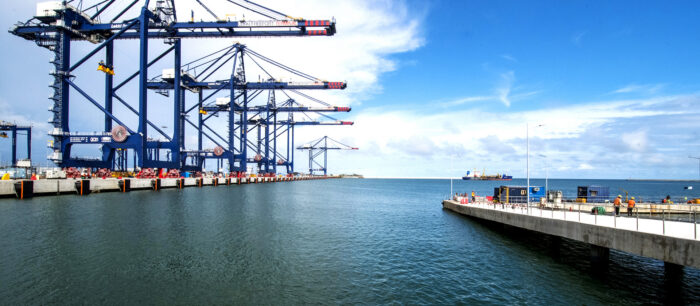
Lekki Deep Sea Port has continued to eat into Apapa Port’s dominance in Nigeria’s maritime trade, as new data shows a gradual redistribution of cargo volumes across the country’s major seaports.
Nairametrics came to this conclusion after a review of the National Bureau of Statistics (NBS) Q1 2026 Foreign Trade in Goods Statistics Report, particularly the “Trade by Top 10 Posts/Ports of Operation” tables, and a comparison with the corresponding Q1 2025 report.
The latest figures indicate that while Apapa Port remains the country’s largest trade gateway, its share of total imports and exports has continued to decline as newer and expanding ports steadily gain ground in Nigeria’s maritime trade network.
The Lekki Deep Sea Port, which became operational in April 2023, has increasingly gained relevance in Nigeria’s trade flows, serving companies operating within the Lekki Free Trade Zone, including large-scale industrial and manufacturing investments such as the Dangote Refinery
What the data is saying
A comparison of Q1 2026 and Q1 2025 data shows that Apapa Port remains Nigeria’s largest trade gateway, but its dominance is weakening across both imports and exports.
- The export data shows a clear shift in market concentration, even though Apapa remains dominant in absolute terms.
- Apapa Port recorded exports of N15.48 trillion in Q1 2026, down from N17.74 trillion in Q1 2025
- Its export share declined from 86.12% to 73.14%, showing reduced concentration
- The decline reflects increasing participation from other ports in Nigeria’s export network
- Lekki Deep Sea Port emerged as the fastest-growing export gateway within the period
The Lekki Deep Sea Port recorded one of the most significant shifts in the review period. Exports rose sharply to N3.29 trillion in Q1 2026 from N303.62 billion in Q1 2025, increasing its share of total exports to 15.53% from 1.47%. Imports also grew to N2.51 trillion from N1.70 trillion, raising its share to 18.43% from 10.99%.
This performance places the port ahead of Tin Can Island Port and Onne Port in overall trade contribution, reinforcing its position as a rapidly expanding secondary hub in Nigeria’s maritime structure.
More insights
Tin Can Island Port recorded mixed performance during the period under review. Imports were stable at N1.95 trillion in Q1 2026, unchanged from Q1 2025, but exports declined to N883.93 billion from N1.49 trillion, pointing to weaker export activity.
Onne Port remained relatively steady as imports eased slightly to N1.23 trillion from N1.30 trillion, while exports rose marginally to N743.18 billion from N728.53 billion, indicating stable but limited expansion.
Other trade locations also showed mixed trends:
- Lagos Free Trade Zone recorded imports of N309.12 billion and exports of N83.84 billion, reflecting gradual industrial activity
- Murtala Muhammed International Airport posted exports of N73.85 billion, down from N114.08 billion, while imports rose to N553.77 billion
- Seme Border Post recorded exports of N37.32 billion, up from N27.25 billion, showing modest recovery in formal cross-border trade
- Inland commands such as Sokoto Area Command and Tincan 2 contributed less than 0.2% of total trade flows
Get up to speed
Lekki Deep Sea Port’s rise in Nigeria’s export structure has been one of the most significant shifts in maritime trade since 2025. Between Q1 and Q3 2025, the port handled N6.07 trillion in exports, making it the second-largest export gateway after Apapa Port’s N52.57 trillion over the same period, and ahead of Tin Can Island Port and Onne Port.
Exports through the port rose from N303.6 billion in Q1 2025 to N2.41 trillion in Q2, before peaking at N3.36 trillion in Q3, reflecting a rapid transition from a marginal route to a core export channel within three quarters. This pattern reflects how deep-sea ports typically scale as trade networks adjust to new infrastructure.
The port also benefits from its location within the Lekki Free Trade Zone and its deep-water capacity of about 16.5 metres, which supports large container vessels and industrial-scale cargo movement.
What you should know
Global trade disruptions continue to influence export flows, particularly in energy, fertiliser, and refined products, with knock-on effects for Nigeria’s industrial export hubs.
Nairametrics previously reported that Dangote Fertilizer Ltd., operating within the Lekki Free Trade Zone, recorded higher global demand following disruptions linked to tensions around the Strait of Hormuz.
The development was disclosed by Devakumar Edwin, Vice President at Dangote Industries Ltd., during a call with Bloomberg.
- Global fertiliser supply constraints increased demand for alternative suppliers.
- Lekki-based industrial operators benefited from shifting global sourcing patterns.
- The Dangote Refinery recorded stronger export volumes amid fuel market disruptions in early 2026.
- The refinery became the largest jet fuel exporter globally by April 2026, supported by higher output and shifting international supply patterns.
In Q1 2026, exports through Lekki Deep Sea Port stood at N3.29 trillion, reflecting stronger utilisation by industrial exporters and reinforcing its growing position in Nigeria’s maritime trade network.