
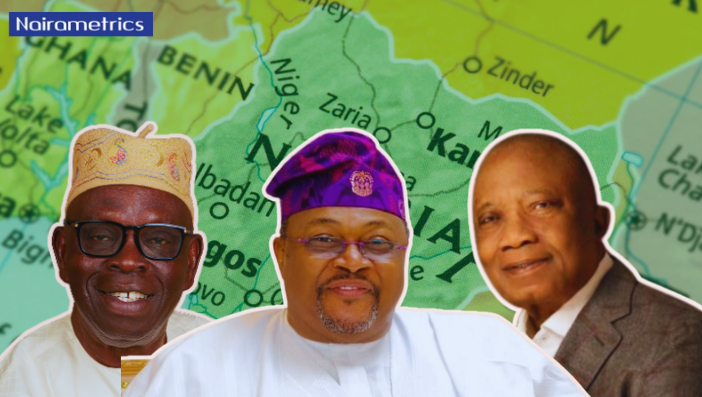
South West Nigeria remains the country’s most concentrated hub of private wealth creation, accounting for a significant share of Nigeria’s high-net-worth individuals, diversified conglomerates, and listed corporate leadership.
In 2026, the region continues to anchor key sectors of the economy, particularly energy, banking, manufacturing, logistics, and infrastructure, through a network of billionaire business leaders whose companies collectively generate tens of trillions of naira in annual economic activity.
According to aggregated industry estimates frequently cited by Nairametrics, Lagos alone contributes over 30% of Nigeria’s GDP, while the broader South West region accounts for more than 40% of formal corporate headquarters in the country.

This concentration of capital has helped produce some of Nigeria’s most influential privately held and publicly listed businesses, with combined valuations running into multiple trillions of naira across banking, power generation, and industrial services.
From legacy conglomerates that began in the 1970s and 1980s to newer wealth built through telecommunications, fintech, and infrastructure, South West–based billionaires have become central to Nigeria’s economic architecture.
In the power sector alone, privately controlled generation assets linked to South West business leaders contribute several gigawatts of installed capacity, supporting Nigeria’s fragmented national grid.
Meanwhile, banking and financial services groups headquartered in Lagos continue to dominate tier-1 capitalisation on the Nigerian Exchange, often accounting for a large share of total market turnover.
This article spotlights the most influential business owners from Southwest Nigeria, adjudged by their dominance in their respective sectors of the economy where they operate.
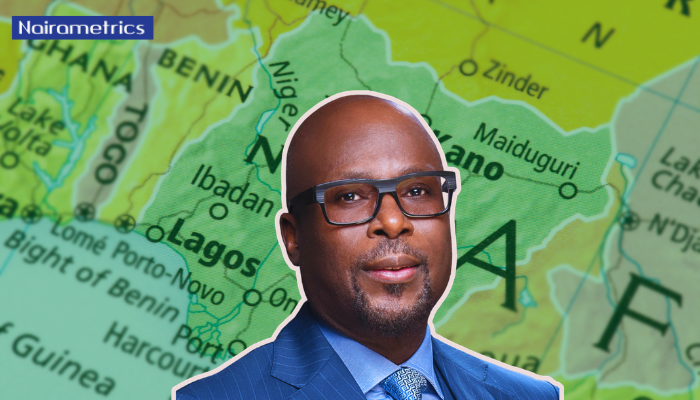
- Chairman, Folawiyo Group
Tijani Babatunde Folawiyo is part of a small circle of Nigerian industrialists who straddle old family capital and the country’s modern energy economy, moving between boardrooms, banks, and the politically sensitive world of oil and gas with a quiet, institutional presence.
Known more commonly as Tunde Folawiyo, he is the chairman of the Folawiyo Group, a diversified family conglomerate with interests in energy, agriculture, shipping, real estate, and petroleum services. He also chairs Coronation Merchant Bank and has held board positions in major financial and telecommunications companies, reflecting a career that has extended well beyond the family enterprise he inherited.
Born in 1960, Mr. Folawiyo was educated in Britain, earning degrees in economics and law from the London School of Economics and University College London. He was called to the Bar of England and Wales in 1985 and briefly practiced law in Nigeria before joining the family business in the late 1980s, a transition that would prove pivotal in the evolution of the group.
He assumed leadership of the Folawiyo Group in 2008 after the death of his father, Wahab Folawiyo, who founded the conglomerate and built its early presence in trading and oil-linked businesses. Under his stewardship, the group has maintained a strong foothold in Nigeria’s energy sector, including upstream petroleum exploration and downstream retail operations.
Mr. Folawiyo has also been active in industry bodies such as the Nigeria Association of Indigenous Petroleum Explorers and Producers, reflecting his influence within Nigeria’s domestic oil sector. He previously served on the board of Access Bank and has held roles linked to MTN Nigeria and other corporate institutions.
Beyond corporate Nigeria, he sits on advisory boards focused on leadership development and education, including the African Leadership Academy. His governance roles span universities and civic institutions, reinforcing a profile that blends business leadership with institutional engagement.
In 2014, Forbes estimated his wealth at around $650 million, placing him among Nigeria’s established business elite, though he has generally maintained a low public profile compared with more visible figures in the country’s private sector.