Follow Us on Google Discover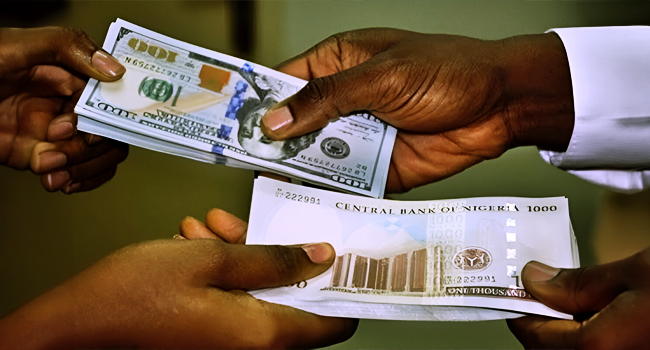
The naira extended its recent rally on Wednesday, closing at N1,341.99/$ at the official market—its strongest level since February 18, 2026, when it traded at N1,340/$.
This is according to data from the Central Bank of Nigeria (CBN).
The latest performance reflects a steady appreciation from N1,358/$ on Monday and N1,348/$ on Tuesday, signalling renewed short-term confidence in the local currency despite mixed macroeconomic conditions.
What the data is saying
The naira recorded consistent gains across the week, reflecting improved market sentiment.
- The currency appreciated from N1,358/$ on Monday to N1,348/$ on Tuesday.
- It further strengthened to N1,341.99/$ on Wednesday, marking its highest level in nearly two months.
- On a week-on-week basis, the naira improved from N1,369/$ recorded on Wednesday, April 8, 2026.
- The sustained appreciation suggests increased stability at the official foreign exchange market.
Overall, the trend indicates a short-term recovery in the naira’s value after previous volatility.
- Nigeria’s external reserves declined to $48.72 billion as of April 13, 2026, down from $49.18 billion at the start of the month.
Get up to speed
Nairametrics recently reported that recent volatility of the exchange rate at the black market has been linked to fiscal leakages, speculation and arbitrage activities, which far outpace the optimism at the official market.
Forex traders say the divergence between official and black market rates is driven by speculative activities and weak liquidity at the retail end of the market.
Experts say resolving the disparity will require boosting FX inflows, improving policy clarity, and ensuring broader access to foreign exchange across all segments of the market.
More insights
Global developments are also influencing currency movements.
- The U.S. dollar remained relatively weak, hovering near recent lows.
- Investor sentiment improved on expectations of renewed peace talks between the United States and Iran.
- Diplomatic signals suggesting a possible de-escalation supported risk appetite in global markets.
- A softer dollar typically provides support for emerging market currencies like the naira.
In the energy market, geopolitical tensions continue to shape global prices.
- Disruptions around the Strait of Hormuz have raised concerns over oil supply.
- Brent crude traded around $94.87 per barrel, while U.S. crude hovered near $91.39.
- Higher oil prices have implications for inflation and external balances.
- However, the dollar index dipped slightly, continuing its recent downward trend.
These external dynamics have contributed to the naira’s recent strengthening.
What you should know
Recent economic developments provide context for the naira’s performance.
- The International Monetary Fund (IMF) revised Nigeria’s 2026 growth forecast downward from 4.4% to 4.1%.
- Headline inflation rose slightly to 15.38% in March from 15.06% in February.
- These indicators highlight ongoing macroeconomic pressures despite currency gains.
The CBN had earlier projected a positive outlook for the country’s external reserves despite recent declines.
- The apex bank expects reserves to rise to $51.04 billion in 2026 from $45.01 billion in 2025.