Follow Us on Google Discover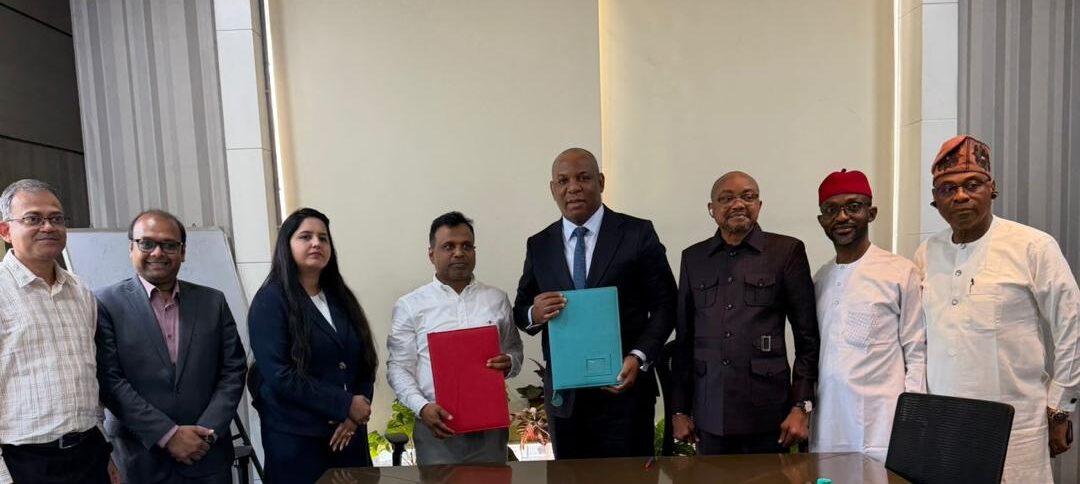
Nigeria has signed a $1 billion agreement with Indian steel company Rashmi Metaliks Group to boost local steel production and attract investment into the sector.
The development was disclosed in a statement by the Ministry of Steel Development, signed by its Head of Press and Public Relations, Salamatu Jibaniya, and reported by NTA.
The deal is part of the Federal Government’s broader strategy to reposition Nigeria’s steel industry, reduce reliance on imports, and strengthen local industrial capacity, the ministry noted.
What they are saying
The Minister of Steel Development, Shuaibu Abubakar Audu, signed the Memorandum of Understanding (MoU) during an official visit to India, marking a significant step in Nigeria’s industrial development agenda.
Also Read
- The agreement is expected to span three years and will cover investment across production, processing, and infrastructure within the steel value chain.
- “Nigeria’s Minister of Steel Development, Shuaibu Abubakar Audu, has signed a $1 billion dollars Memorandum of Understanding (MoU) with India-based Rashmi Metaliks Group to boost investment in Nigeria’s steel sector,” the statement read in part.
The deal followed the Minister’s inspection of the company’s steel facility in Kolkata, where he praised its advanced technology and integrated production system, noting its potential as a model for Nigeria’s industrial growth.
More insights
Audu described the Rashmi Metaliks plant as a model of industrial efficiency, stressing that replicating such systems in Nigeria would be key to achieving global competitiveness. He highlighted the importance of leveraging modern technology and integrated production processes to drive sustainable growth in the steel sector.
- Nigeria has over three billion tonnes of iron ore reserves, with a large portion classified as high-grade deposits.
- Despite these resources, the country relies heavily on imported steel, with annual consumption estimated at about $10 billion.
- The partnership aligns with President Bola Tinubu’s economic agenda, which prioritises foreign direct investment and industrial expansion.
The Minister added that the agreement is expected to create jobs, facilitate technology transfer, reduce import dependency, and position Nigeria as a competitive player in the global steel market.
Get up to speed
Nigeria will implement two complementary automotive policies in 2026 — the End-of-Life Vehicle (ELV) Policy and the Vehicle Conformity Assessment Programme (VehCAP).
The policies are aimed at strengthening local manufacturing and reducing reliance on imports, while also supporting the steel value chain through recycling and improved input sourcing.
- The ELV Policy focuses on the recycling of old and decommissioned vehicles, with steel recovered for reuse in domestic production. This is expected to generate a steady supply of scrap metal, a key input in steel manufacturing.
- VehCAP, introduced by the Standards Organisation of Nigeria (SON) and the National Automotive Design and Development Council (NADDC), will enforce stricter conformity checks on imported vehicles and auto parts.
- By limiting substandard imports, experts believe that it will increase demand for locally produced components and support backward integration.
Together, both policies link recycling, import regulation, and local manufacturing to strengthen Nigeria’s industrial base and expand demand for locally produced steel.
What you should know
The Federal Government, across several administrations, has consistently raised concerns over Nigeria’s dependence on imported steel, with repeated promises to revive local production, particularly the long-dormant Ajaokuta Steel Company.
So far, those promises have not translated into sustained operational revival or a meaningful reduction in import dependence.
- Nairametrics reported in 2025 that President Bola Ahmed Tinubu described the facility as a “monument to abandoned ambition” while pledging renewed efforts to reposition the sector.
- Steel remains a critical input for key sectors, including construction, automotive, telecommunications, and defence.
- A Nairametrics survey in 2025 showed that steel rod prices surged by as much as 210% between 2023 and 2025 for smaller sizes.
- For example, the price of 10 mm rods increased from about N335,000 per tonne in 2023 to N1,040,000 in 2025. Industry sources attribute the spike largely to exchange rate volatility and heavy reliance on imports.
The persistent rise in steel prices and continued import dependence make recent investment deals like the Rashmi Metaliks agreement critical to changing the narrative.