Follow Us on Google Discover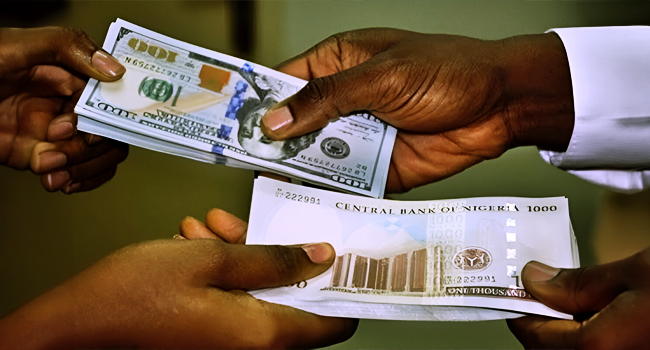
The naira appreciated to N1,348/$ at the official foreign exchange market on Tuesday, strengthening alongside a broader weakness in the U.S. dollar, which has fallen to a six-week low.
This is according to data published on the website of the Central Bank of Nigeria.
The development reflects improving market sentiment driven by renewed optimism over possible diplomatic talks between the United States and Iran.
The gains come amid easing global risk concerns, even as Nigeria’s external reserves continue to trend downward.
What the data is saying
Recent data highlights movements in both the naira and global currency markets.
- The naira closed at N1,348/$ on Tuesday, up from N1,358/$ recorded on Monday.
- Nairametrics reported that the naira closed at N1,355.25/$ at the end of the previous week.
- Nigeria’s external reserves declined to $48.72 billion as of April 13, 2026, from $49.18 billion at the start of the month.
- The U.S. dollar index fell to 98.109, hovering near its lowest level in over six weeks.
The appreciation of the naira aligns with a broader weakening of the dollar across global markets.
Get up to speed
Global financial markets have been heavily influenced by geopolitical tensions in the Middle East.
- The conflict involving the U.S., Israel, and Iran disrupted oil shipments through the Strait of Hormuz.
- The disruption pushed oil prices higher and dampened investor confidence.
- Recent signals of renewed diplomatic talks have improved market sentiment and reduced demand for safe-haven assets like the dollar.
These developments have contributed to a shift toward riskier assets and currencies.
More Insights
Currency and commodity markets reacted positively to easing geopolitical concerns.
- The euro traded near a multi-week high at $1.1793, while sterling rose to $1.3574.
- Brent crude fell to $94.52 per barrel after a sharp decline in the previous session.
- U.S. West Texas Intermediate crude dropped to $90.64 following earlier losses.
- Risk-sensitive assets such as equities and cryptocurrencies also recorded gains.
The improved sentiment reflects investor expectations that diplomatic efforts could stabilise global markets.
Recent economic data points to mixed signals for Nigeria’s outlook.
- The International Monetary Fund has cut Nigeria’s 2026 growth forecast from 4.4 per cent to 4.1 per cent.
- Global growth is projected to slow from 3.4 per cent in 2025 to 3.1 per cent in 2026.
- Advanced economies are projected to grow more slowly, easing from 1.9% in 2025 to 1.8% in 2026 and 1.7% in 2027. The United States is expected to remain relatively resilient, with growth at 2.3% in 2026, while the United Kingdom’s economy is projected to grow at 0.8%.
- Germany, Europe’s largest economy, is expected to recover modestly from 0.2% in 2025 to 0.8% in 2026, and then grow to 1.2 the following year.
- External reserves, which support the naira, have continued to decline in recent weeks.
What you should know
The Central Bank of Nigeria (CBN) had earlier projected a positive outlook for the country’s external reserves despite recent declines.
- The apex bank expects reserves to rise to $51.04 billion in 2026 from $45.01 billion in 2025.