

Just two weeks ago, the bets were firmly on the Naira strengthening below N1,300.
Many analysts believed the currency was finally drifting toward what they considered its fair value.
Optimism was high, and for a brief moment, the Naira appeared determined to prove its critics wrong.


Barely two weeks into March, however, most of those gains have vanished.
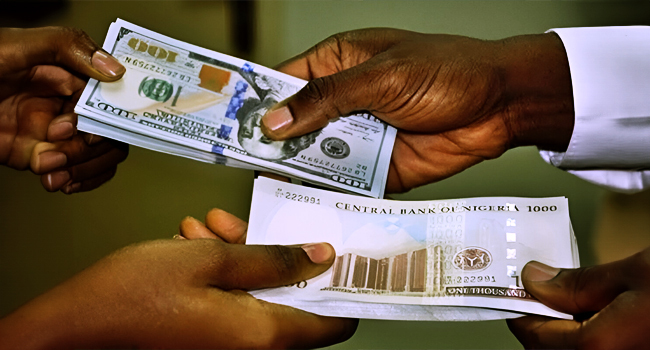
For the first time in six weeks, the exchange rate weakened beyond N1,400, closing around N1,425 in the official market.
In currency markets, optimism can fade quickly, often faster than it arrives.
For the speculators who took the contrarian view, the outcome could hardly be better.
Those who bought dollars when the Naira strengthened to about N1,337 have effectively won their wager. In financial markets, the crowd is often confident, but the contrarian is frequently correct.
The weakening also seems to have coincided with the Central Bank of Nigeria’s decision to cut interest rates by 50 basis points.
The CBN justified the move by pointing to strong reserves of about $50 billion and what it described as stability in the forex market. That outlook assumed disinflation would continue.
Yet the market appears to be reminding policymakers that stability is easier declared than maintained.
To understand the Naira’s unpredictability, one must consider a possibility that sounds counterintuitive.
The CBN may not actually want the Naira to strengthen too much at this stage.
A stronger currency may look attractive on paper, but in the current economic context, it could easily become a Greek gift.
The risk lies partly in the structure of Nigeria’s monetary strategy.
For years, the CBN has relied on relatively high interest rates to attract foreign portfolio investors.
These investors, commonly known as FPIs, bring in foreign exchange and provide liquidity to domestic financial markets.
However, the strategy works best when investors keep their money in the country for a reasonable duration.
If the Naira strengthens too quickly, investors who entered when the currency was weaker can exit early and still lock in handsome gains.
That dynamic undermines the CBN’s preference for longer-term capital inflows. A currency that strengthens too rapidly can inadvertently become an invitation to leave sooner rather than later.
Another factor relates to the state of government finances.
Nigeria’s fiscal position benefits from a weaker Naira because oil revenues, which are earned in dollars, translate into larger Naira inflows once converted.
In simple terms, the weaker the Naira, the more generous those oil receipts appear in the federal accounts. Of course, the story is not entirely cheerful.
Higher interest rates, which are necessary to attract foreign capital, also increase government borrowing costs.
The authorities, therefore, find themselves in a familiar dilemma: between a rock and a hard place, or perhaps between the oil barrel and the bond market.
There is also the matter of non-oil exports. Nigeria has been working steadily to grow earnings outside the oil sector, and recent figures suggest that these exports are gradually expanding.
A weaker Naira improves the competitiveness of these exports by making Nigerian goods cheaper in foreign markets.
While exporters might quietly welcome this development, policymakers see it as part of a broader strategy to diversify the economy.
This dynamic also plays a role in maintaining healthy foreign exchange reserves.
When export earnings rise and the currency remains relatively competitive, reserve accumulation becomes easier.
Strong reserves, in turn, reinforce confidence that the central bank has the capacity to intervene if markets become disorderly.
Taken together, these factors suggest why the exchange rate may hover around the N1,400 range for some time.
In theory, the CBN could attempt to defend the Naira more aggressively by deploying its reserves.
However, that approach appears increasingly unlikely.
The Bank has signalled a clear shift away from the old doctrine of relentlessly defending the currency at any cost.
Instead, the current approach favors a more flexible system where market forces determine the broad direction of the exchange rate.
The central bank intervenes selectively rather than continuously.
When the Naira strengthens sharply, the CBN may purchase dollars to build reserves.
When the currency weakens excessively, it may sell dollars to smooth volatility.
The goal is not to dictate the price of the Naira but to keep the market from spiraling into panic.
Of course, monetary policy does not operate in isolation. External developments often tug the currency in directions that policymakers cannot fully control.
Rising geopolitical tensions in the Middle East, particularly the conflict involving Iran, have pushed oil prices higher.
Predictably, petrol prices have also risen globally, adding another layer of complexity to inflation dynamics.
At the same time, global risk premiums remain elevated. International investors have become more cautious about emerging markets, especially those perceived as vulnerable to inflation or currency volatility.
For Nigeria, this means attracting longer-term capital could become more challenging.
Inflation itself remains a critical variable. Should price pressures re-emerge with force, the Naira would face renewed strain.
Higher inflation tends to erode confidence in a currency and complicates the central bank’s policy choices. In such a scenario, stabilizing the exchange rate becomes a more delicate balancing act.
Yet despite these uncertainties, the CBN appears comfortable with a currency that is neither excessively strong nor dangerously weak.
Policymakers seem to believe that the advantages of a moderately weaker Naira outweigh the risks of an aggressively stronger one.
For observers of the foreign exchange market, the implication is straightforward.
The Naira is unlikely to strengthen dramatically under the current policy framework, but neither is it expected to spiral downward unchecked.
The central bank’s preference appears to be a controlled middle ground.
In practical terms, that middle ground increasingly looks like the N1,400 range. Currency watchers searching for dramatic swings may need to adjust their expectations.
For now, the Naira seems destined to hover within the N1,400s, oscillating enough to keep traders interested but not enough to cause policymakers sleepless nights. In Nigeria’s currency market, stability rarely means calm; it simply means the turbulence is somewhat predictable.









