
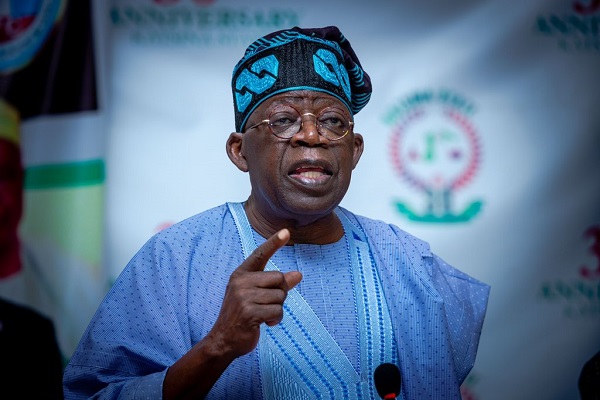
President Bola Ahmed Tinubu has ordered the immediate release of approved funds for the maintenance of Nigeria’s space assets in line with the National Space Policy and Programme.
The directive was given on Tuesday at the first meeting of the National Space Council held at the Presidential Villa, Abuja, where the President was represented by Vice-President Kashim Shettima.
The move is aimed at strengthening Nigeria’s space programme, ensuring accountability in implementation, and positioning the country to compete in the rapidly expanding global space economy.


What the President said
Tinubu also directed that the cost of implementing the revised 25-year roadmap for the national space policy be forwarded to the Federal Executive Council for consideration and approval.
- “I hereby direct that cost of the implementation of the revised 25-year roadmap for the implementation of the national space policy be forwarded to the Federal Executive Council for consideration and approval.
- ” Nigeria will not watch the new frontier unfold from the sideline.
- “We will participate, we will compete, we will contribute. Our space ambitions must be anchored in outcomes, accountability and national value.
- “We must build a programme that serves the farmer in the field, the teacher in the classroom, the entrepreneur in the market, the soldier on duty, the researcher in the laboratory.
- “This is how a nation turns altitude into advantage,” the President said.
He added that investment in space technology is driven by opportunities in outer space, describing it as a frontier for technological advancement and economic diversification.
- “Space technology remains the foundation for cyber security and a vibrant digital economy. The space economy is rapidly growing and it’s expected to exceed one trillion dollars by 2040,” he said.
According to him, investing in space would support precision agriculture, border security, early warning systems against floods and fires, safer skies, stronger communications, and a competitive digital economy.
More details
The President further directed the nation’s space agency to enforce space regulations and spectrum management under the NASDRA Act 2010, and ordered all Ministries, Departments and Agencies, as well as private sector stakeholders, to comply with the space regulatory framework.
- He also instructed the Federal Ministry of Finance to ensure the timely release of all approved funds for the programme.
- The Minister of Innovation, Science and Technology, Kingsley Udeh, disclosed that the council approved the “Conditions of Service and Staff Regulation” of the Nigerian Space Research and Development Agency to align with international best practices
It also set up a working group, including the Nigerian Communications Commission, the National Defence Space Administration and Nigerian Communications Satellite Limited, to refine the revised 25-year space roadmap.
- The council further approved the development of the Bola Ahmed Tinubu Space Centre in Epe to strengthen local satellite launch capacity and reduce reliance on foreign expertise.
On satellite expansion, NASRDA Director-General Matthew Adepoju disclosed that President Bola Tinubu has approved the procurement of four new satellites, including three optical platforms and one Synthetic Aperture Radar satellite capable of day-and-night imaging, aimed at boosting security, maritime surveillance, agriculture and the blue economy.
What you should know
Nairametrics reported that the Federal Government projects the space sector could generate over $200 billion annually through the regulation and licensing of space activities.
The former Minister of Innovation, Science and Technology, Chief Uche Nnaji, said the planned reforms in the sector would unlock value across satellite communications, spectrum management, data services and other commercial space operations with projected annual growth of between 18% and 20%.
The government also plans to deploy space technology to boost revenue in the oil and gas sector, with projections of more than $20 billion yearly from improved maritime monitoring and enforcement.