
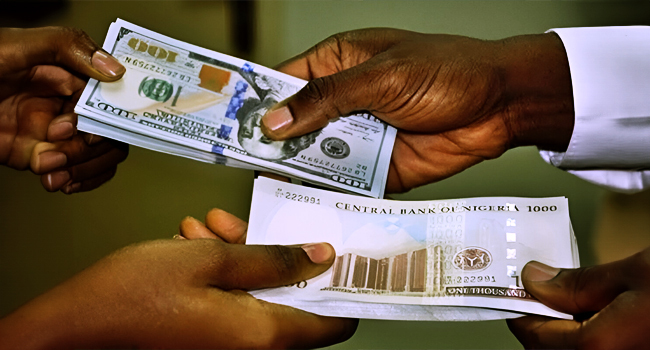
The naira ended February 2026 at N1,368.5/$ in the official market, up from N1,384.5/$ at the start of the month, reflecting a modest month-on-month appreciation.
Data from Central Bank of Nigeria (CBN) shows that despite late-month volatility, the currency maintained a firmer position relative to January.
In the final week of February, however, the naira faced renewed pressure.


It opened the week on Monday at N1,353.5/$ and depreciated steadily across subsequent trading sessions, eventually closing at N1,368.5/$ by Friday — marking a consistent weakening throughout the week.
What the data is saying
The naira’s performance shows signs of gradual improvement compared to the previous month. Key indicators underline this trend:
- The naira opened January 2026 at N1,431/$ and closed at N1,391/$.
- February’s opening rate was N1,384.5/$, with a closing rate of N1,368.5/$.
- Gross external reserves rose to approximately $50 billion at the end of February, up from $46.59 billion at the start of the month.
The Governor of the Central Bank of Nigeria, Olayemi Cardoso, confirmed reserves had reached $50.45 billion as of February 16, 2026.
- The $50.45 billion reserve level is the highest recorded in 13 years.
The data indicates that despite short-term volatility, the naira strengthened overall month-on-month, supported by robust reserves.
More Insights
Monetary policy decisions also shaped market sentiment in February:
- The Central Bank’s 304th Monetary Policy Committee (MPC) cut the Monetary Policy Rate (MPR) by 50 basis points to 26.5 per cent from 27 per cent.
- The Cash Reserve Ratio was maintained at 45.0 per cent for commercial banks and 16.0 per cent for merchant banks.
- The Liquidity Ratio remained at 30.0 per cent, while the Standing Facilities Corridor stayed at +50/-450 basis points around the MPR.
Nairametrics reports that Nigeria’s exchange reserves have climbed to $48.5 billion, their highest level since mid-May 2013.
- Within the first 22 days of January alone, reserve levels rose by about $509 million, highlighting sustained inflows and strengthening foreign exchange liquidity conditions.
- Reserves crossed the $46 billion mark in January for the first time in about eight years and moved above $47 billion by February 11, also the first time in roughly eight years.
The rebuilding phase can be traced to late December 2025, when reserves increased from approximately $44.8 billion to $45 billion, then considered a six-year high.
These monetary adjustments, combined with stronger foreign reserves, provide a cushion against prolonged exchange rate pressures.
What you should know
During the month, headline inflation declined for the eleventh consecutive month to 15.1 per cent in January 2026.
The year-on-year improvement is even more pronounced. Compared to January 2025, when inflation stood at 27.61 percent, the rate has fallen by 12.51 percentage points, reflecting a significant moderation in overall price growth across the country.