
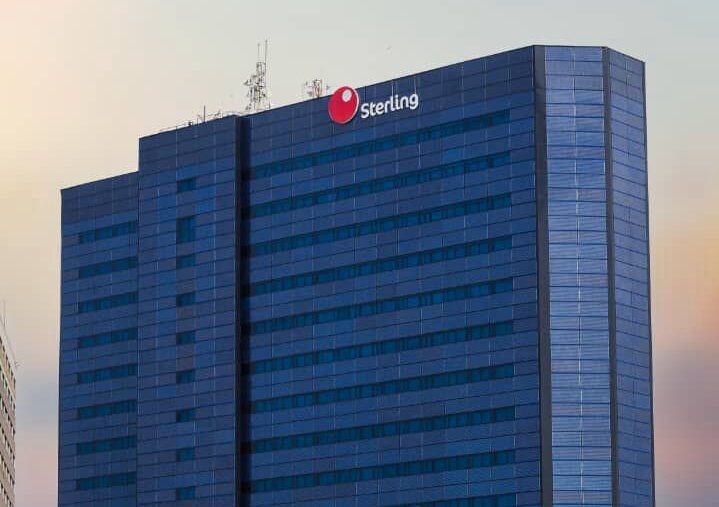
Sterling Financial Holdings Company Plc has released its 2025 unaudited financial statements, reporting a strong performance. The share price has also been bullish.
The stock returned about 26% to investors last year, and as of the close of trading last week, the share price stood at N7.60, reflecting a 7.8% Year-to-Date (YTD) gain.
Notwithstanding, the share price is still 15% short of its 52-week high, indicating that there’s still room for growth.


Whether it will reach and surpass that high largely depends on investor sentiment, market fundamentals, and if the stock is seen as undervalued.
Firstly, the fundamentals, as reflected in Sterling’s 2025 unaudited results, are nothing short of impressive.
- Profit After Tax (PAT) surged to N78.6 billion, marking an 80% year-on-year (YoY) increase, the highest in five years.
- The pre-tax profit came in at about N91 billion, nearly doubling from the previous year with a 98% YoY growth.
- This remarkable performance was largely driven by strong interest income, particularly from loans and advances, as well as impressive revenue from trading activities.
- These contributed to a gross earnings total of N476.5 billion, with interest income from loans making up more than 50% of that, reaching N242 billion.
Earnings per share (EPS) climbed to N1.57, the highest in five years, depicting a 4% growth.
The undervaluation story
Sterling Bank’s stock appears to be undervalued. Its market capitalization of N396 billion still lags its net asset value (N424 billion), and the P/B ratio of 0.93 further suggests that the stock is trading below book value.
- For every N1 Sterling earned, investors are paying just N5, which signals that the stock is still priced cheaply relative to the earnings it generates.
- The PEG ratio of 0.14 (which compares the stock price to its earnings growth) further reinforces the view that Sterling’s growth potential is not being adequately recognized by the market.
A PEG ratio below 1 typically signals that a stock is undervalued relative to its future growth prospects.
Sustaining the trend and possible outliers
For Sterling Bank to sustain its performance, the key will be continuing the momentum in interest income, particularly from its loan portfolio.
- The Non-Performing Loan (NPL) ratio, which decreased from 5.4% in 2024 to 4.7% in 2025, points to improved loan quality and stronger risk management.
- If the bank can maintain this trajectory, the profit growth could continue.
However, there are potential outliers that could affect the bank’s growth.
- While interest income still represents about 78% of gross earnings, the 15.1% decrease in the spread between interest income from loans and advances and interest expense on customer deposits in 2025 signals that Sterling Bank is facing higher funding costs.
The outlook for the spread will largely depend on Sterling’s ability to control deposit costs while continuing to grow its loan portfolio.
If interest rates on deposits continue to climb or if loan growth slows, the bank could face pressure on its profitability.
If these factors are not carefully managed, they could squeeze the bank’s margins and impact overall performance.
Bottom line
Sterling Bank’s 2025 results demonstrate a strong and resilient performance, with solid profit growth and an undervalued stock.
The stock performance reflects positive market sentiment, but the undervaluation signals that the market has not fully priced in the bank’s earnings potential.
Investors looking for an opportunity in a strong, yet undervalued stock should consider Sterling Bank, particularly as the market catches up to its true value.