
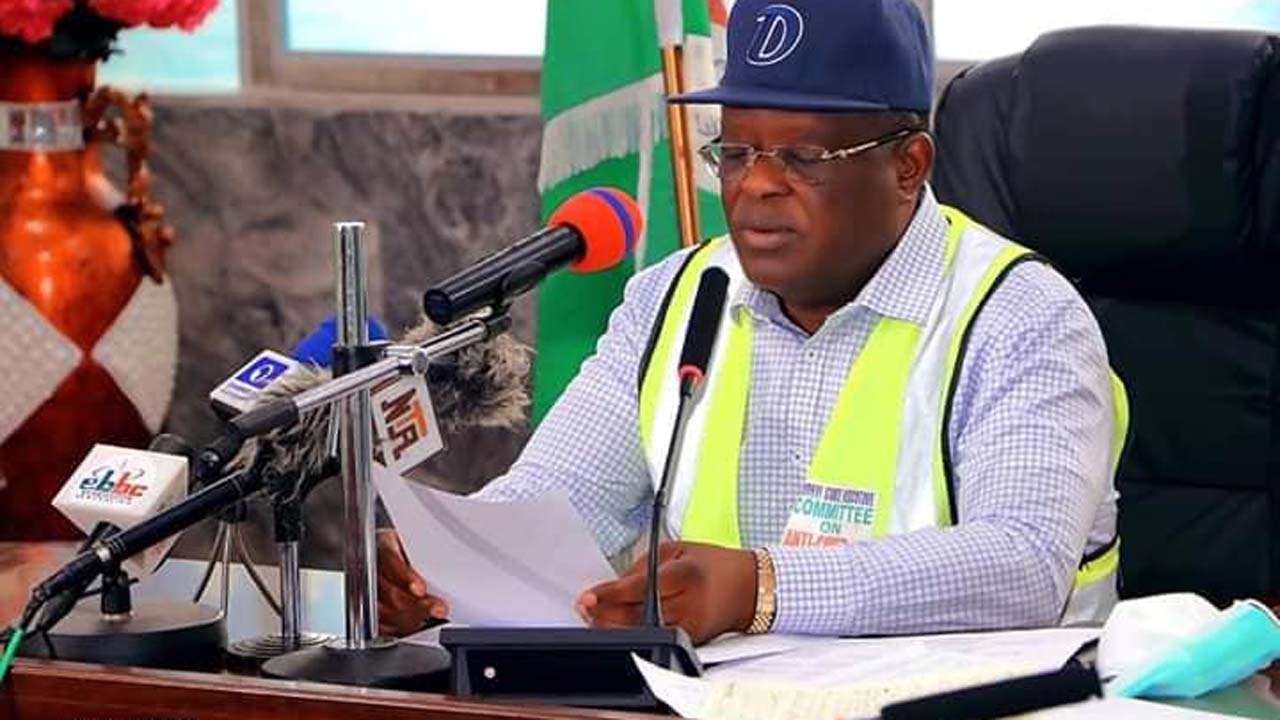
The Federal Government has warned it may recover mobilisation funds from the contractor handling the 7th Axial Road project in Lagos due to slow site mobilisation and delays in construction.
The Minister of Works, David Umahi, disclosed this in a statement published on the ministry’s website on Friday.
The warning follows concerns that, despite substantial funds already released, key construction machinery has not been deployed and only minimal site clearance has been carried out.


The 7th Axial Road is expected to serve as a critical evacuation corridor linking the Lekki Deep Seaport to major transportation routes in southern and northern Nigeria.
What they are saying
The Minister expressed deep concern over the slow pace of work, highlighting that mobilisation on site remains inadequate despite repeated engagements with the contractor, China Harbour Engineering Company (CHEC), both in Lagos and Abuja.
Significant mobilisation funds had already been paid, yet the expected deployment of machinery and construction activity had not commenced.
- “Whilst expressing deep concern over the slow pace of work on the 7th Axial Road project in Lagos, he noted that site mobilisation remains insufficient despite repeated engagements with the contractor at the site and in Abuja,” the statement read in part.
- Umahi said, “If full mobilisation is not achieved within the agreed timeframe, we will recover the funds and take firm contractual action.”
Umahi’s warning signals the government’s intent to enforce contractual discipline and ensure the timely execution of the project.
Other projects under review
The Minister also issued directives on other roads handled by CHEC and its sister company, China Harbour Operation and Maintenance Company (CHOMC).
He ordered immediate dust-control measures on the Makurdi–9th Mile–Enugu road corridor following public complaints and warned that failure to comply within seven days could lead to project suspension.
- On the Mararraba–Keffi–Akwanga–Lafia–Makurdi dual carriageway, CHEC was directed to rehabilitate failed sections, repair damaged bridge expansion joints and drainage systems, and reinstate road furnishings after maintenance works.
- Contractors were instructed to strengthen highway safety management by monitoring corridors and promptly removing stationary vehicles to reduce accidents.
- Umahi emphasised that warning letters, withholding of certificates, and other contractual sanctions would be enforced to protect public funds.
The government has made it clear that poor execution, project delays, or disregard for agreed standards will no longer be tolerated.
More insights
The Federal Executive Council (FEC) approved $651.7 million in May 2025 for the 7th Axial Road project, which will feature 50 kilometres of dual carriageway and five kilometres of bridges. The corridor will facilitate the movement of goods from the Lekki Deep Seaport, including products from the Dangote Refinery and Fertiliser Plant, connecting Epe to the Sagamu–Ore Expressway.
- The project was initially approved under former President Buhari and seeks funding from the China Exim Bank.
- It was one of two strategic road proposals presented by President Bola Tinubu to Chinese President Xi Jinping during his state visit, alongside the Akwanga–Jos–Bauchi–Gombe Road.
The 7th Axial Road is expected to provide a vital logistics link to 17 southern states and northern Nigeria, enhancing trade and transport efficiency.
What you should know
The Akwanga–Jos–Bauchi–Gombe Road, which the Minister directed for rehabilitation, is one of four legacy road projects of the current administration, alongside the Lagos-Calabar Coastal Highway, Abuja-Kano Road, and the Trans-Sahara Highway.
- In June 2025, the Federal Government asked state governors to allocate a 500-metre-wide corridor of land along these legacy roads.
- The corridor is intended to support tolling infrastructure and commercial services under a public-private partnership (PPP) model.
This initiative aims to enhance the viability and sustainability of the projects while generating returns on investment, Umahi noted.