
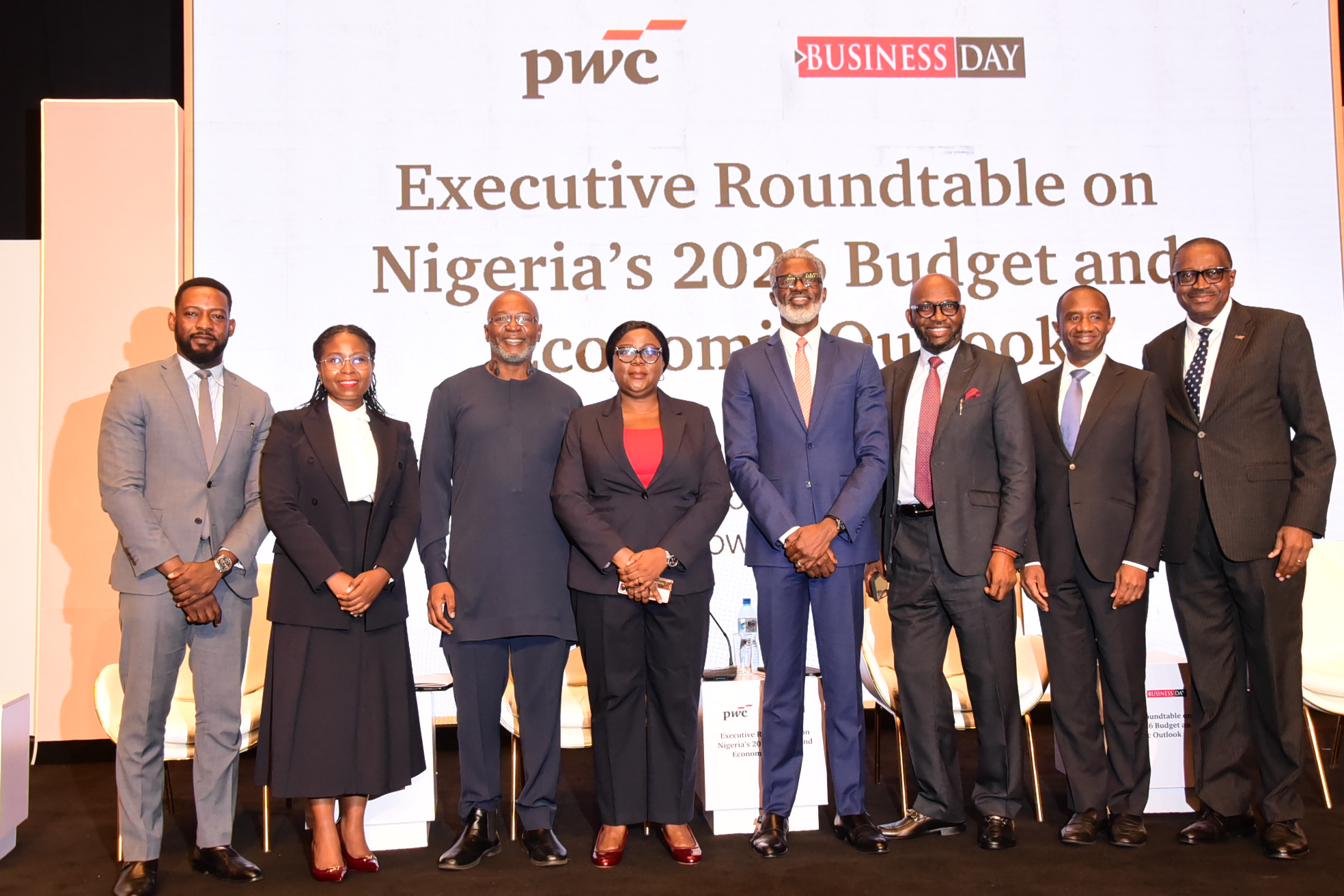
- At PwC Nigeria’s Executive Roundtable—held in partnership with BusinessDay—CEOs and policymakers agreed thatmacroeconomic stability has improved, with inflation moderating, FX reforms restoring predictability, and business confidence rebounding. However, leadersemphasised that stability is only a foundation, and that growth in 2026 will depend on execution, productivity, and strategic reinvention.
- PwC’s CEO Survey revealed asurge in CEO optimism, with 90% of Nigerian CEOs expecting economic improvement in 2026 and 56% confident about revenue growth. Yet the threat landscape is shifting: cybersecurity, skills shortages, and technological disruption are now top concerns, prompting CEOs to prioritise reinvention, AI-driven transformation, and stronger governance.
- Insights from the 2026 Nigeria Budget and West Africa Economic Outlook underscore thatprivate capital, policy discipline, and sector-specific strategies will drive growth. Opportunities will emerge in infrastructure, agribusiness, power, digital economy, minerals, and creative industries, as Nigeria pivots from spending-led stimulus to reform-led, investment-enabled development, where execution becomes the decisive differentiator for success in 2026.
Nigeria’s improving macroeconomic stability has created a critical moment for business decision-making.
The central issue for leaders is how this stability can be translated into higher productivity, stronger investment outcomes, and sustainable growth in 2026.
That question shaped discussions at the second edition of PwC Nigeria’s Executive Roundtable on Nigeria’s 2026 Budget and Economic Outlook, where CEOs, investors, and policymakers examined what the current macro environment means for strategy in the year ahead.

Convened by PwC Nigeria in collaboration with BusinessDay, the forum brought together senior leaders under the theme “Nigeria’s Economic Outlook 2026: The Executive Playbook for Growth, Resilience, and Efficiency.”
At the roundtable, PwC released and discussed three publications: Nigeria’s findings from PwC’s 29th Annual Global CEO Survey, the 2026 West Africa Economic Outlook, and the 2026 Nigeria Budget and Fiscal Strategy Insights. Together, these insights informed a practical discussion on how businesses and policymakers can respond to a more stable macroeconomic environment.
From stability to sustainable growth
Opening the session, Sam Abu, Regional Senior Partner for PwC’s West Market Area, acknowledged the progress recorded over the past year. Monetary tightening and foreign-exchange reforms have reduced volatility, inflation has moderated, and policy signals are clearer than in recent years.
These shifts have helped restore macroeconomic stability and improve predictability for businesses.
Abu stressed, however, that stability is only a foundation.
“Stability is not the end goal,” he said. “CEOs are looking at the world through two lenses: a microscope for near-term threats such as geopolitical tensions and cyber exposure, and a telescope for long-term opportunities in strategic reinvention, technology, data, and AI.”
This perspective framed the day’s discussions. Nigeria’s macro footing may be firmer, but outcomes in 2026 will depend on leadership choices, execution capability, and the ability to turn confidence into measurable performance.
CEO confidence rises as the threat landscape shifts
A key focus of the roundtable was PwC’s 29th Annual Global CEO Survey (Nigerian perspective), which captures executive sentiment following a period of economic adjustment.
The survey points to a strong rebound in confidence. Nine in ten Nigerian CEOs (90%) expect the economy to improve over the next 12 months, up from 64% in 2025. At the firm level, 56% are very or extremely confident in their organisation’s revenue growth, compared with 30% globally.
This confidence is emerging alongside a changing threat landscape. Macroeconomic pressures have eased, with the share of CEOs citing inflation as a high concern falling to 34%, and macroeconomic volatility to 25%.
At the same time, firm-level threats are becoming more prominent. Cyber risk and the availability of key skills are now the most cited concerns, each highlighted by 38% of CEOs. Technological disruption (25%), geopolitical conflict (25%), and tariffs (22%) also feature strongly.
In response, Nigerian CEOs are concentrating transformation efforts on four priorities: strategic reinvention; technology, data and AI; cybersecurity and trust; and sustainability and ESG integration. Technology stands out as a leadership concern, with half of CEOs identifying the pace of technological change, including AI, as their most pressing issue.
West Africa Economic Outlook 2026: different paths from stability to growth
The 2026 West Africa Economic Outlook provided a regional lens for the discussions, showing that recovery across the region is no longer uniform.
Across West Africa, inflation is moderating, currencies are stabilising, and policy signals are clearer than in recent years. However, Nigeria and Ghana are converting these improvements into growth through different policy pathways.
Nigeria’s recovery is being driven by market-led reforms in foreign exchange and monetary policy, reshaping pricing and investment signals. Ghana’s trajectory reflects IMF-backed fiscal consolidation and debt restructuring aimed at restoring macroeconomic credibility.
For Nigeria, projected GDP growth of 4.3% in 2026 reflects a services-led expansion, particularly in ICT, finance, and real estate. Improved monetary policy transmission and FX market transparency are creating a more predictable operating environment. At the same time, fiscal constraints, elevated debt-service costs, and weak household purchasing power continue to shape how growth is distributed across sectors.
For business leaders, the implication is clear: strategy in 2026 must be grounded in country-specific drivers, policy constraints, and where growth is most likely to be sustained.
Nigeria’s 2026 budget: navigating fiscal realities
PwC’s 2026 Nigeria Budget and Fiscal Strategy Insights highlighted how fiscal policy is evolving after recent reforms. Set at ₦58.18 trillion, the 2026 federal budget reflects a shift from spending-led stimulus toward reform-driven growth, following lessons from 2025 around revenue performance, capital execution, and rising debt-service costs.
The budget is built on conservative oil price assumptions, moderate production targets, and an ambitious growth outlook. While execution risks remain, the framework is anchored on macroeconomic stability and stronger coordination between fiscal and monetary policy.
The Medium-Term Expenditure Framework prioritises revenue mobilisation, expenditure efficiency, and debt sustainability, while creating greater space for private capital to support infrastructure delivery. Public-private partnerships, concessions, and blended finance models are expected to play a larger role than direct public spending.
Sectorally, the budget signals opportunities aligned with policy reform rather than government outlays alone. Infrastructure, power, agriculture, the digital economy, solid minerals, and creative industries are positioned for increased private-sector participation.
Complementing this approach are tax reforms aimed at simplifying administration, reducing distortions, and improving compliance. Measures such as expanded input VAT claims, consolidated levies, and revised income and capital gains tax thresholds are expected to lower the cost of doing business while reshaping revenue dynamics.
Overall, the 2026 budget points to an economy where execution discipline, reform credibility, and private investment will define growth outcomes.
Business leadership and sector shifts
The fiscal discussion naturally extended to infrastructure and the role of business leadership. BusinessDay Publisher Frank Aigbogun noted that Nigeria can fund only a fraction of its infrastructure needs through public resources. Strengthening tax compliance and constructive civic engagement, he observed, is essential to supporting sustainable public investment.
From an industry perspective, Tony Attah, Managing Director and CEO of Renaissance Africa Energy Company, highlighted structural changes underway in Nigeria’s oil and gas sector. The transfer of assets from international oil companies to Nigerian operators reflects a shift in ownership and points to a growing role for indigenous firms in driving investment and value creation.
Across sectors, panellists agreed that no single industry will deliver growth in isolation. Productivity gains, technology adoption, and cross-sector collaboration will be central to competitiveness in 2026.
From insight to execution
A consistent theme throughout the roundtable was the importance of execution. Macroeconomic stability has been restored and business confidence has strengthened. The task now is translating these conditions into productivity gains, sustainable growth, and long-term value creation.
As Nigeria enters 2026, the economic conversation is increasingly focused on strategic choice: where to invest, how to allocate capital, and how to build resilience in a more predictable but still demanding environment.
For Nigeria’s executives, the playbook is clearer. The challenge now is execution.