
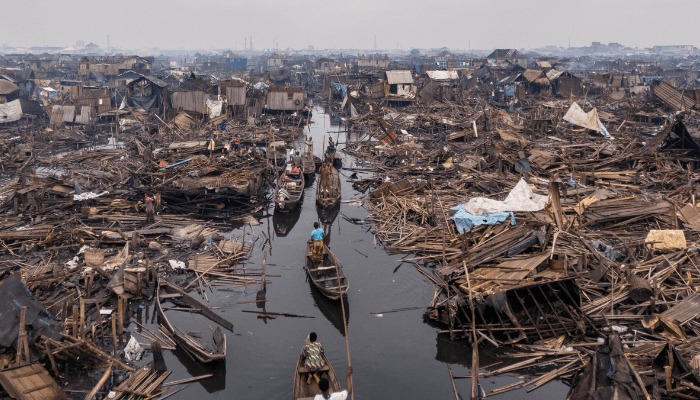
The Lagos State Government has committed $2 million to the Water Cities Project, positioning it as the blueprint for the regeneration and renewal of the Makoko waterfront settlement.
The commitment was disclosed on Monday by the Commissioner for Information and Strategy, Gbenga Omotoso, alongside the Special Adviser to the Governor on E-GIS and Urban Development, Babatunde Olajide, according to a report by the News Agency of Nigeria (NAN).
The announcement comes against the backdrop of the recent demolition of parts of the Makoko settlement and similar actions in other communities, which the state government has defended as part of a broader urban regeneration and safety-driven renewal programme.

What the Lagos State Government is saying
The Lagos State Government said its intervention in Makoko is centred on the Water Cities Project, for which it has committed $2 million, describing it as the most environmentally sustainable option for regenerating the waterfront settlement.
Olajide said Makoko is a sensitive and globally recognised community comprising both land-based and waterfront sections, noting that its international visibility informed the government’s approach.
He explained that the state dropped plans for shoreline extension in the area after experts advised that such an option was not environmentally friendly.
“On Makoko’s future, he disclosed that the state had committed two million dollars to the Water Cities Project, describing it as the most environmentally-friendly option,” the NAN report read in part.
It further quoted Olajide as saying, “We dropped shoreline extension because experts advised it was not environmentally friendly.
“Water Cities is the sustainable option, and that is what we are pursuing with the Makoko community.”
According to him, the Water Cities Project was adopted as a safer alternative that aligns with environmental standards and international best practices, adding that the initiative is being pursued in consultation with the Makoko community.
He further noted that areas located under high-tension power lines were cleared strictly on safety grounds, insisting that such actions were taken to protect lives rather than punish residents.
Other urban renewal projects across Lagos
Beyond Makoko, the Lagos State Government highlighted regeneration projects across the state, as part of a consistent urban renewal policy since 2019.
- Olajide cited the relocation of Okobaba sawmill operators to Timberville as a major success. About 300 housing units were provided free, along with industrial equipment worth billions of naira. The move ended frequent fire outbreaks and created a safer, organised industrial hub, now hosting the permanent NYSC orientation camp.
- On markets, 21 across the state are being redeveloped, including Pelewura, Jankara and Bombata. At Alaba-Arago, thousands of modern stalls are being built for original occupants, with allocations designed to ensure fairness, he noted.
The government has committed about N1 billion to housing regeneration in Adeniji-Adele and continues paying rent for displaced residents. In Dosunmu, over N1 billion was paid in compensation while partnering with property owners, Olajide explained.
More insights
According to the advocacy group Corporate Accountability and Public Participation Africa (CAPPA), recent demolitions in Makoko and Oworonshoki displaced over 10,000 residents and affected more than 3,000 dwellings.
- CAPPA said the initial demolitions targeted structures within 50 meters of power lines but were later extended to 100 meters, exceeding legal limits.
- The group added that this expansion disproportionately affected low-income residents who rely on the waterfront for fishing and small-scale trade.
A human rights group, Take It Back Movement, claimed compensation for verified homeowners ranged from N300,000 to N5 million, with some residents rejecting it as inadequate.
What you should know
The Lagos State Government first announced in September 2025 plans to remove shanties under high-tension power lines in Makoko, citing urgent safety concerns.
Makoko comprises both land-based and waterfront sections, with many residents depending on fishing and small-scale trade for their livelihoods.
Governor Babajide Sanwo-Olu recently alleged that some local and international NGOs profited from the Makoko demolition exercise by requesting foreign grants and aid for the area.
- The government said the demolitions aimed to prevent disasters, protect lives, and improve safety, while verified homeowners were provided palliatives and relocation stipends.
- The Makoko demolitions followed similar exercises in Oworonshoki near the Third Mainland Bridge, where unsafe structures that blocked drainage, posed fire hazards, and were linked to traffic crimes were cleared.
The Lagos State Building Control Agency (LASBCA) confirmed the Oworonshoki demolitions followed due process, with notices served, an amnesty period provided, and unsafe buildings removed.