
 Follow Us on Google Discover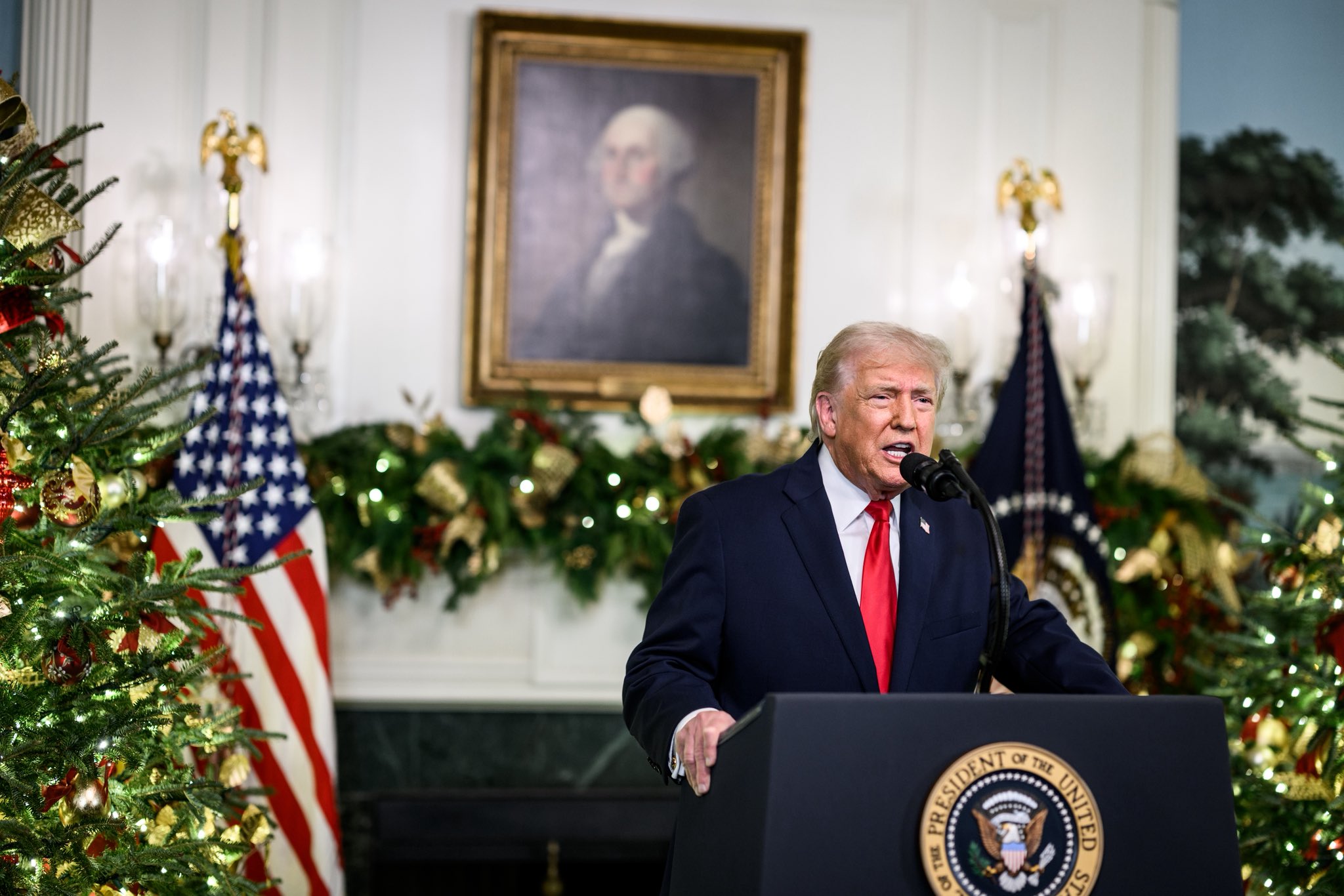
“Power tends to corrupt, and absolute power corrupts absolutely.” — John Dalberg-Acton, The Acton-Creighton Correspondence,1887.
If global geopolitics were a chessboard with intricately placed pieces and set-piece situations, then Donald Trump’s Venezuela campaign would easily be remembered as a high-risk curtain–raiser gambit that, against expectations, won him a few early opposing pieces but some, albeit small, if not tender back pats.
Sanctions, maritime interdictions, and the swift removal of Nicolás Maduro resembled a forceful early double knight attack — disruptive, aggressive, and designed to unsettle the opponent through the enforcement of an aggressively styled tempo.
But in chess, like most other games however, an aggressive, yet successful opening often breeds overconfidence.
And it is precisely this hubris that now appears to be propelling President Doland Trump toward a far more destabilizing and distracting target: Greenland.
What began as defense against narco-terrorism and a clever economic and energy side–maneuver in Latin America is now threatening to morph into a strategic overreach into the Arctic — one with potentially deeper consequences for global markets, alliances, and fragile geopolitical and economic equilibrium.
From Caracas to the Arctic Circle
Trump’s fixation on Greenland has been publicly framed as a matter of national security. The United States, he has argued repeatedly, requires control of Greenland’s airspace to reinforce its Golden Dome missile-defense architecture and better monitor Russian and Chinese activity across the ‘ice corridor’.
To this end, Trump has refused to rule out military coercion, financial inducements, or even the extraordinary offer of American citizenship to Greenlanders.
Yet as with many such gambits in modern geopolitics, the stated rationale now appears, and increasingly so, as a red herring. Greenland sits atop some of the world’s most significantly untapped deposits of rare earth minerals — inputs that would now seem essential to America’s semiconductors, advanced weapons systems, electric vehicles, and next-gen renewable energy infrastructure drive.
In a world already grappling with supply-chain fragility and geopolitical fragmentation, control of these resources would certainly grant Washington enormous leverage over the future trajectory of global manufacturing and technology, and its surreptitious gambit to one–up China in not only the race for geoeconomic supremacy, but AI dominance.
In chess terms, therefore, national security, and the covetous acquisition of Greenland, even given its age-old ties to America, is the distraction, whilst ‘resource-grab’ is the overarching intention.
When allies are made opposing pieces
Unlike Venezuela, Greenland is not an isolated pawn awaiting capture. It is an autonomous territory of Denmark — a NATO ally and, for all analogical intents and purposes, a strategically placed and indispensable Rook in the American-led geopolitical and economic chessboard.
Thus, any attempt to annex or coerce it away would invariably amount to sacrificing alliances for speculative and immaterial positional gain.
The earliest signs to nullify a near century’s old treaty have now begun with Trump’s threatened tariff escalations – an additional 10% on imports from Denmark, Norway, Sweden, France, Germany, the Netherlands, Finland, and Britain, adding to the 15% already imposed in 2025, and potentially rising by an additional 25%.
All potentially culminating in a total 50% tariff by April 2026 should his Greenland ultimatum go unmet. This introduces a punitive economic layer to what is already a delicate modus vivendi in his tariff–led geo-economy.
Should these ‘economically unremunerative’ measures progress to materialization, they risk unraveling rising post-covid capital-market gains and aggravating global risk sentiment witnessed throughout much of 2024 and 2025, adversely affecting all across the geoeconomic board — Nigeria included.
Perhaps, it might be good then we remind Trump, and by extension, the Americans, that markets rarely respond well to uncertainty layered upon uncertainty, particularly when it emanates from within long-standing alliance structures meant to defend and stabilize global economic order.
In chess, this is how gambits rupture and chessboards fracture: not through a single blunder, but through repeated self-defeating moves that undermine the integrity of the game itself.
Market repercussions: Gold, treasuries, and a fracturing order
Even before any overt action on Greenland, markets are already beginning to price in this discomfort. Gold prices have resumed their upward march towards $5,000, reflecting growing investor unease over America’s increasingly covetous posture.
U.S. Treasuries – the risk-free benchmark around which global capital, currencies, and sovereign balance sheets are calibrated – have remained relatively muted through the Greenland spat. But as global spectators turn to the bond vigilantes – the market’s unofficial referees and critical moderators – It is becoming increasingly clear that Trump may yet discover that markets, unlike allies, do not bluff.
Perhaps more concerning however, is a quieter but potentially more destabilizing, but yet unmade, countermove: retaliation through capital markets. Should allied nations subjected to this Greenland–forced tariff coercion begin reducing their holdings of U.S. Treasuries, yields will rise sharply.
For an America already carrying a debt burden exceeding $38 trillion, with annual interest payments north of $1.3 trillion, this would be profoundly destabilizing not just them, but any aligned to the American economy and by extension, the dollar. Thus, a move intended to reinforce American dominance could, instead, accelerate the erosion of its financial privileges – the very foundation upon which its global influence has rested for decades.
A familiar pattern, a predictable outcome
History offers little comfort. America’s post-war record of “administering” other nations’ affairs rarely ends as advertised. From Japan’s prolonged economic stagnation, to Iraq’s fragmentation, Afghanistan’s collapse, Libya’s disintegration, Yugoslavia’s violent dissolution, Syria’s economic ruin, and now Venezuela’s grossly uncertain future, the pattern is worryingly familiar: intervention first, instability later.
Each episode chips away at institutional credibility, fuels further American resentment, and hastens calls for alternatives to the dollar’s long held hegemony. In aggregate, these are not isolated missteps; they are cumulative headwinds against America’s current position – tailwinds, ironically, for China and Russia’s patient, long-game approach.
Thus, Greenland, if mishandled, risks becoming another watershed moment for America — one that nudges the world further toward a multipolar, less predictive order.
Nigeria’s move
For Nigeria, the lesson here must neither be ideological nor emotional. It must be strategic.
Diplomatically, Nigeria should publicly advocate restraint, dialogue, and institutional legitimacy. But prudence demands more than mere rhetoric in a bid to calm rising seas threatening to engulf the world economy, and by extension, ours. The current environment underscores the illusion of the safety inherent in over-reliance on a single global power, currency, or commodity.
Three imperatives thus stand out for Nigeria:
1. Monetary and reserve diversification: Nigeria must accelerate efforts to reduce dollar dependence, broadening its reserve currency base, and — as a matter of national imperative — increase gold accumulation, following the quiet example set by multiple global central banks over the past decade.
2 Economic restructuring: Continued reliance on oil exports in an era of geopolitical whipsaws is untenable. Nigeria must fast-track industrial revitalization using a localized variant of the China-style Catfish model: disciplined government–championed–investor– led manufacturing policies, export-oriented production, and the strategic rejuvenation of our industrial base – not as ideology, but as a matter of existential survival – dollar held assets may not buoy our economy for very long.
3. Strategic pluralism and defense credibility: Sovereignty without deterrence is mere decoration. Nigeria must aggressively hasten its integration into AfCFTA, aggressively expand diversified global partnerships, and forcibly upgrade its defense capacity – not for belligerence, but to inoculate itself against coercion, American–styled or otherwise. Without credible deterrence, economic policy remains hostage to external security guarantees. This is not nationalism. It is realism…
Final positioning
In chess, the most dangerous opponents are not the ones who attack loudly, but the ones who mistake momentum for inevitability. Trump’s Greenland gambit may yet succeed tactically, but strategically it carries the seeds of isolation, mistrust, and systemic economic blowback.
Nigeria’s task is thankfully simpler, though no less urgent: avoid being swept into someone else’s messy endgame. By strengthening internal resilience, diversifying our economic exposure, and pursuing a clear-eyed, Nigeria-first geo-economic strategy, we might yet remain relevant, solvent, and sovereign – even as the global economic chessboard tilts toward disorder.
In an age of reckless positional gambits, the ideology of tactful restraint whilst shoring up your defenses might very well be our only winning move.


Please, talk also about the good of his administration.
Brilliant thoughts. Well done.