

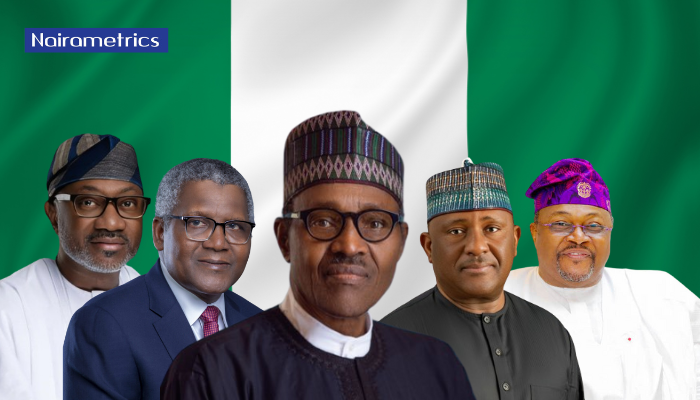
The passing of former Nigerian President Muhammadu Buhari sparked a wave of reflection across the nation.
As citizens weigh the impact of his eight-year administration (2015–2023), opinions vary widely on the economic legacy he left behind.
While many reports have chronicled the economic turbulence of two recessions, inflation spikes, and a volatile naira that defined much of the Buhari era, it is also important to examine how Nigeria’s wealthiest individuals navigated these stormy waters.


Despite widespread economic hardship, some billionaires not only stayed afloat but expanded their empires, while others faced setbacks due to shifting policies, regulatory crackdowns, and an uncertain investment climate.
In this piece, Nairametrics explores how Nigeria’s top billionaires (in dollar terms)performed during the Buhari administration. We examine their net worth trajectories, business growth (or decline), the industries they dominate, and how key government policies affected their standing in the country’s socio-economic landscape.

Net Worth Before Buhari: $1 billion
Net Worth After Buhari: $8.2 billion
In the shadows of Nigeria’s better-known industrial giants, Abdulsamad Rabiu, the Kano-born founder and chairman of BUA Group, spent the Buhari years methodically expanding his empire across cement, sugar, energy, and food processing.
The cement industry, which became a cornerstone of Rabiu’s fortune, saw major growth under Buhari’s administration, largely driven by the government’s heavy infrastructure push and border closure policies between 2019 and 2020.
BUA Cement, the group’s flagship unit, expanded production capacity aggressively, opening new plants in Edo and Sokoto states. By 2021, BUA Cement had become Nigeria’s second-largest cement producer, with a valuation of over N2.5 trillion on the Nigerian Exchange. The company’s stock became one of the strongest performers on the local bourse, helping to significantly boost Rabiu’s net worth.
The Buhari government’s Buy-Nigerian agenda and emphasis on infrastructure, including roads, bridges, and housing, created favourable market conditions. And while Dangote Cement remained dominant, BUA’s low-pricing strategy, regional footprint, and capacity expansions allowed it to thrive without direct confrontation.
Rabiu also scaled operations in BUA Foods, which combined the group’s sugar, flour, pasta, and rice units. The company debuted on the stock exchange in early 2022 and was well-received by investors seeking exposure to Nigeria’s food sector during a time of soaring inflation and heightened food insecurity.
In energy, BUA signed deals to build gas-powered plants and invested in refinery projects and renewable energy initiatives, including a solar-powered industrial cluster in Akwa Ibom. These expansions aligned with the Buhari government’s efforts to promote alternative energy and reduce reliance on imported fuels.
Net Worth: The Fastest Rise Among Nigeria’s Billionaires
Abdulsamad Rabiu’s wealth grew faster than any other Nigerian billionaire during the Buhari years. According to Forbes:
- 2015: Estimated at $1 billion
- 2020: Climbed to $3 billion, following the expansion of BUA Cement
- 2021: Reached $4.9 billion after BUA Cement’s IPO
- 2022: Soared to $7.0 billion, buoyed by BUA Foods’ listing and increased market share
- 2023: Peaked at $8.2 billion, making Rabiu the third-richest person in Africa and solidifying his place in the global billionaire class.
Final analysis: Net gainer










Using exchange rates N200/ dollar in 2015 and N 465/ dollar in 2023, the billionaires lost in dollar terms, but gained in Naira terms.
But the stock market gained both in Naira terms.
This means “poorer” billionaires and richer rest of the investors.
This implies better wealth spread, and probably an expansion of the wealth class and maybe the middle class.
This probably explains why aviation flights and vehicle registrations hit an all time high by 2022.
More people could afford this
Note: Buhari is dead. Let’s reduce the biases now and try and keep the analysis honest and facts based. No more political, ethnic or religious scores to gain.
Did you notice that the business that has made Dangote double his wealth in 2024 was built between 2017 and 2023? Under Buhari? With immense FG support in cash, policies etc?
That’s a true wealth building legacy