
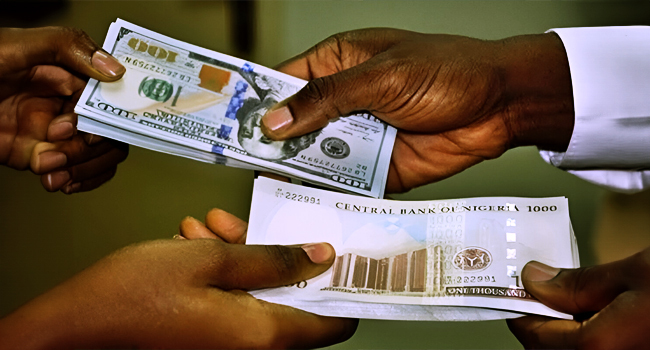
The naira weakened marginally at the official foreign exchange market on Friday, closing at N1,372/$ as investors adopted cautious positions ahead of next week’s Monetary Policy Committee (MPC) meeting of the Central Bank of Nigeria (CBN).
This is according to data published on CBN website on Friday.
Compared to last week’s closing at N1,364/$, the Naira depreciated by N8 this week.


Despite the slight depreciation, the naira continued to trade within a narrow range, suggesting that foreign exchange market volatility has moderated compared to earlier periods of sharp fluctuations.
What the data is saying
A comparison of this week’s trading pattern with the previous week shows that the naira weakened modestly on a week-on-week basis amid sustained demand pressure in the FX market.
The Naira traded at N1,371/$ on Thursday, N1,368.95/$ on Wednesday, N1,373/$ on Tuesday, and N1,375/$ on Monday, indicating a relatively stable but mildly pressured trading week.
- Before closing at N1,364/$ last week Friday, the currency traded at N1,358.01/$ on Thursday, N1,361/$ on Wednesday, N1,362/$ on Tuesday, and N1,367/$ on Monday.
- Nigeria’s external reserves rose slightly to $48.54 billion on May 14, 2026, from $48.45 billion recorded on May 11, 2026.
- The increase represents a reserve accretion of approximately $93.9 million during the period, providing limited support for the local currency.
The CBN has yet to provide an official explanation for the reasons behind the modest reserve increase.
Get up to speed
Market sentiment is now largely focused on the upcoming 305th MPC meeting of the Central Bank of Nigeria scheduled for next week, with investors closely watching for signals on interest rates and broader monetary policy direction.
Historically, the naira has shown mixed performance ahead of MPC meetings depending on investor expectations and anticipated policy outcomes.
- Ahead of the 304th MPC meeting in February 2025, the naira weakened slightly to N1,353.5/$ as investors adopted cautious positions.
- In contrast, the currency recorded modest gains before the 303rd MPC meeting in November as confidence improved around policy expectations.
- At its last meeting, the CBN reduced the Monetary Policy Rate by 50 basis points to 26.5% from 27%, marking the first easing move after an extended tightening cycle.
The adjustment signaled a more cautious policy stance as the apex bank balanced inflation concerns with slowing economic activity and pressure from businesses seeking lower borrowing costs.
What you should know
Nigeria’s headline inflation rate rose to 15.69% in April 2026, up from 15.38% recorded in March.
Earlier this week, Nairametrics reported that Nigeria’s external reserves declined by approximately $855 million within five weeks, falling from $49.18 billion on April 1, 2026, to $48.33 billion as of May 7, 2026.
Prior to the reforms introduced under President Tinubu, Nigeria operated a tightly managed foreign exchange regime in which the central bank played a dominant role in supplying foreign currency and maintaining multiple exchange rate windows.