

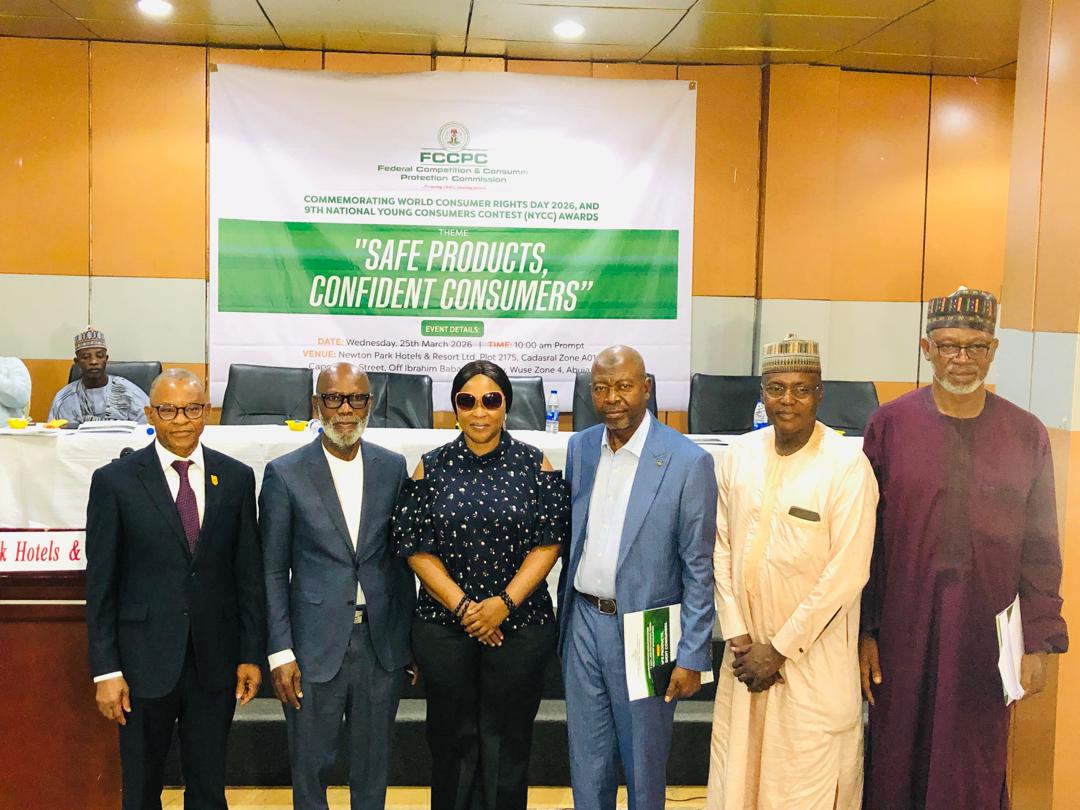
The Federal Competition and Consumer Protection Commission (FCCPC) has warned businesses in Nigeria to recall substandard products or face consequences in line with relevant laws.
The Executive Vice Chairman/CEO of the FCCPC, Tunji Bello, made this clear during the Commission’s commemoration of World Consumer Rights Day 2026 and the 9th National Consumers Contest Awards held in Abuja, themed “Safe Products, Confident Consumers,” and attended by Nairametrics.
The development comes nearly a year after officials of the FCCPC raided the Utako Market in Abuja, sealing several shops over the alleged buying and selling of local rice re-bagged as foreign brands by market cartels.


What the Commission is saying
In his opening remarks, the CEO, represented by Mrs. Boladale Adeyinka, Director of the Surveillance and Investigation Department at the FCCPC, said that across several sectors, the Commission continues to encounter products that do not meet basic safety and quality standards.
According to the official, these include improperly labelled goods, products that fall short of essential safety requirements, and, in some cases, conduct that raises concerns about misrepresentation.
- “Some of these failures arise from weak internal controls. Others reflect gaps in compliance culture. In certain instances, there are indications of deliberate disregard for legal and regulatory obligations.
- “Consumers are exposed to avoidable risks, trust in the market is weakened, and law-abiding businesses are placed at a disadvantage,” he said.
Citing the Federal Competition and Consumer Protection Act, 2018, the official noted that the legal framework entitles consumers to goods that are safe, durable, and fit for purpose, while businesses are under a duty to ensure that the products they place on the market consistently meet these standards.
- “Where a product presents a risk, the law requires prompt corrective action, including withdrawal, recall, and proper notice to consumers.
- “These are not optional expectations. They are statutory duties. Non-compliance attracts regulatory consequences,” the official warned.
The Commission, however, stressed that it does not control prices, but added that fair pricing is an essential part of a well-functioning market.
He also acknowledged the roles of the Competition and Consumer Protection Tribunal, the Standards Organisation of Nigeria, the National Agency for Food and Drug Administration and Control, and the Manufacturers Association of Nigeria in ensuring that products meet acceptable standards before and after they enter the market.
Backstory
In 2025, FCCPC officials, in collaboration with security agencies, targeted shop owners selling rice brands such as Royal Stallion and Mama Gold in Utako Market, asserting that intelligence indicated these companies had ceased importing their rice brands into Nigeria as early as 2015.
Explaining the development in a press interview, Mrs. Boladale Adeyinka had said intelligence pointed to a trend of re-bagging local rice as foreign brands.
According to her, information from foreign brand owners also confirmed that these rice brands are no longer available in the Nigerian market.
What you should know
Under Section 125 of the FCCPA, businesses are prohibited from making false or deceptive representations about product attributes to consumers.
Section 138 reinforces this by holding manufacturers, importers, distributors, and suppliers accountable for breaches of implied obligations, including product claims.
Litigation remains one of the mechanisms through which the Commission enforces compliance against defaulters.









