 Follow Us on Google Discover
A capital raise can be well-priced, well-advised, and strongly marketed, yet still lose momentum if the execution layer is not ready.
In an IPO or rights issue, investor confidence is shaped not only by the strength of the offer but also by the accuracy of shareholder records, the clarity of communication, the ease of participation, the discipline of reconciliation, and the transparency of allotment and post-issue processes.
That is why registrar readiness should not be treated as an administrative step at the end of transaction planning. It should be viewed as a core execution discipline.
Across Nigeria’s capital market, issuers are using public offers, rights issues, and other equity-raising structures to support recapitalisation, expansion, balance-sheet strengthening, and strategic growth.
Also Read
As activity increases, execution standards become more important. Regulatory documentation must be complete, transaction timetables must be realistic, and investor-facing processes must be clear enough to withstand high-volume participation and scrutiny.
SEC Nigeria’s securities registration process also reinforces the importance of complete, accurate filings. For the registration of the distribution of securities, including IPOs and rights issues, the SEC checklist identifies the required documents, such as shareholder and board approvals, a draft prospectus or rights circular, SEC forms, CAC documents, consent letters, mandate letters, specimen e-allotment advice, and other transaction materials.
It also notes that where deficiencies are communicated, timelines are reset. For issuers, this means readiness is not cosmetic. It can affect timetable discipline, regulatory responsiveness, and transaction confidence.
The hidden execution layer in capital raising
An IPO or rights issue is often described in terms of valuation, pricing, investor appetite, and market timing. These are critical. But behind the visible transaction sits a less visible execution layer that determines whether investors can participate smoothly and whether the issuer can complete the process with confidence.
This layer includes the shareholder register, entitlement calculations, investor communication, application capture, payment and subscription reconciliation, allotment support, refund or crediting workflows, query management, and post-transaction reporting. When these elements are aligned, the transaction feels orderly. When they are not, avoidable issues can appear quickly.
In a rights issue, the starting point is the shareholder register. Entitlements must be calculated from accurate holdings as at the applicable record date. If records are incomplete, duplicated, outdated, or inconsistent, the issuer may face disputes, missed participation, delayed clarifications, or additional exception handling.
In an IPO, the challenge is different but equally important: applications must be captured, reconciled, validated, and supported through allotment and post-offer communication.
The lesson is clear. Capital raising is not only a financing event. It is also a test of operational readiness.
What registrar readiness really means
Registrar readiness is the ability to support a capital-raising transaction with accurate data, disciplined processes, clear communication channels, and defensible records before the offer opens, during the offer period, and after allotment.
For issuers, this readiness can be assessed through five practical questions.
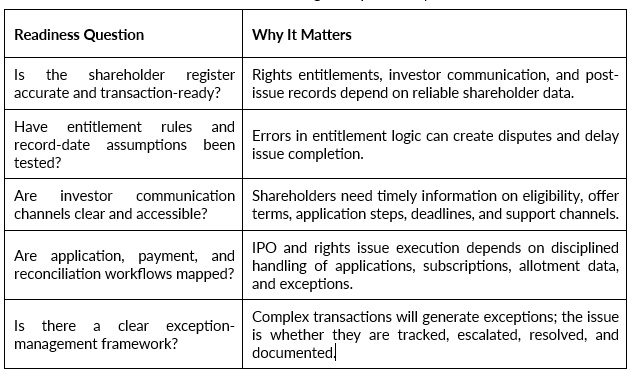
This is where experienced registrars add value. The best registrar engagement does not begin when the transaction is already in motion. It begins early enough to identify data gaps, clean records, align stakeholders, test communication workflows, and agree escalation rules before pressure builds.
Why early engagement matters
One of the most common execution risks in capital raising is discovering issues too late. A shareholder record that looks adequate for routine administration may not be ready for a rights issue. An investor communication channel that works for ordinary notices may not be sufficient for a compressed transaction window. A data exception that appears minor before launch can become material as entitlement, allotment, or investor-query deadlines approach.
Early engagement with registrars helps issuers move from reactive problem-solving to proactive readiness. It allows the issuer and its advisers to validate shareholder records, identify incomplete mandates, review account details, address duplicated or inconsistent records, and clarify investor communication workflows before the transaction timetable becomes constrained.
It also improves coordination among the issuer, issuing house, legal advisers, stockbrokers, receiving banks, custodians, regulators, exchanges, and investors. The registrar should not be seen as replacing any of these parties. Rather, the registrar provides a critical operational coordination point for shareholder data, entitlement processing, investor-facing workflows, and post-issue record integrity.
Data integrity is the foundation of confidence.
In capital raising, poor data quality can create disproportionate consequences. Inaccurate holdings, outdated contact details, unvalidated mandates, unresolved estate or transmission matters, and fragmented shareholder records can all create friction. The effects may show up in entitlement disputes, missed communications, delayed responses, or post-allotment complaints.
A transaction-ready registrar function, therefore, requires more than routine recordkeeping. It requires data verification, reconciliation discipline, controlled workflows, audit trails, and structured exception handling. These controls make the process more transparent and defensible.
For boards and CFOs, this is a governance issue. For company secretaries, it is a documentation and shareholder-rights issue. For investor relations teams, it is an experience and communication issue. For issuing houses and investment banks, it is a matter of timetable and execution risk. Registrar readiness connects all these concerns.
Digital access helps, but it is not enough on its own
Digital platforms are increasingly important in shareholder engagement. Coronation ShareholderLive, for example, helps shareholders manage share portfolios, access portfolio and dividend information, generate reports, submit self-service requests, update details, and engage through web and mobile channels. These capabilities can support clearer communication and easier access during corporate actions.
However, technology alone does not create execution confidence. Digital access must rest on accurate data, validated records, secure systems, clear investor instructions, and well-managed support channels. A digital platform is most valuable when it is part of a broader readiness model that includes process discipline and human oversight.
For issuers, the question is not simply whether a digital channel exists. The question is whether the entire investor journey has been tested: from notification to eligibility confirmation, from application to query resolution, and from allotment to post-transaction record update.
Coronation Registrars’ execution-readiness approach
Coronation Registrars supports issuers by combining shareholder record management, corporate action execution, investor communication, meeting administration, and digital shareholder engagement capabilities.
The firm’s approach to capital-raising readiness is built around three principles.
First, accuracy before activity. The shareholder register, investor details, mandates, and entitlement assumptions should be reviewed before launch, not corrected under pressure during execution.
Second, coordination before complexity. Every transaction participant should understand the workflow, dependencies, cut-off points, exception rules, and escalation path before the offer period begins.
Third, communication before confusion. Investors should receive clear, consistent, and timely information on the offer, their participation route, deadlines, support channels, and post-issue expectations.
These principles are especially important in rights issues, where eligible shareholders must understand their entitlements and deadlines, and in IPOs, where application capture, reconciliation, allotment support, and investor updates must be handled with precision.
From transaction execution to market confidence
A single party never determines the success of an IPO or rights issue. Market conditions, issuer fundamentals, pricing, adviser quality, regulatory review, and investor appetite all matter. But execution quality can materially affect how the transaction is experienced and how confidence is sustained.
For issuers preparing for an IPO or rights issue, registrar readiness should be addressed early. Before the offer opens, issuers should ask whether the register is clean, whether the entitlement logic has been tested, whether investor communication is ready, whether application and reconciliation workflows are mapped, and whether exceptions can be resolved quickly and with accountability.
Capital raising is ultimately a confidence exercise. The issuer asks investors to commit capital. Investors, in turn, expect the process to be clear, fair, timely, and transparent. A ready registrar helps protect that confidence where it matters most: in the details of execution.
Organisations preparing for IPOs, rights issues, or other corporate actions can engage Coronation Registrars early to conduct a readiness review, strengthen shareholder-data integrity, reduce avoidable execution friction, and deliver a more transparent investor experience.
Visit ShareholderLive at https://shareholderlive.coronationregistrars.com/.
For more information, contact Coronation Registrars at [email protected] or call 02012272570.
Stay connected with Coronation Registrars on LinkedIn, Instagram, Facebook, and X.
Suggested disclaimer for publication: This article is provided for general information only and does not constitute legal, regulatory, financial, or investment advice. Issuers should obtain professional advice from their appointed advisers regarding specific capital-raising transactions.