Follow Us on Google Discover
The Dangote Refinery IPO closed on Tuesday, 27 October 2026, bringing a major offer for the Nigerian capital market to a close.
The offer drew a wide range of investors, from pension funds and asset managers to first-time individual shareholders, and Dangote Petroleum Refinery and Petrochemicals FZE (DPRP) reports applications from 120 countries, including all 54 African countries.
For investors, the focus now shifts from getting into the offer to what comes next: the allotment process, the return of surplus funds, and the commencement of trading on the Nigerian Exchange (NGX).
That process will play out over the coming weeks, and its outcome matters well beyond this one offer. A smooth allotment and an orderly debut would show that Nigeria’s capital market can handle a transaction of this size. They would also influence new investors’ decision to participate in future listings.
Also Read
From close to listing: the timetable
Understanding what happens during this period starts with the mechanics. Before a share is issued, every application must be validated and reconciled against its payment, whether submitted at a bank branch, through a mobile platform, or from outside Nigeria. The indicative timetable is set out below.
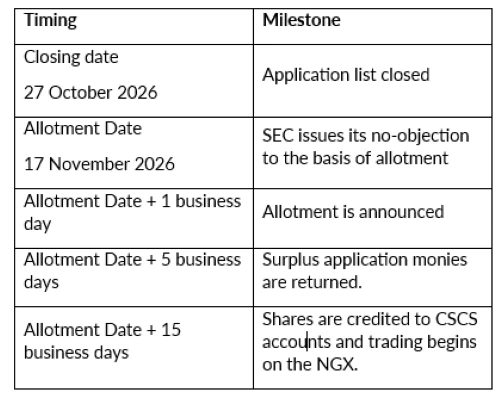
The closing date, Allotment Date, and the timing of each subsequent step are taken from DPRP’s revised offer timetable, published in its notice extending the offer period. DPRP states that all dates are indicative and subject to change.
What this means for investors
Each of these milestones has practical consequences, and four stand out for anyone expecting an allotment or planning to trade once the shares list.
- Allotments may fall short of applications. The first consequence arrives with the allotment announcement. If the offer is oversubscribed, Dangote Petroleum Refinery and Petrochemicals FZE (DPRP) may set a full allotment threshold. Every valid application at or below that level will likely be allotted in full, and the remaining shares will be shared among larger applications. This aligns with the issuer’s interest in a broad and diversified shareholder base, which may favour smaller applicants.
- Early trading will be a period of price discovery. Early trading will be a period of price discovery. Whatever the size of their allotment, investors should be prepared for a lively start once trading begins. Subject to the terms of NGX’s listing notice, the exchange’s ±10% daily price limit is expected to apply from the first day of trading, capping how far the share price can rise or fall in a single session. The 4.1 billion shares on offer compare with about 120.1 billion existing shares. That means the offer represents only about 3.3% of the enlarged share capital of about 124.2 billion shares. The prospectus notes that the number of shares available for public trading may affect liquidity, and that limited liquidity may lead to greater price volatility and wider bid-ask spreads. It also warns that the share price may fall below the ₦525 offer price. From that point on, the market, not the offer price, will decide what the shares are worth.
- Dividends are an intention, not a commitment. For investors looking beyond price movements to income, the outlook also calls for patience. DPRP intends to declare dividends in US dollars, although payment may be made in dollars, naira or another currency (DPRP Prospectus, p. 133). Payouts will also depend on the terms of its financing arrangements, which may restrict its ability to declare or pay dividends. With borrowings of about US$5.67 billion at 30 June 2026 (DPRP Prospectus, p. 38) and a major expansion programme ahead, the prospectus notes that DPRP may prioritise its cash flows for debt service and capital investment. (DPRP Prospectus, p. 152).
- The investment case is long-term. Taken together, these points suggest that the real test of this investment lies years ahead, not in its first weeks of trading. The proceeds will help fund the expansion of refining capacity to about 1.4 million barrels per day by 2029, in a programme expected to cost about US$14.3 billion (DPRP Prospectus, pp. 34–35, 80). The refinery reached stable, full-capacity production only in March 2026 (DPRP Prospectus, p. 80). The prospectus also lists significant risks, including dependence on a single site, changes in crude supply and refining margins, and the possibility of delays or cost overruns on the expansion (DPRP Prospectus, pp. 135–137, 141).
What retail investors should know
These considerations apply to every shareholder, but the practical steps differ by investor type. For individual investors, particularly those new to the market, the priority over the coming weeks is to make sure nothing delays the allotment of their shares or refunds.
- Keep your records until the shares are allotted. Retain your payment receipt and application confirmation until the shares are credited to your account.
- Know where your shares will be credited. If you applied with a CSCS account, your allotted shares will be credited to that account, identified by your Clearing House Number (CHN). If you applied through Coronation without a CSCS account, one was created for you automatically, and your shares will be credited there. Where valid CSCS details are not available, the registrar holds the shares under a temporary Registrar Identification Number (RIN) until they are provided.
- Rely on official announcements. The allotment announcement is expected one business day after the SEC approves the basis of allotment. Look for it from the issuer, the SEC, the NGX or your stockbroker rather than on social media.
- Understand how refunds work. Money for shares not allotted to you will be returned in naira, together with any interest it earned while held by the receiving banks (where applicable). Note that monies may sit in interest-bearing or non-interest accounts, so interest isn’t guaranteed (DPRP Prospectus, pp. 153–154, 186).
- Understand the bonus-share programme. The programme has not yet been approved; it still needs approval from DPRP’s shareholders, as well as the Securities & Exchange Commission (SEC), the Oil and Gas Free Zones Authority (OGFZA), and the NGX. If any of these approvals is not obtained, DPRP may change or withdraw the programme (DPRP Prospectus, p. 65).
- Know the tax position. Dividends are subject to 10% withholding tax, which may fall to 7.5% for investors in countries with a double tax agreement. Gains on the sale of shares are exempt where your total sale proceeds are below ₦150 million, and your gains do not exceed ₦10 million in any 12 months. Gains above these thresholds are also exempt if the proceeds are reinvested in shares of Nigerian companies within the same year of assessment, with tax due only on any portion not reinvested (DPRP Prospectus, pp. 176–177).
- Take a long-term view. Sharp price movements in the first weeks of trading are common for an offer like this. Judge the investment against your long-term goals, not by its first week on the market.
What institutional investors should know
Institutional investors face a different set of priorities. With larger applications and stricter mandates, their attention turns to scale-back, the cost of committed capital, valuation and settlement.
- Plan for a scale-back. Large applications may sit above the full allotment threshold and are most likely to be reduced.
- Account for the cost of committed capital. Application monies remain committed until allotment, with refunds due five business days after SEC approval, and shares credited to CSCS accounts 15 business days after approval. Interest is paid only on the refunded portion and may not match the return available from other uses of that money.
- Weigh the price against the track record. At ₦525 per share, the whole company is valued at about ₦65.2 trillion (₦525 multiplied by about 124.2 billion shares after the offer). It made a profit of ₦2.5 trillion in the first half of 2026, but it made losses in both 2024 and 2025. It also has large debts to repay and an expansion to pay for, and both will compete with dividends for its cash (DPRP Prospectus, pp. 35–36, 38, 152).
- Understand how the shares are structured. The shares are denominated in US dollars but trade in naira. Foreign investors need a valid Certificate of Capital Importation (e-CCI) to repatriate proceeds through the official foreign exchange market. As a free-zone enterprise, DPRP is regulated differently from most companies listed on the NGX. (DPRP Prospectus, pp. 6, 134)
- Make sure the shares land in the right place, and fit the rules. Institutions that are Pension Fund Administrators (PFAs) often hold shares for several funds through a custodian, so they should confirm the new shares will go into the correct account. Many funds also have rules on how much they can invest in a single company or sector and should check that this holding stays within them. Pension Fund Administrators have been cleared to take part through a one-off PenCom waiver issued in May 2026, though they remain responsible for assessing their own exposure. Other institutions must invest in line with the rules that govern them, so they should confirm with their compliance teams that DPRP’s free-zone structure fits their mandate (DPRP Prospectus, p. 184).
How Coronation can help
Whichever group an investor belongs to, the weeks ahead will run more smoothly with the right support. Coronation has four roles in the offer: Joint Issuing House, Registrar, Joint Stockbroker and licensed subscription platform. Two of these matter most to investors right now.
As Registrar, Coronation Registrars handles allotment, refunds, and crediting shares to CSCS accounts. Investors can reach its contact centre on 0201 227 2570 or at [email protected], or visit its office at 9 Amodu Ojikutu Street, off Saka Tinubu Street, Victoria Island, Lagos (Monday to Friday, 8 am–4 pm).
As a joint stockbroker, Coronation Securities can support you before and after listing:
- If you applied through Coronation, our team can answer questions about your application, CSCS account or CHN details.
- Once trading begins, you can view and trade your Dangote Refinery shares on the Coronation Wealth App alongside other NGX-listed stocks.
- If you did not take part in the offer, you can buy the shares on the NGX after listing through Coronation Securities.
This article is for information only and does not constitute investment advice. Investors should read the prospectus in full, including the risk factors on pages 134 to 155, before making any investment decision. For tailored investment decisions, consult qualified financial professionals who can provide guidance aligned with your financial goals.