 Follow Us on Google Discover
For corporates, cash in the bank can feel reassuring: it is readily available for day-to-day operations and unexpected needs. But idle cash, meaning surplus funds not needed for immediate obligations, carries a cost.
It earns little or nothing while it waits to be used.
Fixed-income securities let businesses put that surplus to work while keeping it available when needed. The question is no longer only whether the balance sheet has enough cash to meet the next obligation.
The more strategic question is how much liquidity a business needs, when it will need it, and how to put surplus cash to work without compromising financial flexibility.
Also Read
This question is especially relevant in the current market. In September, the Monetary Policy Committee cut the Monetary Policy Rate to 23%, down from 26.5% held since February. Inflation has continued to moderate, easing to 14.06% in October.
Yields on short-term government instruments have also declined since August, but remain above inflation. Cash held in Nigerian Treasury Bills (NTBs) and Open Market Operations (OMO) bills therefore continues to earn a positive real return (roughly 4.8 percentage points above inflation before tax on the 364-day NTB, at c.18.88% against 14.06%, and over 4.5 percentage points on tax-exempt OMO bills), whereas cash in a current account does not.
Cash on the balance sheet provides certainty, control, and immediate access to funds, all essential to running a business. But holding more than the business needs also has a cost: capital that could be earning a return sits idle instead.
The answer is to structure liquidity around when the money will be needed, what return it should earn while it waits, and which instrument—NTBs or OMO bills—fits that timeline.
The opportunity in surplus liquidity
At the November 4, 2026 NTB auction, investors submitted ₦2.045 trillion in bids against ₦800 billion on offer. Stop rates were unchanged from the previous auction, holding at 15.40% on the 91-day bill, 15.79% on the 182-day bill and 15.80% on the 364-day bill, before the 364-day rate edged up to 15.89% on November 11. (These are discount rates; the 15.89% rate translates to an effective yield of about 18.88%.) Notably, ₦1.994 trillion of the November 4 bids, about 97.5%, targeted the 364-day bill, suggesting investors are locking in current rates for as long as possible ahead of further easing.
That demand, however, has not translated into predictable allocation. At the October 28 auction, investors bid ₦1.908 trillion, yet only ₦71.16 billion was allotted against ₦800 billion on offer, as the Debt Management Office rejected most bids to keep government borrowing costs in check.
Allotment recovered to ₦509.40 billion on November 4, still well short of the offer, and on November 11 the DMO allotted ₦695.19 billion against ₦700 billion on offer. Source: Central Bank of Nigeria, Government Securities (NTB auction results)
OMO Bills: a growing route for corporate liquidity
The OMO market offers corporates a second option, and demand there has been even stronger. At its most recent auction on November 10, 2026, the CBN offered ₦1.50 trillion across 154-, 252-, and 329-day bills, received ₦4.074 trillion in bids, and allotted ₦3.854 trillion, more than two and a half times the amount offered.
The following day’s NTB auction allotted ₦695.19 billion. On that scale, OMO bills have become one of the main outlets for short-term cash in the market.
How OMO bills and NTBs Compare
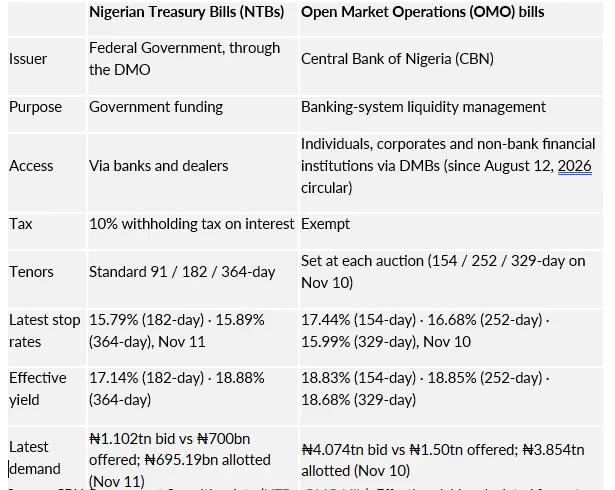
At first glance, OMO bills appear to pay far more than NTBs. But stop rates are discount rates, and comparing them across tenors can be misleading. When converted to effective yields, the OMO bills on offer pay between 18.7% and 18.9% across tenors, while NTBs range from about 17.1% on the 182-day bill to 18.9% on the 364-day bill.
OMO bills therefore offer a clear premium at short and mid tenors, while pre-tax returns are similar at the longest tenor. Tax tips the balance. After 10% withholding tax, and before any credit against company income tax, the 364-day NTB’s effective yield falls to about 17.0%, against 18.68% tax-free on the 329-day OMO bill.
Tenor still matters. A shorter placement returns cash sooner, and that cash must then be reinvested at whatever rates are available at the time. Those rates may well be lower: the MPR is down 350bp, and the 364-day NTB rate has fallen about 170bp since mid-August.
Because the CBN decides which tenors to offer at each auction, the same option may not be available when the bill matures. A liquidity strategy that focuses only on rates risks a mismatch between when cash is needed, when it returns and what it can earn at that point.
Through an authorised DMB, Coronation Securities helps corporates access OMO bills, from planning tenors around their cash needs to managing the bid process on their behalf.
Liquidity strategies evolve with the market
That is why a liquidity strategy is not a static policy. It should move with both market conditions and the business’s own cash-flow requirements.
Recent auctions show how quickly those conditions can shift. The 364-day NTB stop rate has fallen from 17.59% at the August 12 auction to 15.89% on November 11, underscoring that timing matters as much as the choice of instrument. A corporate weighing where to place surplus cash today faces a real choice. A 364-day NTB locks in a known return for a full year on a regular issuance calendar.
OMO bills offer similar or higher effective yields, tax-free, but the CBN decides which tenors are available at each auction. Depending on the company’s cash-flow horizon, the right call could be an NTB position, an OMO placement, or a mix of both.
With the Monetary Policy Committee due to meet again on November 23–24, finance teams should assess their placements in light of the meeting’s outcome. Beyond monetary policy, working-capital cycles, expansion plans, foreign-exchange exposure and borrowing needs can all affect how much cash a business should hold and for how long. Keeping placements aligned with the business’s direction means tracking not only the company’s cash position but also the movements in interest rates, inflation and funding conditions.
At Coronation Securities, we work with corporates across primary auctions and the secondary market, evaluating fixed-income opportunities, from NTBs to OMO bills, against each company’s liquidity requirements, investment horizon and income objectives.
Backed by Coronation Research’s market intelligence and research capabilities, our Fixed Income team helps finance leaders move beyond simply holding cash to actively and strategically managing it. If your business holds surplus cash, speak with our Fixed Income team to align your liquidity strategy with current market conditions. Email [email protected].
This publication is intended solely for informational purposes and must not be regarded as investment advice or a recommendation to buy or sell any financial instrument. Market conditions can change and may impact the performance of financial instruments. Coronation Securities Limited is registered and regulated by the Securities and Exchange Commission, Nigeria. RC No. 971184.