Follow Us on Google Discover
Nigeria’s listed oil sector has become increasingly dominated by two companies, not only in production and assets, but also in liquidity.
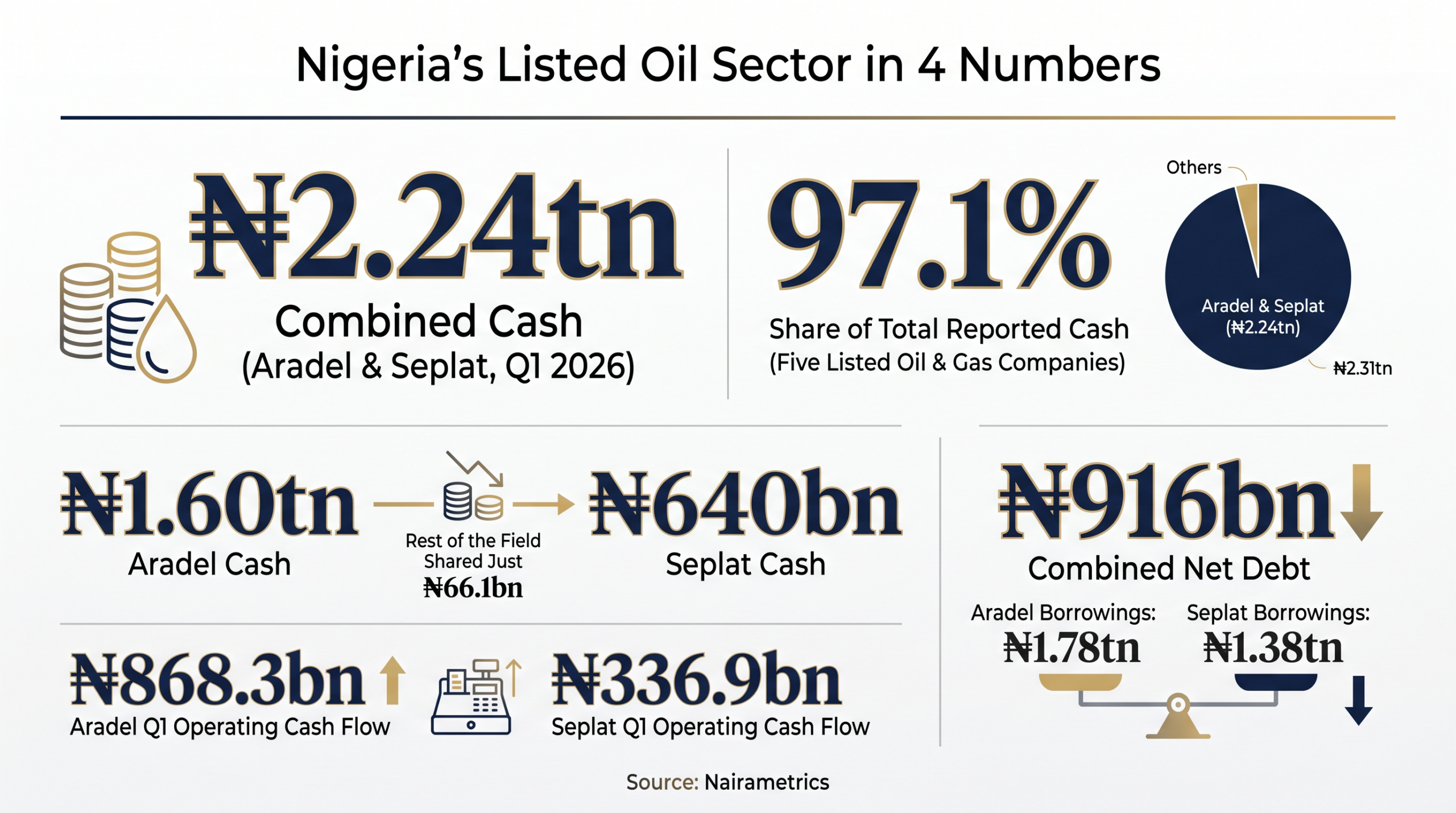
By the end of the first quarter of 2026, Aradel Holdings Plc and Seplat Energy Plc together held N2.24 trillion in cash and bank balances, representing almost the entire cash reserve of Nigeria’s listed upstream oil industry.
An analysis of first-quarter financial statements filed with the Nigerian Exchange shows the two companies accounted for 97.1% of the N2.31 trillion in cash reported by the five listed oil and gas companies that had published results as of the review date.
Aradel alone held N1.60 trillion, equivalent to nearly 70% of the sector’s reported cash, while Seplat followed with N640 billion. The remaining reported cash was spread across TotalEnergies Nigeria, Conoil, and Eterna, which together held just N66.1 billion.
Two listed companies, Oando Plc and Japaul Gold & Ventures, had yet to publish first-quarter results.
The concentration underlines how the financial landscape of Nigeria’s listed energy industry has shifted.
Once populated by several relatively comparable operators, the sector is increasingly defined by two large indigenous producers whose balance sheets now dwarf those of their peers.
What the data is saying
The headline figures suggest both companies enjoyed another robust quarter. A closer reading of their accounts, however, indicates the drivers of those results were markedly different.
- For Aradel, cash and cash equivalents almost quadrupled to N1.60 trillion from N401.7 billion a year earlier, while profit after tax rose 252% to N120.3 billion.
- Revenue more than tripled to N728.5 billion, reflecting the company’s expanded operations following recent acquisitions. But revenue growth alone does not explain the scale of the earnings improvement.
- The company recognised a N208.9 billion one-off operating gain, materially boosting operating profit during the quarter. At the same time, several balance-sheet indicators suggest the business has become significantly larger.
- Finance costs climbed to N101.8 billion from N5.4 billion a year earlier, while profit attributable to minority interests surged more than 120-fold to N54.1 billion, both consistent with a substantially enlarged corporate structure following acquisitions and consolidation. Profit attributable to shareholders rose 96% to N66.2 billion, while total assets reached N9.06 trillion.
Seplat’s first-quarter performance presented a different picture.
- The company ended the quarter with N640 billion in cash, up 24.5% year-on-year, while profit after tax increased 48.4% to N52.5 billion.
- Yet underlying operations weakened.
- Revenue declined 5.2%, operating profit fell 18.2%, and profit before tax dropped 27.2%, suggesting earnings quality softened during the period. The increase in net profit was largely attributable to a lower effective tax charge rather than stronger operating performance.
- Even so, Seplat remained Nigeria’s second-largest listed cash holder, with total assets of N8.54 trillion.
Cash generation remains robust
Despite the different earnings trajectories, both companies continued to generate substantial operating cash flow.
Aradel produced N868.3 billion from operating activities during the quarter, while Seplat generated N336.9 billion.
Neither company raised additional borrowings during the period. Aradel, in fact, reduced outstanding debt through repayments.
Both companies also entered 2026 with already substantial liquidity positions, meaning the first-quarter performance reinforced rather than created their financial strength.
Cash-rich does not necessarily mean debt-free
The sizeable cash balances may suggest financial firepower, but they do not tell the whole story.
Both companies remain highly leveraged.
Aradel reported N1.78 trillion in borrowings against N1.60 trillion of cash, while Seplat carried N1.38 trillion in debt compared with N640 billion in cash.
Taken together, the two companies remain in a combined net debt position of roughly N916 billion.
That leverage is not unusual for capital-intensive upstream oil producers, particularly following major acquisitions, but it illustrates that headline cash balances alone provide an incomplete measure of financial strength.
Capital deployment continues
The accumulation of cash has not come at the expense of investment.
- Aradel continued deploying capital into asset acquisitions, debt repayments, interest obligations and distributions to minority shareholders during the quarter.
- Seplat similarly invested in oil and gas assets while servicing financing costs, without either materially increasing or reducing its borrowings.
- In both cases, operating cash generation proved sufficiently strong to offset significant investment and financing outflows.
One notable difference between the two companies is shareholder distributions.
Seplat has already declared an interim dividend of $0.05 per share alongside a special dividend of $0.04 per share, representing a combined payout of approximately N73.4 billion that will reduce its cash balance during the second quarter.
Aradel has yet to announce a dividend for the 2026 financial year.
What you should know
The first-quarter results preceded renewed geopolitical tensions surrounding the Strait of Hormuz, through which roughly one-fifth of globally traded crude oil passes.
- Although uncertainty over shipping disruptions has fluctuated in recent weeks, the episode reinforced the sensitivity of oil markets to geopolitical events.
- For Nigerian upstream producers, sustained periods of elevated crude prices typically translate into stronger operating cash flow and improved profitability.
- Companies with deep liquidity and access to capital are generally better positioned to finance production, acquisitions and infrastructure investments when market conditions are favourable.
- Aradel and Seplat appear well placed in that regard. Their first-quarter balance sheets suggest they possess both the cash-generating capacity and financial flexibility to pursue growth opportunities.
- Yet their leverage also serves as a reminder that much of that liquidity sits alongside sizeable financing obligations.
In other words, Nigeria’s two largest listed indigenous producers have built formidable cash reserves, but they remain companies using substantial amounts of borrowed capital to fund long-term expansion rather than businesses simply sitting on excess cash.