Follow Us on Google Discover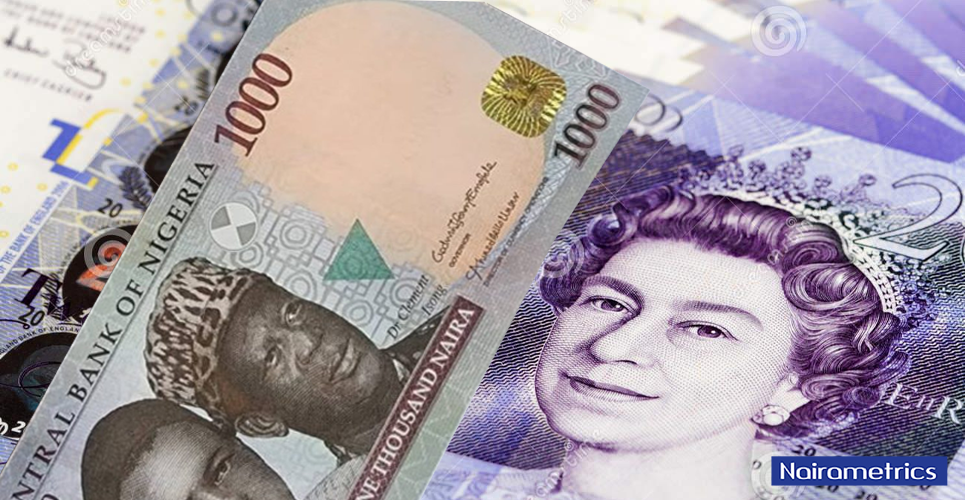
Most recent market activity has revealed that, despite rising demand for assets denominated in naira and weak UK economic performance, the Naira was stable versus the British pound in the Nigerian foreign exchange market.
The official market saw the naira settle at N1,862/£1 on Thursday, April 9, 2026.
The Nigerian Naira faces immediate resistance at N1,816.7/£1.
The pair will probably test the 1,800/£1 psychological floor, which corresponds with the historical low of N1,799/£1, if this level is breached.
Also Read
The N1,854/£1 mark is the first significant obstacle to a bearish trend. A breakout above this could lead to a return to the N1,900/£1-point range.
The Naira has gained about 7.5 percent against the Pound this year. The GBP/NGN pair is currently in a neutral-to-bearish consolidation phase on the daily charts after peaking at N1,853.9/£1 on April 7th
In addition, Nigeria’s high-interest-rate environment is giving the Naira “carry trade” support because of the historically high MPR (Monetary Policy Rate), which has been between 26 and 27 percent in recent cycles.
Fundamentally, this is limiting the Pound’s capacity to maintain long-term rallies.
Market action at NFEM indicated that the local currency’s psychological “break” below N1,900/£ has raised the spirits of NGN bulls, given that the naira has maintained most of its gains against the British pound this year
The Nigerian currency traded around N1,919/£1 at Nigeria’s black market. Currently, the difference between the official foreign exchange rate and the “black market” is less than 5%.
The increased (or even unrestricted) access provided to Bureau De Change (BDC) operators, which has successfully demystified access to foreign exchange for retail traders, is probably the reason for the market alignment.
The CBN placed a higher priority on currency stability than aggressive appreciation in an effort to lower volatility and boost market confidence.
Although the British Pound is a major international reserve and trade currency, the value of the Naira is primarily determined by local factors like oil production, fiscal policy, foreign exchange inflows, and the success of local monetary reforms.
The British pound dipped against the US dollar on Friday
The British pound sterling dipped during Friday’s session but remained near its highest level since late February, set earlier this week.
- Spot prices are trading around the $1.342 level and appear poised to post significant weekly gains as currency traders look to the latest US consumer inflation data for a new boost.
- The important US Consumer Price Index (CPI) report is expected to show that, amid the war-related spike in crude oil prices, inflation likely rose further in March.
This may further deter the US Federal Reserve (Fed) from temporarily lowering interest rates. Furthermore, tensions around the Strait of Hormuz are providing some support for the US dollar, which is thought to be a major factor putting pressure on the GBP/USD pair. In response to the vicious Israeli attacks on Lebanon, Iran blocked shipping through the vital waterway.
- US President Donald Trump claimed that Iran was not adhering to its agreement and was handling oil through the Strait of Hormuz in a very poor manner. Trump also threatened to launch new strikes if the Iran deal fails, which supports crude oil prices, the U.S dollar and implies that risks of escalation remain.
- In the meantime, currency traders are pricing in increases of about 30 to 40 basis points (bps) by the end of the year after drastically lowering their bets on Bank of England (BoE) rate hikes.
This still represents a substantial divergence compared with the Fed’s signal for one interest rate cut by the end of this year and another in 2027.