
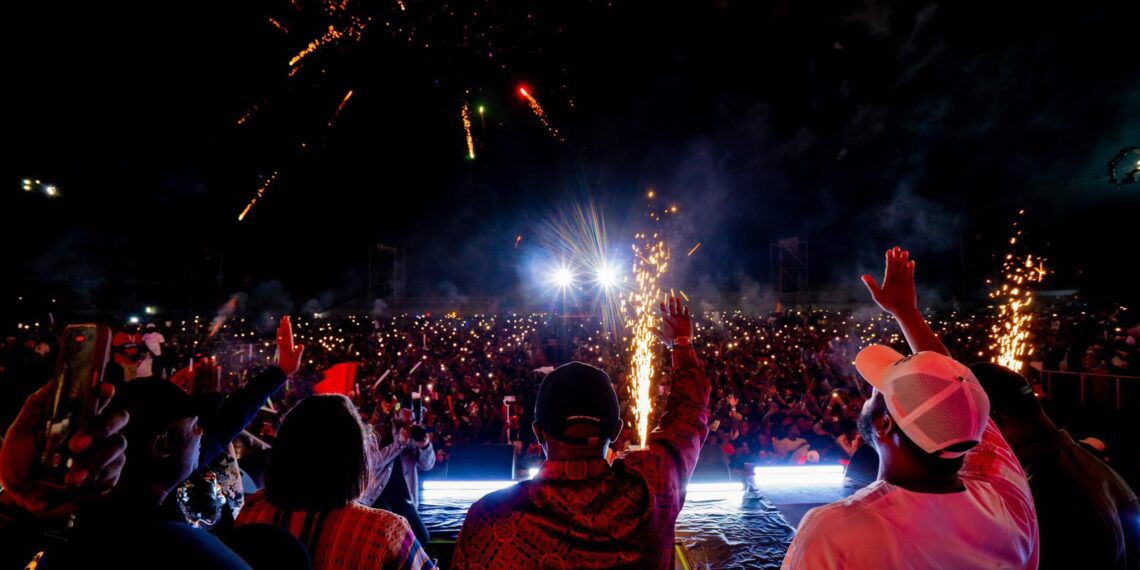
The United States emerged as the largest source of diaspora visitors to Lagos during the 2025 Detty December season, overtaking the United Kingdom.
This is according to a report by MO Africa Co titled The Economics of Euphoria: Lagos’ Detty December 2025 Report.
Travelers starting their journey in the U.S. accounted for 27% of all international arrivals, marking the first time the U.S. led over the U.K.

What the report is saying
The report revealed a significant shift in diaspora travel patterns, with U.S. travelers taking the lead in international arrivals. Their presence reflects both increased engagement of Nigerian-Americans and the viral success of prior festivities.
- “The most significant shift of 2025 was the United States taking the top spot. Travelers starting their journey in the US accounted for 27 percent of all arrivals, overtaking the UK for the first time.
- “The viral success of the previous year’s festivities created a powerful ‘FOMO’ (Fear Of Missing Out) effect across the Nigerian-American diaspora,” the report read in part.
U.S. travelers often used connecting flights through Europe and the Middle East, with major departure cities including Houston, Atlanta, and other hubs.
Other source markets included Europe (12 percent), Canada (11 percent), the African region (10 percent), the rest of the world (9 percent), and Asia and the Middle East.
Overall, 3.6 million people participated in the 55-day festive window between mid-November 2025 and January 10, 2026, with over 70 percent being Gen Z and Millennial travelers. Diaspora visitors spent an estimated $384.5 million on air travel alone.
More insights
The report highlighted the economic weight of diaspora participation, showing that Detty December continues to be a major revenue generator.
- Total consumer spending reached N396.54 billion, with diaspora visitors contributing 55 percent of the total.
- Hospitality and accommodation led spending at 44.23 percent (N175.40 billion), followed by entertainment and nightlife at 32.67 percent (N129.55 billion). Food and dining contributed 12.91 percent, while fashion, retail, and wellness made up the rest.
- Geographically, Victoria Island, Ikoyi, and Lekki captured most high-value transactions, despite significant foot traffic on the Mainland.
The city operated at 238 percent of its designed human density capacity, creating infrastructure strain, heavy traffic, and waste management challenges. Beyond consumer spending, N19 billion was spent on logistics, security, and operational support, reflecting a substantial “invisible economy” underpinning the festivities.
Flashback
In 2024, Lagos’ Detty December generated $71.6 million across hospitality, tourism, and entertainment, according to the Lagos State Ministry of Tourism, Arts, and Culture.
Hotels contributed $44 million, while short-let apartments brought in $13 million.
Both domestic and international visitors drove high demand for luxury and mid-tier accommodations, alongside concerts, parties, and cultural events, laying the groundwork for the growth seen in 2025.
What you should know
Detty December has evolved into a cultural and economic juggernaut, drawing millions from Nigeria and the diaspora. The month-long festivities feature high-profile Afrobeats concerts, corporate events, and lifestyle experiences, fueling substantial economic activity across hospitality, entertainment, and retail.
- Hotels and short-let apartments are often fully booked weeks in advance.
- Digital payments dominate, enabling seamless transactions and supporting fintech adoption.
- Infrastructure pressure is significant, affecting roads, transport, and event venues, highlighting the need for dedicated transit solutions and upgraded event spaces.
Beyond economics, Detty December enhances Nigeria’s cultural influence, amplifying its position in Africa’s creative economy and attracting global media and diaspora attention.
With the U.S. leading diaspora arrivals, the 2025 season underscores Lagos’ rising international appeal, the economic power of its diaspora, and the potential for further growth in both tourism and cultural influence.