Follow Us on Google Discover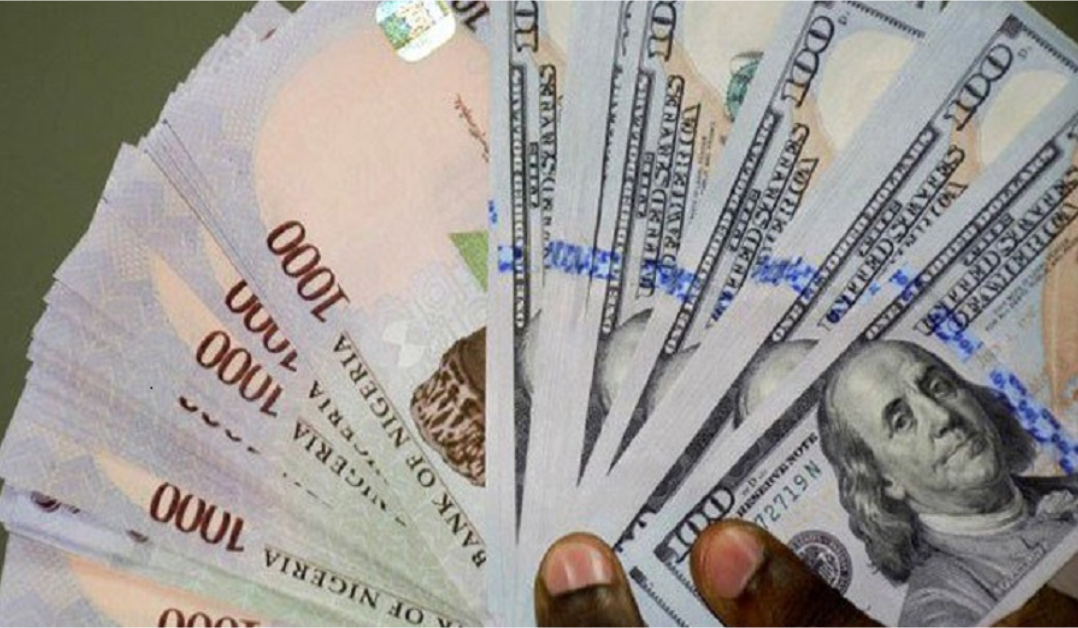
The Naira weakened to N1,425 per dollar on Monday, slipping from N1,398 per dollar recorded on Friday, as volatility in global oil prices and movements in the U.S. dollar continued to influence currency markets.
This is according to data published on the Central Bank of Nigeria’s (CBN) website on Monday.
The latest exchange rate marks the naira’s weakest closing level since January 12, 2026, when it last traded at the same rate.
The decline reflects sustained pressure on the local currency in recent weeks amid global financial uncertainty and shifting investor sentiment.
Also Read
What the data is saying
The naira’s latest decline comes as geopolitical tensions and movements in global currency markets influence capital flows and commodity prices.
- The naira depreciated to N1,425 per dollar on Monday, from N1,398 per dollar on Friday, marking its weakest closing level since January 12, 2026.
- Market data shows the currency traded around N1,337 per dollar on February 17, before gradually weakening in subsequent trading sessions.
- Last week, the naira recorded only one day of appreciation, strengthening slightly to N1,382 per dollar on Wednesday from N1,390 per dollar on Tuesday, before resuming its downward trend.
The sustained depreciation highlights the currency’s sensitivity to shifts in global financial markets and commodity prices, particularly crude oil.
More Insights
Global markets have been reacting to geopolitical tensions in the Middle East and shifting expectations around the strength of the U.S. dollar. The uncertainty has contributed to fluctuating oil prices and currency movements.
- In international markets, the U.S. dollar traded at 157.73 yen and $1.1632 per euro during early Asian trading on Tuesday, although it had already retreated from the highs reached a day earlier.
- The pullback followed comments by Donald Trump, who suggested that military operations against Iran were nearing completion and progressing faster than initially expected.
- Iran’s Revolutionary Guards dismissed the claims as “nonsense,” but the remarks appeared to calm fears of an immediate escalation that could disrupt global oil supplies.
The mixed signals prompted many investors to adopt a wait-and-see approach, easing earlier concerns about a sharp spike in energy prices.
What you should know
The Central Bank of Nigeria says the country’s improving external reserve position could help cushion the naira against prolonged pressure.
- According to the apex bank, Nigeria’s net foreign exchange reserves rose to $34.80 billion at the end of 2025, reflecting improved external liquidity.
- The country’s gross external reserves climbed to $50.45 billion as of February 2026, supported by stronger oil earnings and increased foreign inflows.
- The governor of the central bank, Olayemi Cardoso, said ongoing monetary and foreign-exchange reforms are aimed at strengthening market confidence and improving liquidity.
- According to projections contained in the Central Bank of Nigeria 2026 Macroeconomic Outlook for Nigeria, the country’s external reserves could rise further to $51.04 billion in 2026, supported largely by higher oil revenues.