
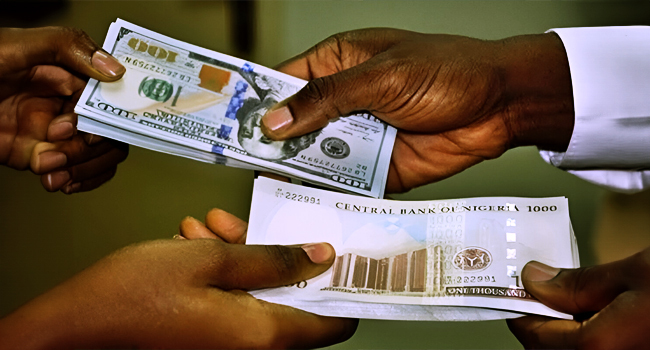
The naira continued its downward trend at the official foreign exchange market on Tuesday, March 3, 2026, closing at N1,390/$ and extending a depreciation streak that has lasted nearly two weeks.
This is according to data published on the Central Bank of Nigeria’s (CBN) website on Tuesday.
The latest figures reflect sustained pressure on the local currency amid liquidity concerns and a strengthening U.S. dollar. Market data shows a steady weakening pattern since mid-February.


From N1,337/$ on February 17, the naira declined consistently in daily trading sessions.
What the data is saying
The exchange rate has followed a clear downward trajectory over the past two weeks, with incremental losses recorded almost daily.
- February 17: N1,337/$
- February 18: N1,340/$
- February 19: N1,346/$
- February 20: N1,348/$
- February 23: N1,353.5/$
- February 24 and 25: N1,359/$ and N1,359.5/$ respectively
- February 26 and 27: N1,361.5/$ and N1,368.5/$
- March 2 and 3: N1,376/$ and N1,390/$
The sustained depreciation reflects mounting demand pressures in the official market.
More Insights
The weakening of the naira comes amid concerns over foreign exchange liquidity and the widening gap between the official and parallel markets.
- Reports by Nairametrics indicate that speculative activity and persistent dollar supply constraints have intensified pressure on the currency.
- The disparity between official and parallel market rates has created arbitrage opportunities.
- Demand from importers and manufacturers continues to outpace supply.
While external reserves have improved, immediate liquidity challenges remain a key concern for market participants.
Despite the currency’s recent weakness, the Central Bank of Nigeria has pointed to improvements in Nigeria’s reserve position.
- CBN Governor Olayemi Cardoso disclosed that net foreign exchange reserves rose to $34.80 billion at the end of 2025.
- Gross reserves climbed to $50.45 billion as of February 2026.
Analysts note that while higher reserves provide a buffer, liquidity conditions and capital inflows remain critical to short-term stability.
Externally, the U.S. dollar has strengthened significantly, reaching a three-month high amid escalating geopolitical tensions in the Middle East. The euro weakened to $1.1604, while the U.S. dollar index held firm at 99.103, its strongest level since late November.
What you should know
The CBN said Nigeria’s external reserve is projected to rise to $51.04 billion in 2026, supported by stronger oil earnings.
- This is according to the Central Bank of Nigeria’s (CBN) 2026 Macroeconomic Outlook for Nigeria.
- Earlier this week, Nairametrics reported that the Naira was showing signs of stability, although it remains under pressure from global geopolitical tensions, in contrast to the extreme volatility of previous years.
Yesterday, Nairametrics reported that the naira weakened to N1,376 per dollar as the U.S. currency rallied globally following renewed geopolitical tensions in the Middle East.
The dollar index climbed nearly 1% on Monday, marking its strongest single-day gain in seven months as investors sought safety.