

For most of the past two decades, cocoa was a quietly cyclical commodity.
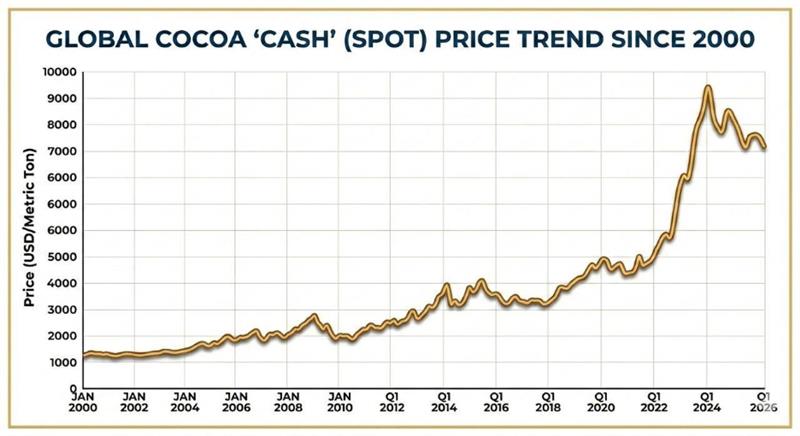
From 2010 to 2023, prices bobbed within a relatively predictable band of $2,000 to $3,500 per metric ton, volatile enough to keep traders busy, but fundamentally range-bound.
Then, in a span of barely eighteen months, everything changed.


From around $2,000 per metric ton in 2022, cocoa prices surged to an all-time high, surpassing $12,000 by December 2024 (a six-fold increase that shocked supply chains, upended the global chocolate industry, and forced a fundamental rethinking of how this market is valued).
This wasn’t a speculative bubble conjured from thin air. It was the culmination of compounding structural and climatic failures that had been building quietly for years.
The anatomy of a supply shock – West Africa’s perfect storm
The cocoa price crisis has its roots in a geography problem: West Africa supplies over 70% of the world’s cocoa, and that concentration of production proved devastatingly fragile.
Côte d’Ivoire and Ghana, the two dominant producers, were hit simultaneously by a convergence of threats that their farming communities were ill-equipped to absorb. Global cocoa production is estimated to have declined by 14% in the 2023-24 season, falling to 4.2 million metric tons from 4.9 million metric tons in 2022-23.
This decline is largely due to reduced output in Côte d’Ivoire and Ghana, which together produce nearly 60% of the world’s cocoa.
The first culprit was the weather. Erratic rainfall, prolonged dry periods, and the broader fingerprints of El Niño disrupted flowering and pod development across the region. But weather alone doesn’t explain the depth of the crisis, the underlying trees were already weakened.
The disease factor
Cocoa crops in Côte d’Ivoire and Ghana were hit hard by Cacao Swollen Shoot Virus (CSSV), a disease that significantly reduces the lifespan of cocoa trees and has been spreading rapidly across plantations, further limiting supply.
Unlike drought, which is cyclical, viral disease is structurally destructive. Infected trees cannot simply recover with the next rainy season; they must be uprooted and replanted, a process that takes years to yield results.
Aging plantations and chronic underinvestment
Behind the immediate shocks lies a longer-running failure. The decline in stocks was a result of significant levels of cocoa crop and pod disease, ageing cacao trees in the Ivory Coast and Ghana, and extreme weather events impacting crops.
Many West African cocoa farms are worked by ageing smallholder farmers who have not had the resources or incentives to replant or rejuvenate their orchards.
For decades, the low, stable price of cocoa offered little reward for investment. The price spike, then, is partly a reckoning for years of neglect, the market finally demanding compensation for the structural decay it had been quietly subsidizing.
The financial amplifier
Speculative trading amplified price swings, with non-commercial investors holding over 60% of futures positions in early 2024. As the supply deficit became undeniable, financial participants piled into long positions, turning a fundamental imbalance into a price explosion.
At the same time, the mechanics of the futures market itself became destabilizing: as prices rose, the margin requirements for hedging escalated sharply, forcing processors and traders to reduce their forward cover, which in turn reduced the supply of hedged cocoa available to the market and fed further price anxiety.
The demand response
At $12,000 per ton, the market began to destroy its own demand. This is the classic self-correcting mechanism of commodity markets, but it played out with unusual drama in cocoa. The prior price shocks in Q1 and Q4 of 2024 forced a structural adjustment within the industry.
Grinding capacity declined as cocoa processors faced rising costs. Demand declined as chocolate formulations changed and became more diluted, with some analyses arguing that part of the demand loss and lower cocoa intensity in products could become permanent.
Major confectionery players were not shy about the impact. Mondelēz International, the group behind Cadbury, Milka, and Toblerone, predicted a significant drop in earnings directly attributable to cocoa costs. Consumers began to feel it too, with standard chocolate bar prices in some markets climbing well above historical norms. Shrinkflation which is reducing product sizes rather than raising prices, became a widespread industry response.
Meanwhile, global grindings are estimated to fall from 4.81 million tonnes in 2023/24 to 4.60 million tonnes in 2024/25, pointing to weaker processing demand.
The turn: From crisis to correction
By early 2025, the market began to breathe again. By the start of 2025, cocoa port arrivals and crop prospects improved, including better mid-crop figures and more optimistic pod counts. Rainfall patterns normalized across key growing regions, and disease management efforts started showing early results.
Crucially, the 2024/25 season is forecast at 4.84 million metric tons, an 8% year-on-year increase. The market swung from pricing a crisis to pricing a recovery, sometimes with brutal speed. After peaking around $12,000 per ton in late 2024, front-month cocoa futures dropped sharply in 2025, registering a 40-45% price decline.
The shift in sentiment from multi-year deficit to prospective surplus was the decisive trigger. The International Cocoa Organization outlines a shift from a deficit of around 489,000 tonnes in 2023/24 to a projected surplus of 49,000 tonnes in 2024/25.
It is a modest surplus barely a rounding error in a 5 million ton market but psychologically, the direction of travel matters enormously.
The Outlook: Structurally higher, episodically volatile
The critical question now is whether cocoa returns to its pre-2023 trading range or whether the world has permanently repriced this commodity. The weight of evidence suggests the latter.
The current price equilibrium is lower than the previous record peaks over the last two years, but structurally higher than longer-term, pre crisis, 2023 cocoa price levels. Structural supply risks, evolving demand behaviour, and tighter financial conditions continue to shape price formation.
The key reasons the old range is unlikely to return are threefold.
First, the cost of production has risen; farmers, processors, and logistics providers have all repriced.
Second, output in West Africa, which supplies over 70% of the world’s cocoa, remains fragile,with swollen shoot disease, aging trees, and environmental pressures nowhere near resolved.
Third, demand has been structurally altered: some of the reduced cocoa intensity in chocolate formulations may stick, but so too may the premium placed on certified, traceable, sustainably sourced beans adding a cost floor that didn’t exist before.
On the supply side, there are reasons for cautious optimism. Expansion in Indonesia, Nigeria, and Brazil is underway, and these origins could gradually reduce the world’s dangerous dependence on a single West African corridor. But tree crop agriculture moves slowly: new plantings today bear fruit in three to five years, meaning relief is measured in crop cycles, not trading quarters.
Institutionally, the medium-term equilibrium for cocoa seems to be around $6,000 per ton while the market finds balance. The consensus view is that cocoa at $2,000 the world of five years ago is gone.
A new era for cocoa
The cocoa price saga of 2023–2025 is ultimately a story about the cost of ignoring long-term structural fragility. Years of underinvestment in West African farming infrastructure, an over-concentration of global supply in two countries, and a failure to anticipate how climate variability would interact with aging orchards all collided at once.
What emerged on the other side is a commodity market that has re-rated permanently upward, where volatility is the baseline rather than the exception, and where the chocolate industry, farmers, processors, confectioners, and consumers alike must now operate at a fundamentally different cost level.
The question going forward is not whether cocoa will be expensive, but whether the industry can build the resilience to make that expense sustainable.