
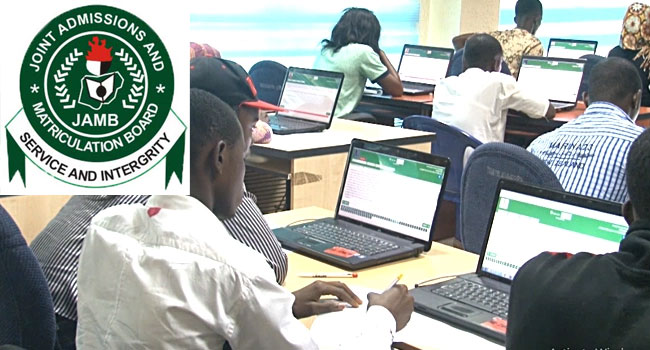
The Federal Government has proposed a total allocation of over N1.3 billion for the construction, furnishing, renovation, and equipment of Joint Admissions and Matriculation Board (JAMB) Computer-Based Test centres across Nigeria
This is according to data contained in the 2026 Appropriation Bill, covering multiple CBT and ICT infrastructure projects under ongoing capital expenditure.
The projects span several states, including Rivers, Lagos, Abia, Ondo, and Gombe, and expand access to standardised examination


What the document is saying
- Details from the budget document show that it allocates N1,326,850,000 billion allocation is spread across six ongoing projects targeted at improving JAMB’s CBT and ICT capacity.
- One of the largest allocations is N420 million under project code ERGP30236070 for the construction and equipping of JAMB standard ICT centres in Igbotako, Okitipupa Local Government Area, Ondo South Senatorial District, Ondo State.
- Another N336.7 million is earmarked under project code ERGP29239674 for the supply of computers and internet services for JAMB CBT centres in Eric Moore and the ICT centre at Epe Grammar School, Lagos, covering multiple project lots.
- In addition, the Federal Government allocated N280 million under project code ERGP29243195 for the construction and furnishing of a JAMB CBT centre in Emohua Local Government Area, Rivers State.
Other JAMB CBT projects
Further allocations include N175 million under project code ERGP29244411 for the construction and equipping of an ICT and JAMB centre in Balanga Local Government Area, Gombe State.
The budget also provides N87.15 million under project code ERGP23225152 for the renovation and upgrading of ICT infrastructure for JAMB registration purposes, aimed at improving system reliability during examination and registration periods.
Meanwhile, N28 million is allocated under project code ERGP1246643 for the construction and furnishing of the Oloko JAMB CBT centre in Oloko, Ikwuano Local Government Area, Abia Central District.
Why this matter
There has been heightened attention on JAMB’s Computer-Based Test system following a challenging 2025 UTME cycle.
Last year’s UTME was marred by technical glitches and irregularities in CBT centres, including errors that affected results from hundreds of centres and disrupted the testing experience for roughly 380,000 candidates.
- In addition to technical glitches and irregularities, the 2025 UTME cycle drew criticism over examination logistics and candidate inconvenience, including situations where students had to travel far from their local environments to sit for the test.
- Although JAMB clarified that candidates were generally allowed to select their preferred exam towns nationwide, the limited availability of accredited Computer-Based Test (CBT) centres meant some candidates wrote their exams away from home or in towns farther than expected.
- The Board late last year began the accreditation of 848 CBT centres nationwide in preparation for the 2026 UTME, a move aimed at strengthening technical readiness and standardisation ahead of the exam season.
They also delisted several CBT centres for failing to meet technical standards and have recommended sanctions against centres involved in examination infractions, as part of efforts to uphold the credibility of the UTME process.
What you should know
Computer-based testing is increasingly embraced worldwide due to its potential to reduce examination malpractice and shorten result turnaround times.
- In Nigeria, the government has mandated the transition of major national exams, including WAEC and NECO, to CBT by 2026 in a bid to strengthen exam integrity and align the country’s assessment system with international practices.
- However, the transition has not been without controversy. Stakeholders have warned that Nigeria may not yet have the infrastructure or digital readiness needed for wide-scale CBT implementation.
- Critics point to the lack of reliable electricity, internet connectivity, and sufficient computers in many public schools and rural areas, arguing these gaps could widen educational inequality if not addressed in parallel with CBT rollout.
Students and educators have also raised concerns about CBT readiness, noting that many candidates lack basic computer literacy and that technical issues during exams can create stress and disadvantage those without prior experience.