Follow Us on Google Discover
Mr President,
I write not as an academic, nor as a partisan critic, but as a witness to one of the clearest reflections of Nigeria’s economic reality: the Balance of Payments (BOP).
It records what we earn, what we spend, what we retain—and what we leak.
In Q3 2025, Nigeria posted a current account surplus of approximately US$3.4 billion, with external reserves nearing US$43 billion. In a world of tightening liquidity and rising geopolitical tension, this stability matters. It reassures markets, buys time, and creates room for reform.
Yet stability alone is no longer enough. True economic strength is measured not merely by earnings, but by how predictably we earn, how long we retain capital, and how productively we deploy foreign exchange.
The Balance of Payments speaks clearly: Nigeria’s opportunity is not just to remain stable—but to become structurally strong.
Lesson One: Nigeria Earns FX Like a Resource Economy and Spends It Like a Services Importer
The headline surplus masks a deeper structural imbalance. Nigeria’s foreign exchange inflows remain overwhelmingly anchored to hydrocarbons and remittances, while FX outflows are dominated by services—transport, logistics, insurance, ICT, professional advisory, travel, and offshore government procurement.
These outflows are not indulgent; they are the cost of running a modern economy.
The problem is that Nigeria continues to outsource the very services that convert exports into value.
We export oil and refined products—then pay foreign shipping lines to move them, foreign insurers to cover them, foreign consultants to structure them, and foreign digital platforms to manage them.
This is not a temporary gap. It is a permanent foreign exchange leak.
The implication is profound: Nigeria earns FX like a commodity exporter but spends FX like an economy that has not yet built its services backbone. No exchange-rate regime can sustainably reconcile that mismatch.
Lesson Two: Stability Without Services Is Fragile Stability
Mr President, the global economy is changing faster than our external accounts.
Capital markets are already repricing fossil-fuel exposure. Energy transition is no longer theoretical—it is financial. Commodity cycles are shortening. By contrast, services exports are repeatable, higher-margin, and structurally less volatile.
Across Africa, the economies building durable external strength are not those extracting the most resources, but those exporting services, systems, and certainty.
Below a high level comparable Africa BOP benchmark:
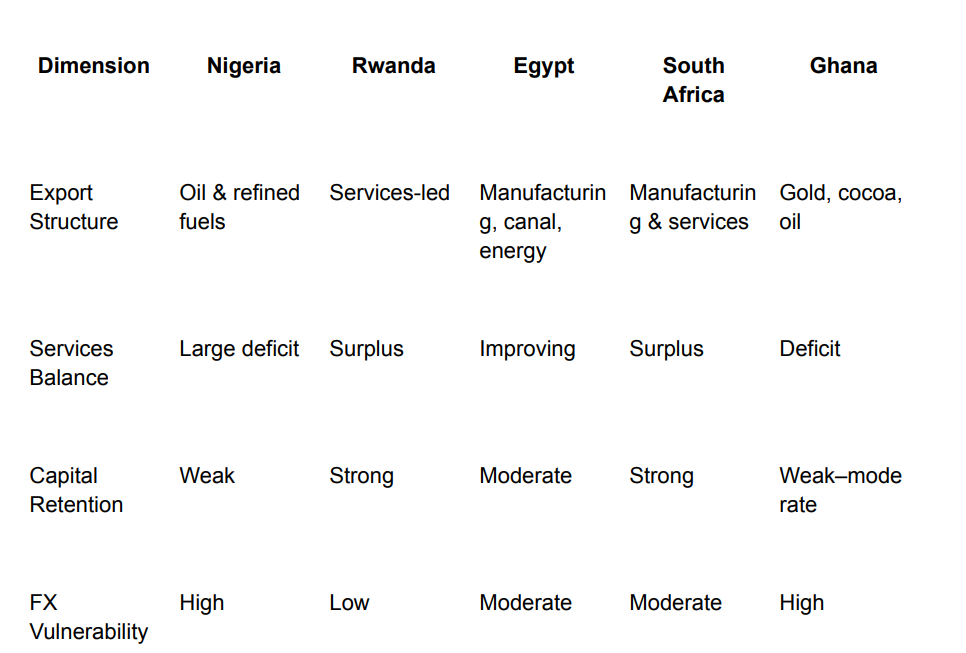
Rwanda earns FX from logistics efficiency, tourism, and digital services.
South Africa exports financial and professional services across the continent.
Egypt has deliberately built multiple FX pillars—manufacturing, tourism, and logistics—to reduce single-sector risk.
Nigeria, despite unmatched scale, remains structurally exposed.
That is lesson two: stability anchored to oil, without services exports, is fragile stability.
Lesson Three: Capital Comes—But Confidence Does Not Stay
The Balance of Payments reveals something more concerning than volatility: capital impermanence.
Portfolio inflows remain highly sensitive to policy signals and global liquidity. Foreign direct investment, while improving, remains modest relative to Nigeria’s scale. Meanwhile, the primary income deficit continues to widen—a clear signal that profits are being repatriated rather than reinvested.
Capital is entering Nigeria. But too little of it is committing.
This tells us something uncomfortable but useful: investors may see opportunity, but they do not yet see predictability. And in global capital markets, predictability—not controls—is what anchors capital.
Lesson Four: Nigeria’s Most Reliable FX Is Human, Not Mineral
Perhaps the most striking lesson in Nigeria’s external accounts is this: our most stable foreign exchange inflow is not oil—it is people.
Diaspora remittances consistently stabilise the FX market. Yet they are overwhelmingly consumptive. In a world where development finance is shrinking and private capital is increasingly selective, countries that convert remittances into structured investment will outperform those that treat them merely as welfare inflows.
Nigeria has not yet made that transition at scale. This challenge goes beyond fintech.
Lesson Five: The Balance of Payments Is a Competitiveness Index
Mr President, the Balance of Payments is no longer just a quarterly statistical report. It is a competitiveness index, reflecting how effectively an economy converts scale into strength.
By that measure, Nigeria’s challenge is not Africa.
It is time.
Smaller economies are moving faster to export complexity, retain capital, and build services capacity. Nigeria’s advantage of scale risks becoming a disadvantage if structural re-engineering is delayed.
What These Lessons Demand: Strategic Action (Next 12–18 Months)
1. Shift from Oil Surplus to Export Complexity
Lead MDAs:
- Ministry of Industry, Trade & Investment | Ministry of Marine & Blue Economy | Ministry of Agriculture | NEXIM | Bank of Industry | Customs | NAFDAC | SON
- Incentivise value-added exports (petrochemicals, agro-processing, fertilisers, pharmaceuticals)
- Tie export incentives to domestic value addition, not export volume
2. Close the Services Gap
Lead MDAs:
- Ministry of Trade & Investment | Ministry of Marine & Blue Economy | Ministry of Aviation | NCDMB | BPP
- Enforce local content in logistics, shipping, insurance, and government procurement
- Accelerate PPPs in ports, aviation support, and maritime services
3. Make Services a First-Class Export
Lead MDAs:
- Ministry of Communications & Digital Economy | Ministry of Arts, Culture, Tourism & Creative Economy | NITDA | NEPC | CBN | NATEP
- Incentivise ICT, BPO, fintech, creative, and professional services exports
- Simplify cross-border payments for services exporters
- Support Nigerian firms’ access to global markets
4. Retain Capital Through Credibility, Not Controls
Lead MDAs:
- Ministry of Finance | CBN | DMO | SEC
- Incentivise profit reinvestment
- Expand long-tenor naira instruments with FX and inflation hedges
- Provide predictable FX access for productive investors
5. Turn Remittances into Productive Capital
Lead MDAs:
- NiDCOM | Ministry of Finance | CBN | NSIA | MOFI
- Launch diaspora bonds and co-investment platforms
- Channel diaspora capital into services, logistics, and export-oriented SMEs
- Guarantee transparent entry and exit mechanisms
Mr President, the Final Lesson
Nigeria has achieved external stability. That is commendable.
But in a world of energy transition, geopolitical fragmentation, and mobile capital, stability is the starting line—not the finish.
The lesson from Nigeria’s Balance of Payments is clear:
Foreign exchange strength is no longer built primarily in oil fields.
It is built in offices, ports, data centres, studios, service platforms, and above all, in policy coherence and clear storytelling.
Solve the services gap, and FX stability follows. Ignore it, and no volume of oil exports will ever be enough.
Mr President, the Balance of Payments is already speaking. The question is whether we are ready to act on what it is telling us.
While elections and insecurity dominate public discourse, these strategic actions would help your government consolidate gains, build resilience, and deliver shared prosperity—making renewed hope a reality.
About the Author
Abel Aboh is a UK-based Data and AI Leader and a governance board member of The Data Lab Scotland. He serves on the Nominations Committee and the Technology Law and Practice Committee of the Law Society of Scotland.
With over two decades of experience in data management, technology, human resources, and governance, Abel advises UK critical institutions and organisations on data, AI, innovation, technology, and transformation. He regularly writes for NairaMetric.
He was a finalist for British Data Leader of the Year 2021 and was inducted into the UK Data Leader Hall of Fame 2024.
A proud Nigerian from the Niger Delta (Delta and Bayelsa States), Abel is passionate about inclusive leadership, data, AI, education, finance, technology, trade, and empowering the next generation of African innovators and change-makers.