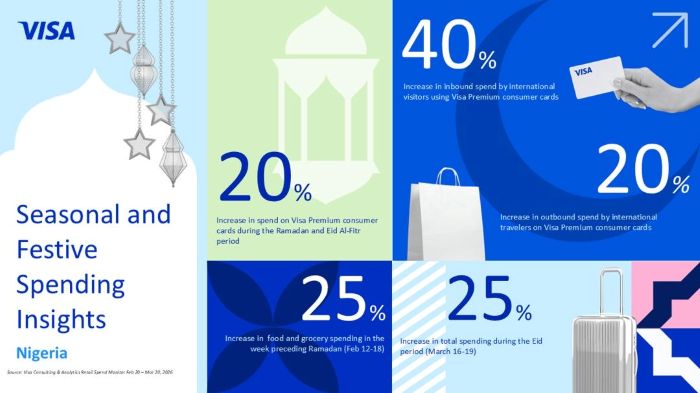
- Spending on Visa premium consumer cards increased 20% year-over-year during the Ramadanand Eid Al-Fitr period, supported by higher travel and everyday retail spending.
- Spending patterns shifted during Ramadan and peaked around Eid Al-Fitr, with total spending up +25% pts during the Eid period.
Visa, a global leader in digital payments, today released its latest consumer spending insights for the Ramadan and Eid Al-Fitr period in Nigeria, based on the Visa Consulting & Analytics Retail Spend Monitor. During this period, spending on Visa premium consumer cards increased 20% year-over-year, with spend share up +10% percentage points. This reflected higher spending on travel, everyday retail, and food-related categories.
Key seasonal spending trends include:
Inbound Travel Spend During Ramadan
Spending by international visitors using Visa premium consumer cards in Nigeria increased 40%. Spending from United States of America, United Kingdom and Canada increased 40%.


Outbound Travel Spend During Ramadan
International travel spending from Nigeria on Visa premium consumer cards increased around 20%. Booking behavior skewed toward shorter lead times, with 70% of trips booked within one month of travel. Spending to destinations including United Kingdom, Saudi Arabia and France increased 40%.
Ramadan Spending Behavior
Spending behavior during Ramadan reflected both pre-month stock-up and in-month in-store activity. In the week preceding Ramadan (Feb 12-18), food and grocery spending rose 25% compared to the prior week (Feb 5-11). Spending activity also occurred later in the day, with late-night spending (1am–4am) up 35% compared to non-Ramadan weeks.
Spending Peaks Around Eid Al‑Fitr
Spending peaked around Eid Al-Fitr, with total spending up 25% during the Eid period (Mar 16-19) compared to the preceding days (12–15 Mar). During Eid, spending on food and restaurants increased 80% compared to the preceding days.
Andrew Uaboi, Vice President and Country Manager for Visa in West Africa, said, “The Ramadan and Eid Al-Fitr period saw higher spending across travel and everyday retail categories, reflecting both inbound visitor activity and sustained local spending. These insights highlight how consumer behavior shifts during key seasonal moments and underscore the opportunity for businesses to respond with more relevant and seamless commerce experiences.”