Follow Us on Google Discover
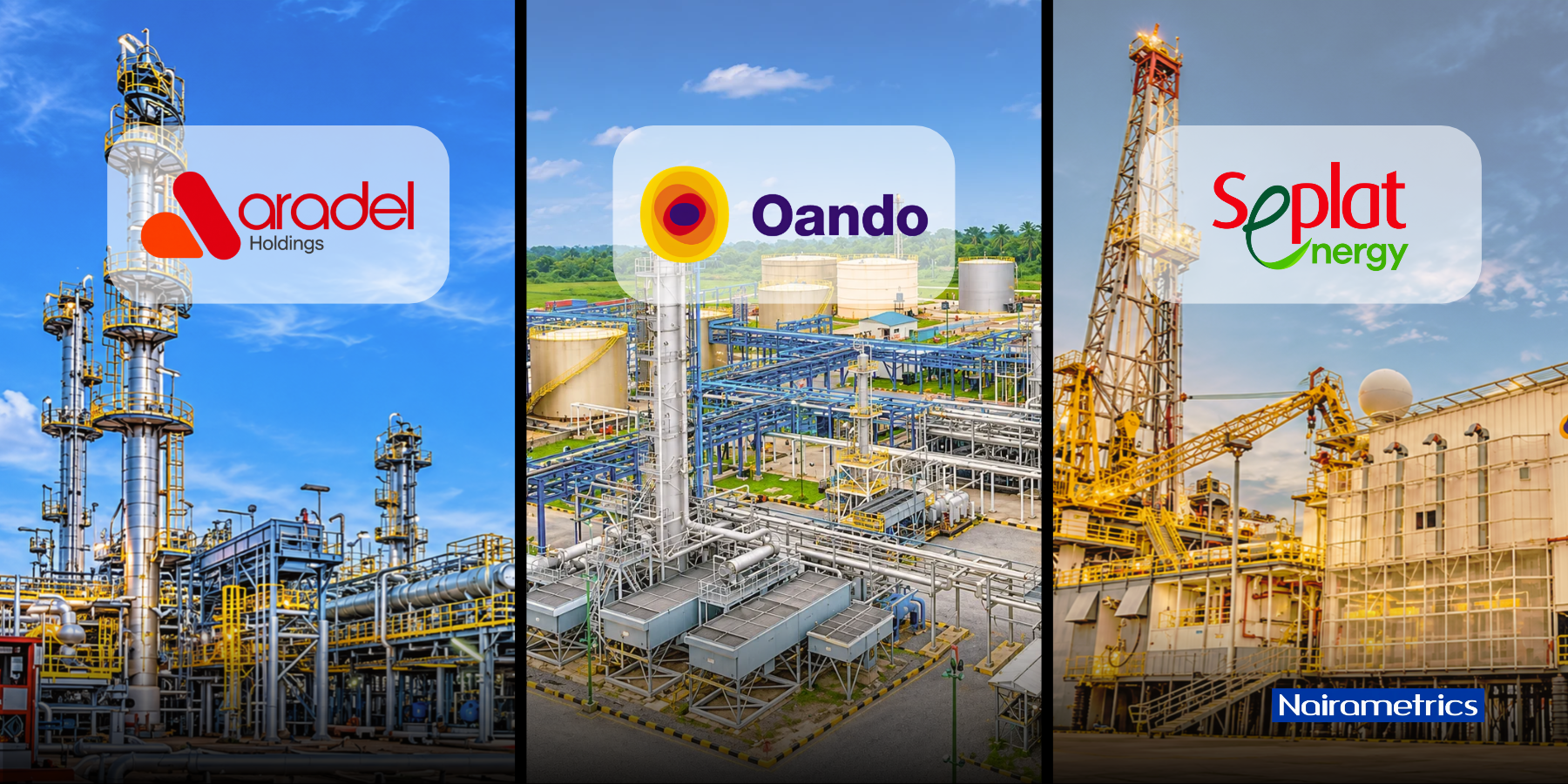
Aradel Holdings Plc and Oando Plc cut what it costs them to produce a barrel of oil in the first nine months of 2026, while Seplat Energy Plc spent more.
This is according to the unaudited 9M 2026 results of the three companies, Nigeria’s largest listed oil producers, released in October.
Aradel’s unit operating cost fell 28% to $7.9 per barrel of oil equivalent (boe), the lowest of the three. Oando’s dropped 22% to $15.39/boe, while Seplat’s rose to $16.0/boe from $14.1/boe.
Despite the higher costs, Seplat still recorded the strongest operating margin, helped by oil prices that averaged above $96 per barrel.
Also Read
Key highlights (9M 2026)
- Aradel: Unit field operating cost of $7.9/boe, down from $11.0/boe. Production of 144,700 barrels of oil equivalent per day (boepd).
- Oando: Production operating cost of $15.39/boe, down from $19.67/boe. Production up 14% to 42,985 boepd.
- Seplat: Production cost of $16.0/boe, up from $14.1/boe. Production up 7% to 144,999 boepd.
- Oil price realised: Aradel $97.5, Seplat $96.19 and Oando $87.31 per barrel.
Seplat reported an adjusted EBITDA margin of 55%, while Aradel’s EBITDA margin stood at 53%.
Aradel: the cheapest barrel
Aradel’s $7.9/boe is within its guidance of $7.0–9.0/boe for the year. The company said the drop came from better reliability on the Trans Niger Pipeline, lower field activity costs and inventory movements.
The nine months were the first period in which Aradel fully consolidated ND Western and Renaissance Africa Energy, which bought Shell’s onshore business. That pushed production up by about six times, to 144,700 boepd, from 24,000 boepd a year earlier.
Revenue rose 633% to N3.95 trillion, and EBITDA climbed to N2.10 trillion.
- “The first nine months of 2026 demonstrated what our enlarged portfolio can deliver,” said Chief Executive Officer Adegbite Falade.
One caution: Aradel measures its “field operating cost” more narrowly than Seplat does. On a like-for-like basis the gap between them is smaller, though Aradel still comes out cheaper.
Oando: biggest improvement
Oando recorded the sharpest turnaround. Its production cost fell to $15.39/boe from $19.67/boe in the same period of 2025.
The company attributed the savings to lower transport, logistics, services, and ICT costs. Higher output across a largely fixed cost base also helped, as production rose 14% to 42,985 boepd.
Facility uptime improved to 96.1% from 85%, after new Idu wells came on stream and the Oshie flow station returned to service.
- Group Chief Executive Wale Tinubu said execution under its operatorship was delivering “lower unit costs and ultimately higher production.”
Gross profit grew 483% to N174.5 billion, and the company swung to an operating profit of N159.7 billion from a loss of N109.7 billion.
Oando’s margins remain thin, though. About 80% of its N2.78 trillion revenue came from low-margin crude trading, and two-thirds of its output is gas, which sold at $2.26 per thousand cubic feet.
Seplat: costs up, but so are prices
Seplat was the only one of the three whose production cost rose, climbing to $16.0/boe from $14.1/boe. It rose further to $16.5/boe in the third quarter.
The main driver was the restoration of its offshore Yoho facility, which added about $1.8/boe. The company has raised its full-year cost guidance to $15.5–16.5/boe, from $14.5–15.5/boe.
Work on Yoho was completed in the third quarter, but start-up has been pushed to the fourth quarter after damage to a pipeline was found.
Higher oil prices more than made up for the extra cost. Seplat realised $100.4 per barrel in the third quarter, “a full $10.2/bbl higher than the average Brent price,” said Chief Executive Officer Effiong Okon.
Revenue rose 27% to $2.76 billion, and adjusted EBITDA reached $1.53 billion, a margin of 55%. Production averaged 155,801 boepd in the third quarter, putting the company on track for the upper half of its 145,000–155,000 boepd guidance.
Where the gains went
Lower costs and strong prices lifted operating profits at all three companies. Much less of it reached shareholders.
- Seplat paid $722.4 million in tax on a pre-tax profit of $982.6 million, an effective rate of 74%. Profit after tax still jumped 174% to $260.2 million.
- Aradel booked a N529.1 billion charge tied to the earnout it owes the seller of Renaissance’s assets. Profit after tax fell 82% to N43.3 billion, with N141.5 billion attributable to shareholders. Without the charge, the company says attributable profit would have been N572.4 billion.
Oando spent N244.2 billion on finance costs, mostly interest on the debt it took on to buy the Nigerian Agip Oil Company from Eni. That left a pre-tax loss of N74.6 billion, which a N181.1 billion tax credit turned into a profit of N106.5 billion.
What to watch
Each company now has one issue that will decide whether its lower costs show up in shareholder returns.
- For Seplat, the priority is restarting Yoho and controlling restoration costs. Management said Yoho added approximately $1.80/boe to nine-month costs and raised its full-year guidance to $15.50–$16.50/boe. It is also pursuing insurance recovery as part of the expenditure, according to its nine-month report.
- For Aradel, it is the earnout. The company says the charge will keep building at a similar pace for the rest of 2026 while it renegotiates the terms with the seller, and N1.32 trillion is still owed. It has also cut its interim dividend to N7.00 per share, from N10.00 a year earlier.
- For Oando, it is the balance sheet. The company plans to raise up to N500 billion in equity, including a N220 billion rights issue now before the SEC, and to convert $300 million of debt into shares.
On the stock market, Seplat led the three with a 179.6% year-to-date gain as of November 25, closing at N16,241.90. Aradel gained 74.1% to N1,166.40, while Oando remained down 17.9% at N33.00.
Cheaper barrels are no longer the differentiator. What separates these three stocks is who gets to keep the profit.