Follow Us on Google Discover
Arsenal’s first Premier League title in 22 years has earned the club £198.1 million in central payments, as distributions to England’s top-flight clubs exceeded £3 billion for the first time in the 2025/26 season.
The figures, shared by Chris Weatherspoon, The Athletic’s football finance writer, show that the Premier League distributed a combined £3.14 billion among its 20 clubs, representing an increase of approximately 10.9% from the £2.83 billion paid out in the 2024/25 campaign.
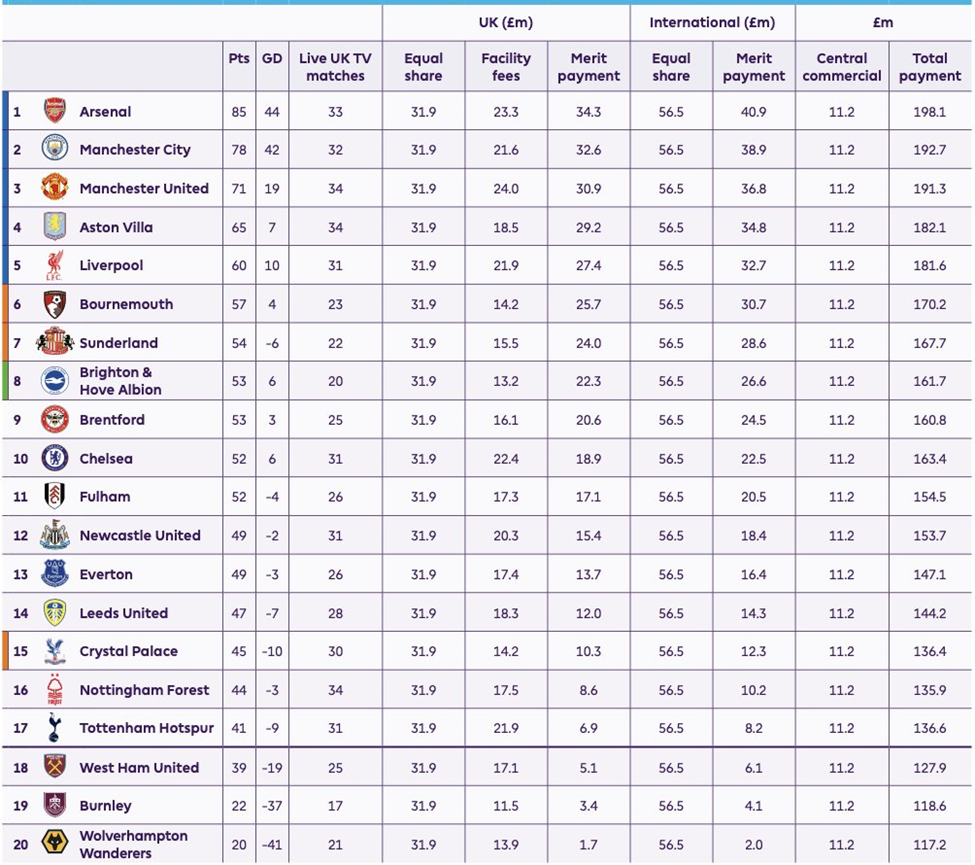
Arsenal received the largest allocation, ahead of Manchester City, which earned £192.7 million, and Manchester United, with £191.3 million. Aston Villa and Liverpool completed the top five, receiving £182.1 million and £181.6 million, respectively.
Also Read
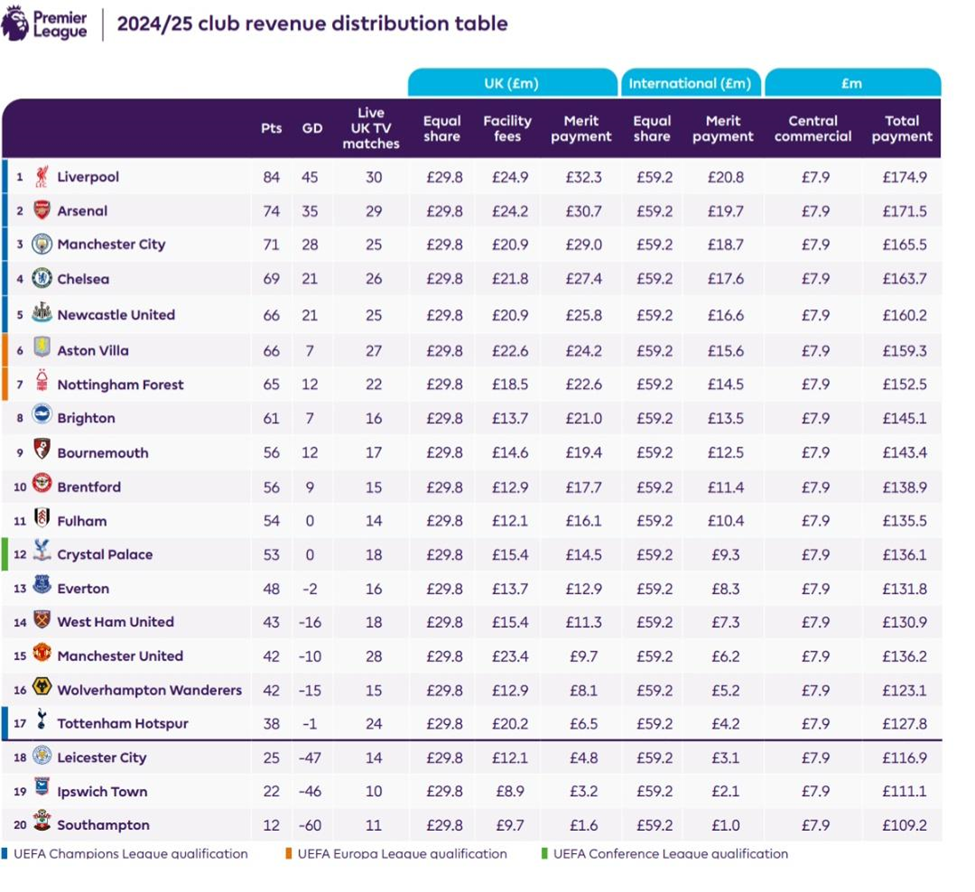
The Gunners’ latest distribution represents an increase of £26.6 million, or 15.5%, from the £171.5 million they received in the 2024/25 season, when they finished second behind Liverpool.
The increase reflects both the financial growth of the Premier League and the additional reward attached to finishing at the top of the competition, with merit payments accounting for a significant part of Arsenal’s improved earnings.
How the Premier League distributed the £3.14bn
The Premier League’s distribution model combines revenue from domestic broadcasting rights, international broadcasting agreements and central commercial activities.
- The payments are divided into equal shares, facility fees and merit payments, with the amount each club receives determined partly by its final league position and the number of matches selected for live television coverage in the United Kingdom.
- For the 2025/26 season, every club received £31.9 million as its UK broadcasting equal share and £56.5 million from international broadcasting revenue. Each club also received £11.2 million in central commercial payments.
- This gave every participating club a common allocation of £99.6 million before facility fees and merit payments were added.
Facility fees are determined by the number of a club’s matches selected for live domestic television coverage. Clubs whose matches attract more television selections therefore receive larger allocations from this component.
Merit payments, on the other hand, are linked to final league positions, with clubs finishing higher in the table receiving larger shares of domestic and international broadcasting revenue.
Arsenal’s distribution included £34.3 million in UK merit payments and £40.9 million in international merit payments, bringing its combined merit allocation to £75.2 million.
The club also received £23.3 million in facility fees after 33 of its league matches were selected for live UK television coverage.
Arsenal’s payments increase by 15.5% in one season
Arsenal’s £198.1 million distribution represents a significant increase from the £171.5 million received in 2024/25.
A breakdown of the figures shows that the biggest contributor to the increase was merit payments, which rose from a combined £50.4 million in the previous season to £75.2 million in 2025/26.
- The increase of £24.8 million reflects the difference between finishing second and winning the Premier League, as the distribution formula rewards clubs according to their final league positions.
- The club’s combined equal-share and central commercial allocation also increased from £96.9 million to £99.6 million, while facility fees declined slightly from £24.2 million to £23.3 million.
- The overall increase of £26.6 million demonstrates how finishing at the top of the Premier League can translate into a substantial financial advantage, even within a distribution system that shares a significant portion of broadcasting revenue equally among clubs.
For context, Liverpool received £174.9 million after winning the 2024/25 title, while Arsenal collected £171.5 million as runners-up.
Arsenal’s latest payment is therefore £23.2 million higher than Liverpool’s distribution in the previous campaign.
Manchester City and Manchester United among the biggest earners
Manchester City received £192.7 million, the second-highest payment, despite finishing behind Arsenal in the league standings.
- Manchester United followed with £191.3 million, while Aston Villa earned £182.1 million to rank fourth. Liverpool completed the top five with £181.6 million.
- The figures also show that league position is not the only factor determining how much clubs receive.
- Manchester United, for instance, finished third with 71 points but received £24 million in facility fees after 34 of its matches were broadcast live in the UK. Arsenal received £23.3 million from the same component.
- Chelsea, which finished 10th, received £163.4 million, more than Brighton and Hove Albion and Brentford, who finished eighth and ninth, respectively.
Chelsea had 31 matches selected for live UK television coverage, earning £22.4 million in facility fees. Brighton had 20 televised matches and received £13.2 million, while Brentford’s 25 matches generated £16.1 million.
This shows how television exposure can influence clubs’ financial rankings beyond their final league positions.
Premier League’s financial distribution continues to grow
The latest figures build on the financial growth recorded in previous seasons.
- In 2024/25, the Premier League distributed £2.83 billion to its clubs, with champions Liverpool receiving £174.9 million, followed by Arsenal with £171.5 million.
- The previous season’s distribution included an equal share of £29.8 million from UK broadcasting revenue, £59.2 million from international broadcasting and £7.9 million in central commercial payments for each club.
- For 2025/26, the respective allocations stood at £31.9 million from UK broadcasting, £56.5 million from international broadcasting and £11.2 million in central commercial revenue.
- While the international equal-share component was lower than in the previous season, the increase in UK broadcasting and central commercial allocations contributed to a higher common payment for clubs.
The growth in the overall distribution also means that clubs can earn more from the Premier League’s central revenue pool, even without improving their league positions.
The Premier League’s international broadcasting audience remains a major part of its commercial appeal, allowing the competition to generate substantial revenue from markets outside the United Kingdom.
Its distribution model also provides clubs outside the title race with significant broadcasting income, supporting their ability to invest in players, infrastructure and other football operations.
With the latest payments reaching £3.14 billion, the Premier League has crossed another financial milestone, reinforcing the commercial value of participation in English football’s top division.