 Follow Us on Google Discover
The expansion of bachelors degree-awarding authority to Colleges of Education marked a significant development in Nigeria’s teacher education reform.
With this mandate, Colleges of Education can now offer a more direct academic pathway for aspiring teachers, but, while institutional autonomy addresses a longstanding structural constraint, the success of the reform will depend on the quality of educators the system produces.
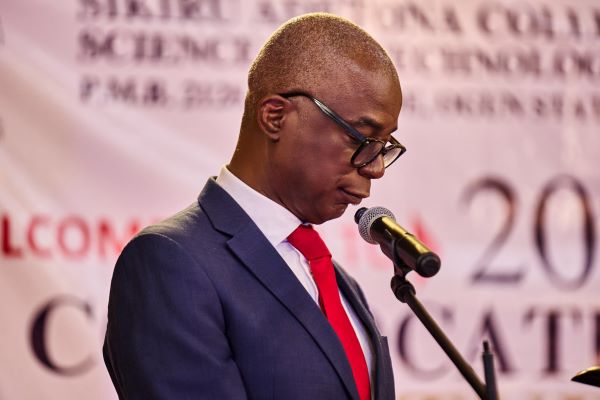
This was the central case advanced by Dr. Tunji Olowolafe, Chancellor of Ekiti State University, while delivering the 2026 Convocation Lecture at the Sikiru Adetona College of Education, Science and Technology (SACOETEC), Ogun State.
Speaking on the theme, “The Dual-Mandate NCE-Degree Programme: Prospects, Challenges and the Future of Teacher Education in Nigeria,” he described the reform as a major opportunity to reposition teacher education within Nigeria’s tertiary education system.
Also Read
The Federal Colleges of Education Act 2023 empowered eligible institutions to award degrees independently, ending decades of dependence on university affiliations. Operationalised in May 2025, the Dual-Mandate programme provides a five-year pathway comprising three years of NCE training and two additional years for a Bachelor’s degree.
For Dr. Olowolafe, the value lies in combining the practical competencies of teaching with the academic depth required to understand subject matter and how children learn.
He cited the Joint Admissions and Matriculation Board (JAMB) figures showing that approximately 97 per cent of candidates applied to universities, compared with about one per cent who applied to Colleges of Education, highlighting the need to improve the appeal of teacher education.
Yet autonomy alone cannot resolve the challenges facing the sector. Nigeria’s basic education system faces an estimated shortfall of one million teachers, while demographic growth will continue to increase demand for qualified educators.
“Nearly eight million babies will be born in Nigeria this year alone. In 2032, those children will walk into Primary One classrooms across this country,” he said, underscoring the urgency of preparing the country’s teaching workforce ahead of growing demand.
He therefore called for sustained investment in teacher development, modernised curricula and vocational education, alongside greater integration of artificial intelligence and digital learning.
The financing architecture is crucial; Dr. Olowolafe highlighted the development levy under the Nigeria Tax Act 2025, which supports education interventions through the Tertiary Education Trust Fund (TETFund) and the Nigerian Education Loan Fund (NELFUND). He noted that NELFUND had disbursed over ₦372 billion to more than one million students, urging SACOETEC management to guide eligible students through the loan application process.
He emphasised that building a stronger education system requires coordinated investment from both the public and private sectors, with resources directed towards developing capable educators and expanding access to quality learning.
Demonstrating the role of private investment, the Tunji Olowolafe Foundation announced plans to establish a fully equipped, solar-powered GOMTECH ICT centre with high speed internet connectivity at SACOETEC. The Foundation is also committed to recognising academic excellence and outstanding teaching at the College. This includes recognising the College’s first-class degree graduates and NCE distinction holders, alongside the overall best NCE and degree graduates. Lecturers, selected based on student ratings, will also be honoured for their contributions to teaching.
These initiatives build on its existing digital education interventions, including Project Digi-Teach at Ekiti State University and GOMTECH in Are-Ekiti.
Ultimately, the Dual-Mandate programme creates an important institutional opportunity. Its success, however, must be measured by more than the authority to award degrees. It must produce better-prepared educators, improve learning outcomes and strengthen the human capital required for Nigeria’s long-term development.